3.1.5.5 - Catalysts
Catalysts matter because they let reactions happen faster without needing harsher conditions. In this lesson, you will pin down what a catalyst actually does, see how it changes the energy pathway of a reaction, and use a Maxwell-Boltzmann distribution to explain why a gas reaction becomes faster when a catalyst is added.
What a catalyst changes
A reaction only happens when particles collide with enough energy to get over the activation energy barrier. If too few particles can do that, the reaction is slow. A catalyst speeds the reaction up by changing that barrier, not by becoming part of the final products.
Catalyst
A catalyst is a substance that increases the rate of a chemical reaction without being changed in chemical composition or amount.
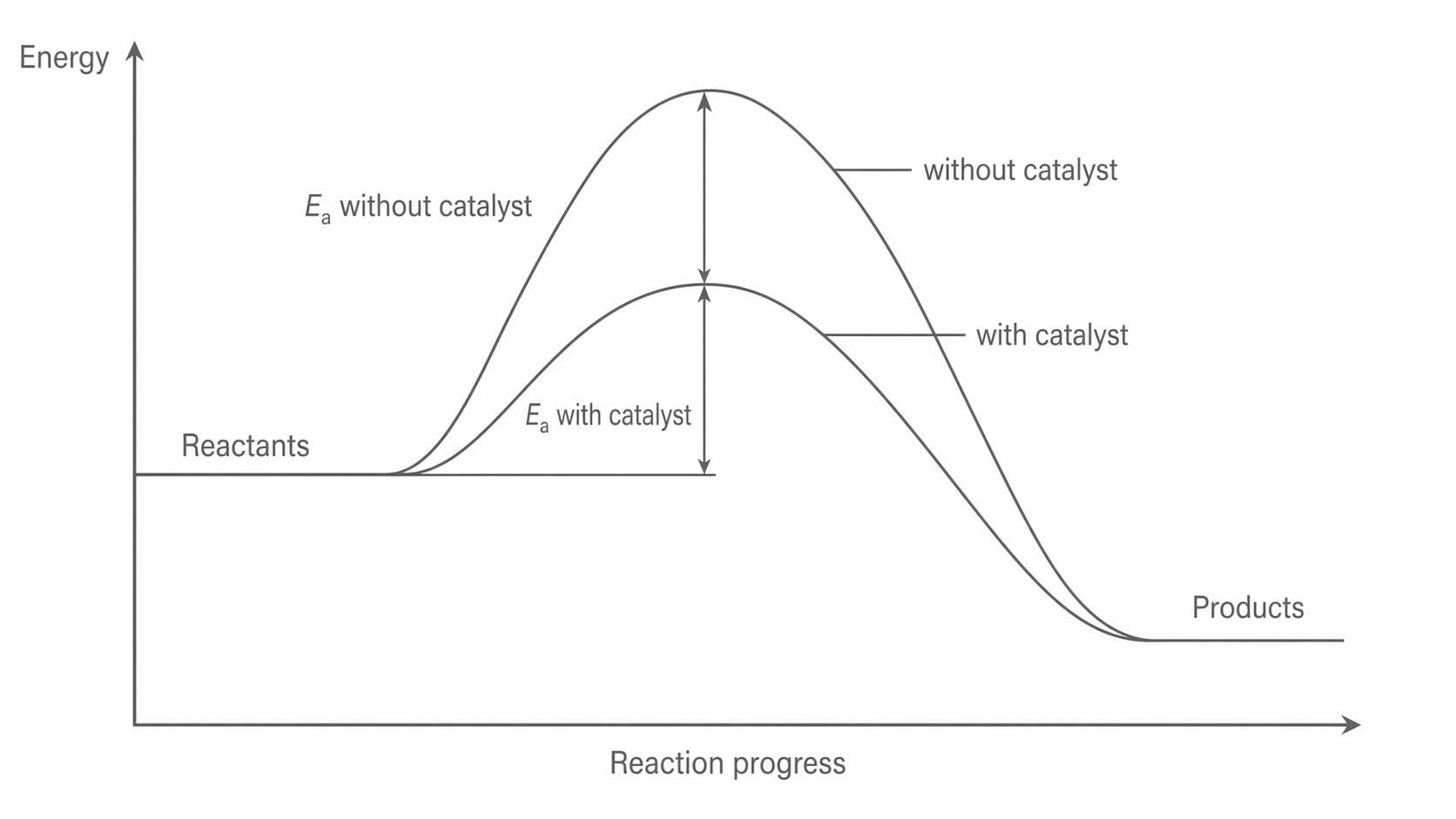
The key phrase is "alternative reaction route". A catalyst provides a different pathway from reactants to products, and that pathway has a lower activation energy than the uncatalysed route. Because the energy barrier is lower, a larger fraction of collisions can lead to reaction.
Activation energy
Activation energy is the minimum energy that colliding particles must have for a reaction to occur.
This does not mean the catalyst gives particles extra energy. The particles in the mixture still have the same range of energies at the same temperature. What changes is the minimum energy needed for success.
The diagram below compares uncatalysed and catalysed reaction profiles, making it clear that the catalyst lowers the activation energy without changing the overall energy difference between reactants and products.
[DIAGRAM: asset_name: 1.5.5 - Catalysts - Diagram 1; asset_slug: 1.5.5 - Catalysts - Diagram 1; recommended_method: retained_png; description: Reaction profile with "Energy" on the y-axis and "Reaction progress" on the x-axis. Show the same reactant energy level on the left and the same product energy level on the right, with products lower than reactants. Connect them by two smooth curves: a higher peak labelled "without catalyst" and a lower peak labelled "with catalyst". Draw activation energy arrows from the reactant level to each peak, labelled "Ea without catalyst" and "Ea with catalyst", and keep the overall reactant-to-product energy change identical for both routes.]
Using the Maxwell-Boltzmann distribution
For gas reactions, the Maxwell-Boltzmann distribution helps you picture why a catalyst works. The curve shows how many particles have each energy value at a particular temperature. Most particles have middling energies, while only a smaller fraction have very high energies.
The diagram below keeps the Maxwell-Boltzmann curve unchanged but moves the activation energy line to the left, so a larger area lies to the right of .
[DIAGRAM: asset_name: 1.5.5 - Catalysts - Diagram 2; asset_slug: 1.5.5 - Catalysts - Diagram 2; recommended_method: retained_png; description: Maxwell-Boltzmann distribution for a gas with "Energy" on the x-axis and "Number of molecules" on the y-axis. Draw one unchanged distribution curve at constant temperature. Add a left vertical line labelled "catalysed Ea" and a second vertical line further right labelled "uncatalysed Ea". Lightly shade the whole area to the right of the catalysed line, darken the smaller area to the right of the uncatalysed line, and label the extra shaded region between the two lines as "more molecules with E >= Ea".]
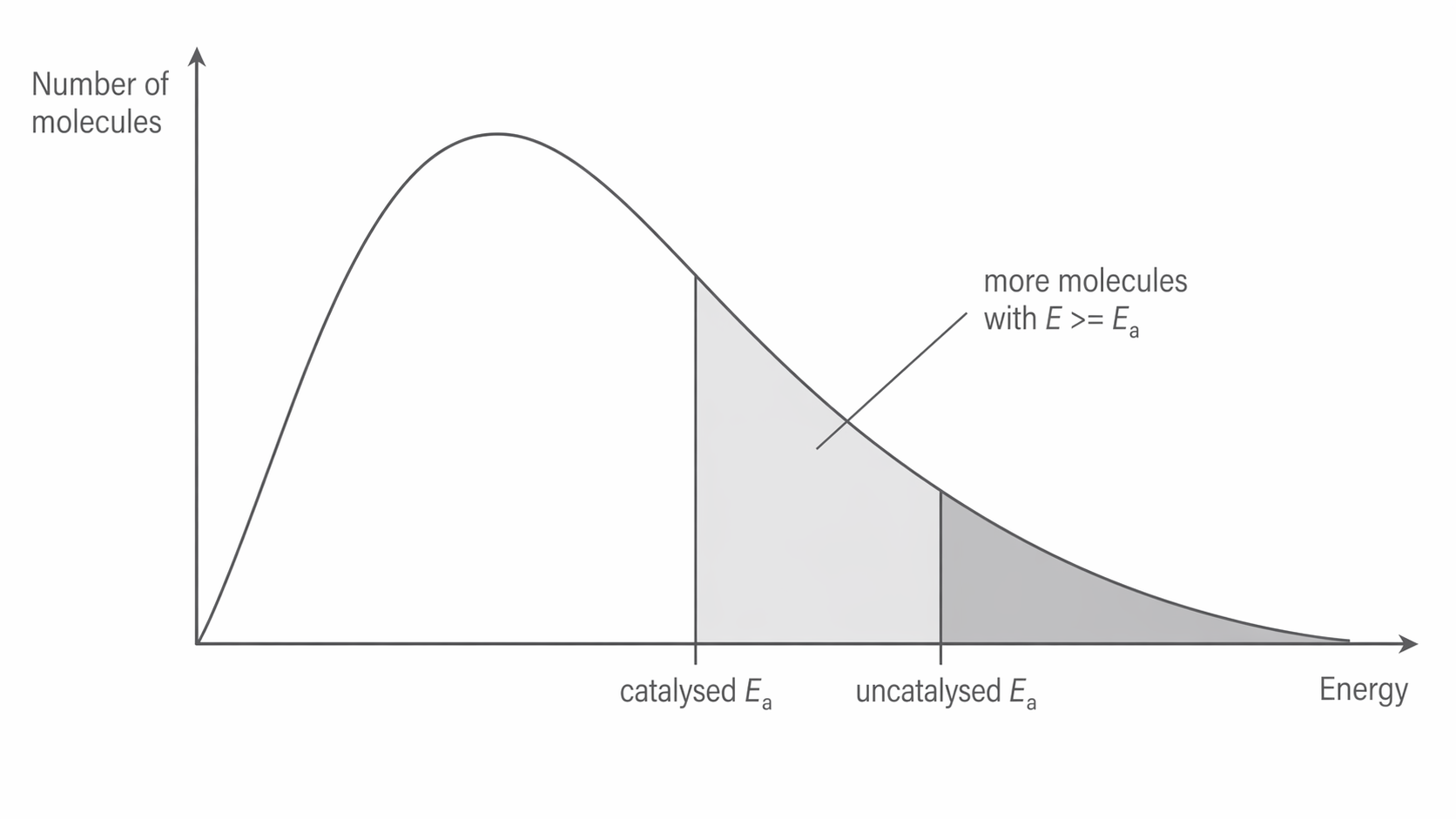
At constant temperature, adding a catalyst does not change the shape of the Maxwell-Boltzmann curve. The particles have not been heated, so their energy distribution is unchanged. Instead, the activation energy line moves to the left because the new route needs less energy.
Effective collision
An effective collision is a collision that leads to reaction because the particles collide with sufficient energy and in a suitable way.
With the catalysed route, the area under the curve to the right of the activation energy line becomes larger. That means a greater proportion of gas molecules now have enough energy to react when they collide. So, in the same time interval, there are more effective collisions and the reaction rate increases.
One common mistake is to say that the curve shifts left when a catalyst is added. It does not. A leftward shift in the whole distribution would mean the particles themselves had different energies, which is not what a catalyst does. The important point is that the curve stays the same, but the activation energy is lower.
Pulling the idea together
The full explanation links three ideas in order: lower activation energy, larger proportion of molecules with enough energy, and more effective collisions per second. Miss one of those links and the chain of reasoning is incomplete.
It also helps to be precise about what a catalyst does not change. It is not used up overall, so its chemical composition and amount are unchanged at the end of the reaction. It does not increase the energy of the molecules in the gas, and it does not make every collision successful. It simply lowers the threshold for success.
Industrial catalysts are valuable because they can speed up reactions without relying only on higher temperatures or pressures. That can reduce energy costs in processes such as the Haber process, where reaction rate matters on a large scale.
Taken together, those ideas give the full picture: a catalyst changes the route to reaction, not the energy distribution of the particles.