3.1.2.2 - The Mole and the Avogadro Constant
Chemists cannot count atoms, ions, or molecules one by one, so they use the mole as a counting unit. This lesson shows how the mole links mass, number of particles, concentration in solution, and the ratios in chemical equations. By the end, you should be able to move confidently between these ideas and see the mole as the bridge between them.
What a mole counts
Chemistry often deals with unimaginably large numbers of particles. The mole gives us a practical way to count them by weighing.
Avogadro constant
The Avogadro constant, , is the number of particles in one mole of substance. Its value is about , and you will usually be given it when you need it.
The mole is defined using this constant, so the two ideas always go together.
Mole
One mole is the amount of substance that contains Avogadro's constant number of specified particles.
The key word is specified. A mole can refer to different kinds of entities:
- 1 mol of atoms
- 1 mol of molecules
- 1 mol of ions
- 1 mol of electrons
- 1 mol of formula units in an ionic compound
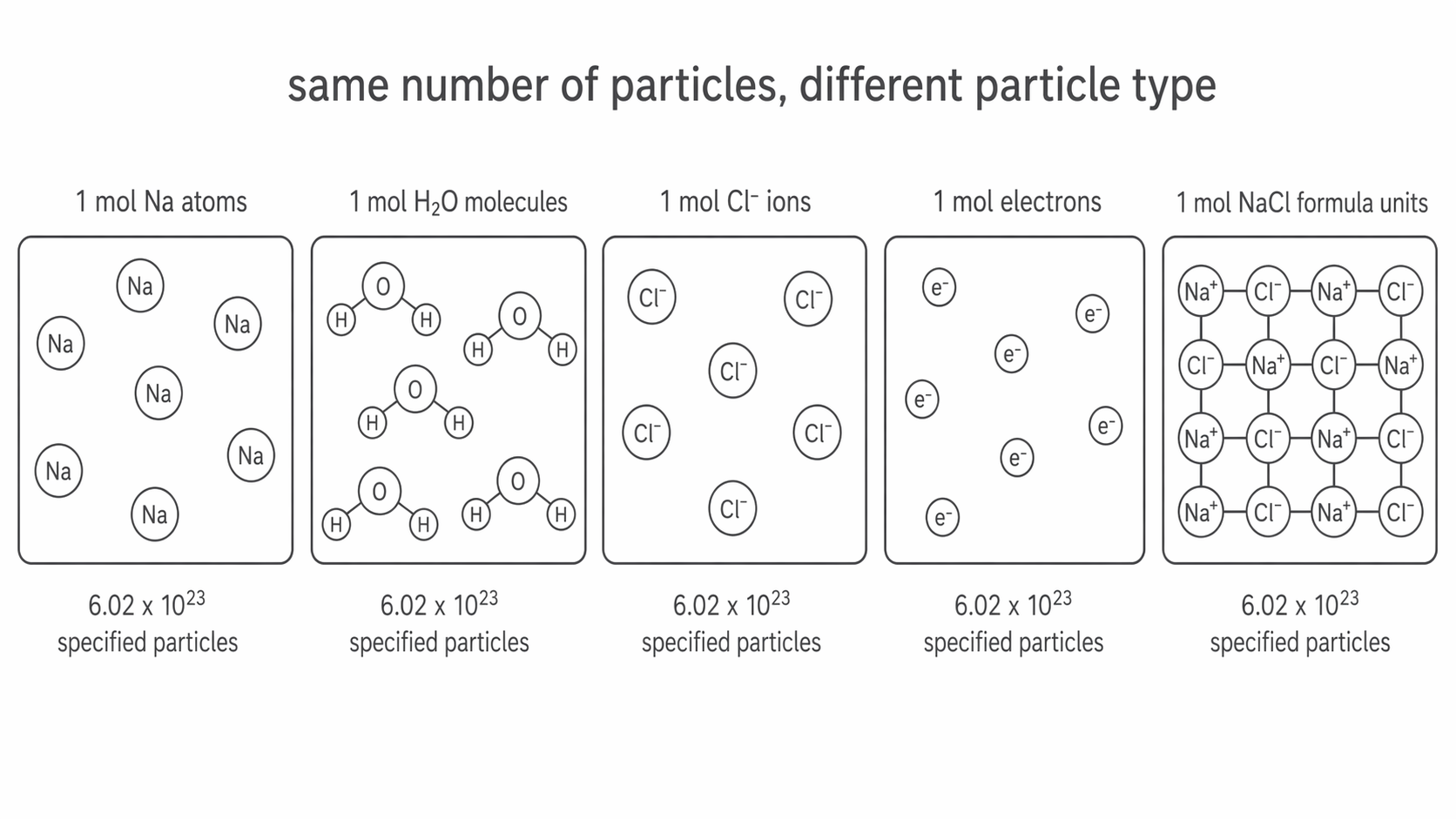
So 1 mol of sodium atoms, 1 mol of chloride ions, and 1 mol of water molecules each contain the same number of particles, even though their masses are different.
For ionic substances, be careful with language. Sodium chloride does not exist as discrete molecules, so we talk about formula units of NaCl, not NaCl molecules.
The diagram below compares different kinds of entities that can each make up 1 mol while keeping the particle count the same in every case.
[DIAGRAM: asset_name: 1.2.2 - The Mole and the Avogadro Constant - Diagram 1; asset_slug: 1.2.2 - The Mole and the Avogadro Constant - Diagram 1; recommended_method: retained_png; description: A 16:9 landscape comparison infographic with five equal rounded boxes in a single row beneath the heading same number of particles, different particle type. Label the boxes 1 mol Na atoms, 1 mol H2O molecules, 1 mol Cl- ions, 1 mol electrons, and 1 mol NaCl formula units. In the first box show several separate circles labelled Na. In the second box show several bent water molecules with one larger O joined to two smaller H atoms. In the third box show several separate circles labelled Cl-. In the fourth box show several small e- symbols or tiny circles labelled e-. In the fifth box show a simple repeating lattice section with alternating Na+ and Cl- ions to represent formula units. Under every box repeat the caption 6.02 x 10^23 specified particles. Use white background, thin grey lines, light sans-serif labels, and clean monochrome chemistry styling.]
Finding moles from mass
In many calculations, the first step is to find the amount of substance, , in moles.
Amount of substance
Amount of substance is the quantity measured in moles, with symbol and unit mol.
For a substance with known mass:
Moles from Mass
Here, is the mass in g. For molecules and formula units, is the relative molecular mass or relative formula mass. For atoms, use to identify the molar mass in .
Use the formula that matches the particle being counted. For example:
- , so 1 mol of oxygen atoms has a molar mass of and a mass of 16.0 g
- , so 1 mol of oxygen molecules has a molar mass of and a mass of 32.0 g
That distinction matters because the particle you are counting changes the molar mass.
Worked example: How many moles are in 9.00 g of water, ?
Always include the unit mol and give the final answer to a sensible number of significant figures.
Once you can find moles from mass, you can compare how many particles are present in different samples and prepare for equation work.
Using the Avogadro constant
The Avogadro constant converts between moles and number of particles.
Particles and Moles
Here, is the number of particles and is the Avogadro constant.
You can also rearrange this:
This works for any specified entity. For example:
- atoms in a sample of copper
- molecules in a sample of carbon dioxide
- ions in a sample of sodium chloride solution
- electrons transferred in a redox process
Worked example: How many molecules are present in 0.250 mol of carbon dioxide?
If you need atoms rather than molecules, you need an extra step. Each molecule contains 3 atoms, so mol of contains atoms in total.
For ionic substances, the formula tells you how many ions come from one formula unit. For example, mol of contains mol of ions and mol of ions. If you wanted the number of chloride ions, you would then multiply mol by .
That same idea lets you move smoothly between moles, particle counts, and ion counts.
Moles in solutions and concentration
When a substance is dissolved, we often need the amount present in a certain volume of solution.
Concentration
Concentration is the amount of solute dissolved per cubic decimetre of solution, usually measured in .
The main relationship is:
Concentration
In this equation, is in , is in mol, and must be in .
This unit conversion is essential:
So if volume is given in , divide by 1000 before using . Rearranging gives:
or
Worked example: What is the concentration of a solution made by dissolving 0.200 mol of sodium hydroxide in of solution?
First convert the volume:
Then calculate concentration:
Students often make two avoidable mistakes here:
- using the volume in directly in
- forgetting that the volume is the volume of the solution, not just the solvent added
A quick unit check helps here: must become before you substitute into , because the concentration formula is defined using .
These concentration calculations are the groundwork for later titration and reacting-volume work, so getting comfortable with the units now is important.
Using the mole in equations
Balanced chemical equations do more than show which substances react. The coefficients also show the simplest whole-number ratio in which particles react, so they also give the mole ratio.
For example:
This means:
- 1 mol of reacts with 3 mol of
- 1 mol of forms 2 mol of
The coefficients do not tell you a mass ratio. They tell you the ratio of moles.
A dependable route through these calculations is:
- Write the balanced equation, or check that the one given is balanced.
- Read off the mole ratio you need from the coefficients.
- Convert any given mass or solution data into moles first.
- Use the ratio to find the unknown amount in moles.
Worked example: How many moles of hydrogen are needed to react completely with mol of nitrogen?
From , the ratio is .
If you were given a mass of nitrogen instead, first convert that mass into moles using , then apply the same ratio step.
Once you have found an amount in moles, you can convert it into mass, number of particles, or concentration depending on the quantity you need. That is why the mole is the bridge between grams, particles, solutions, and chemical equations.