3.1.3.1 - Ionic Bonding
Ionic bonding explains how metals and non-metals form compounds by making ions, and how those ions are held together in a giant structure. In this lesson, you will build the particle model first, then use it to predict ion charges and construct correct formulae for ionic compounds, including ones that contain compound ions.
What ionic bonding really is
Ionic compounds form when electrons are transferred from metal atoms to non-metal atoms. That transfer creates charged particles called ions. A sodium atom, for example, loses one electron to form Na+, while a chlorine atom gains one electron to form Cl-.
Ionic bond
The ionic bond is the strong electrostatic attraction between oppositely charged ions in a lattice.
Keep two ideas separate here. Electron transfer is how the ions are formed, but it is not itself the bond. The bond is the attraction between the positive and negative ions after those ions exist.
In sodium chloride, the ions do not sit as one isolated Na+ next to one isolated Cl-. They arrange in a giant three-dimensional ionic lattice with alternating positive and negative ions. Each positive ion is attracted to negative ions around it, and each negative ion is attracted to positive ions around it. That repeated electrostatic attraction is why ionic compounds are stable.
The diagram below separates the two linked ideas in ionic bonding: electron transfer forms the ions, and the giant lattice holds those ions together by repeated electrostatic attraction.
[DIAGRAM: asset_name: 1.3.1 - Ionic Bonding - Diagram 1; asset_slug: 1.3.1 - Ionic Bonding - Diagram 1; recommended_method: retained_png; description: Two-panel ionic bonding diagram. Left panel titled "electron transfer forms ions": a sodium atom with electron arrangement 2,8,1 transfers one outer electron to a chlorine atom with electron arrangement 2,8,7, giving bracketed Na+ and Cl- ions with full outer shells. Right panel titled "ionic lattice": a regular repeating array of alternating Na+ and Cl- ions with arrows showing electrostatic attraction acting in all directions through the lattice.]
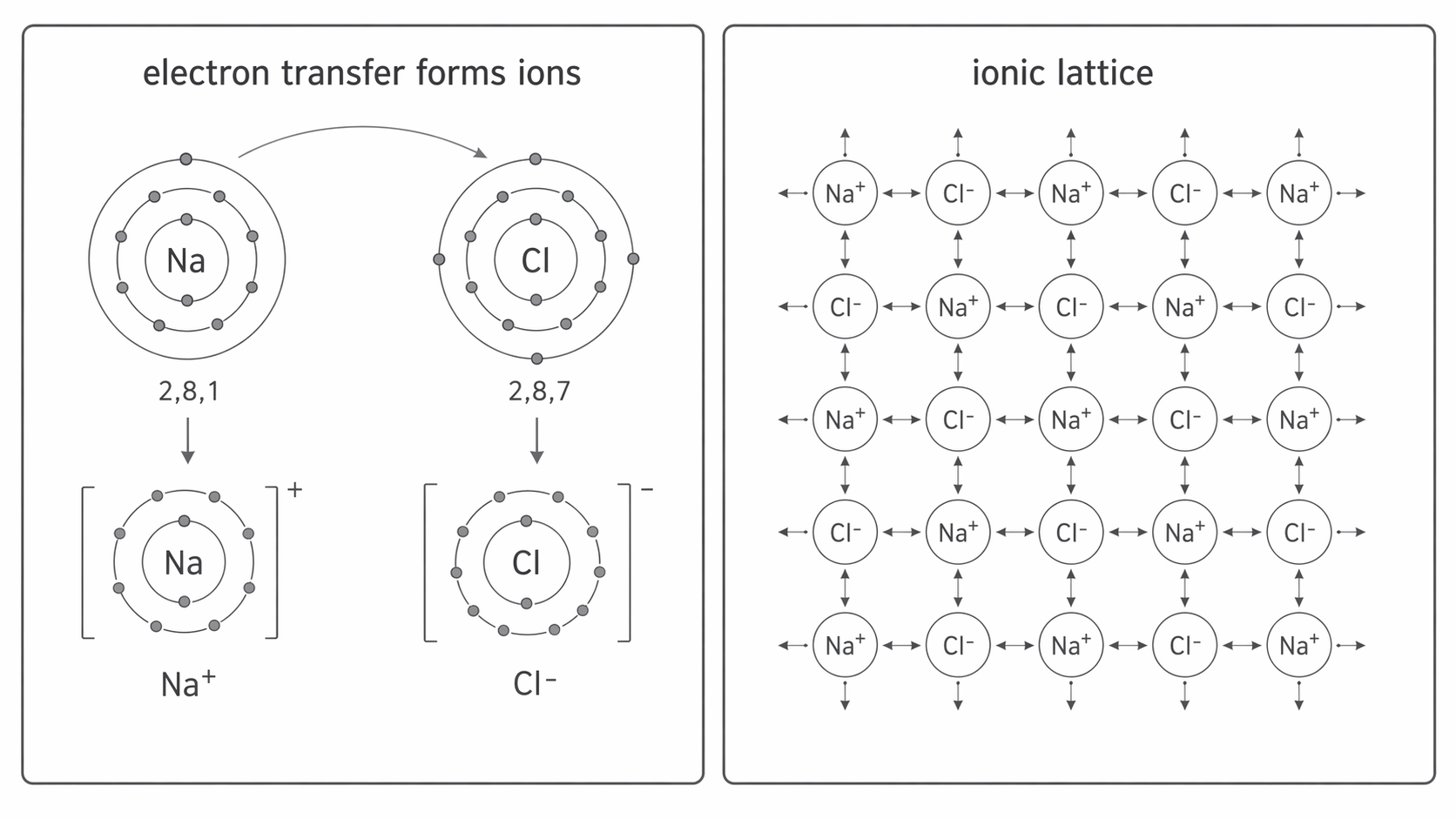
This also explains why the formula of an ionic compound shows the simplest ratio of ions in the lattice, not a small molecule. NaCl means the ratio is 1 sodium ion to 1 chloride ion throughout the lattice.
Predicting charges on simple ions
A simple ion is an ion formed from a single atom. For the main-group elements in this part of the course, the position of the element in the Periodic Table helps you predict the charge of the ion it forms.
Simple ion
A simple ion is an ion formed when a single atom gains or loses electrons and carries an overall charge.
The pattern comes from how many electrons an atom needs to lose or gain to reach a full outer shell:
- Group 1 elements lose 1 electron to form
1+ions, for exampleNa+andK+. - Group 2 elements lose 2 electrons to form
2+ions, for exampleMg2+andCa2+. - Group 3 elements lose 3 electrons to form
3+ions, for exampleAl3+. - Group 5 elements gain 3 electrons to form
3-ions, for exampleN3-. - Group 6 elements gain 2 electrons to form
2-ions, for exampleO2-andS2-. - Group 7 elements gain 1 electron to form
1-ions, for exampleCl-andF-.
You can think of the charge as a balance between protons and electrons. Magnesium has 12 protons. When it loses 2 electrons, it still has 12 protons but now only 10 electrons, so the ion has an overall 2+ charge.
For this spec point, these charge predictions work best for the common main-group simple ions. Group 0 elements do not normally form ions, and Group 4 does not usually form simple ions in this model.
When you write an ion, include both the symbol and the charge.
The compound ions you must know
Not all ions are single atoms. Some are groups of covalently bonded atoms that carry an overall charge.
Compound ion
A compound ion is a group of two or more bonded atoms with an overall charge that acts as a single ion.
For this lesson, you need the formulae of these common compound ions:
- sulfate,
SO4^2- - hydroxide,
OH- - nitrate,
NO3- - carbonate,
CO3^2- - ammonium,
NH4+
The charge belongs to the whole ion, not to one atom inside it. For example, NO3- is one nitrate ion with a 1- charge overall. The three oxygen atoms are part of the ion; they are not three separate oxide ions.
Ammonium is especially important because it is a positive compound ion. The others in this list are negative compound ions. Once you know these five ions securely, building ionic formulae becomes much quicker and more reliable.
Worked example: calcium nitrate contains Ca2+ ions and NO3- ions. One calcium ion has charge +2, so it needs two nitrate ions with total charge -2. The formula is Ca(NO3)2.
Learn these as whole units. If you recognise the ion quickly, you are much less likely to invent incorrect formulae such as NO6 or SO8.
Constructing formulae for ionic compounds
To construct the formula of an ionic compound, use charges to find the smallest whole-number ratio of ions that gives no overall charge.
This four-step method is reliable:
- Write the ions with their charges.
- Choose the ratio that makes the total positive charge equal the total negative charge.
- Write the formula without the charges.
- Use brackets if you need more than one of a compound ion.
For magnesium chloride:
- ions:
Mg2+andCl- - charge balance: one
Mg2+needs twoCl- - formula:
MgCl2
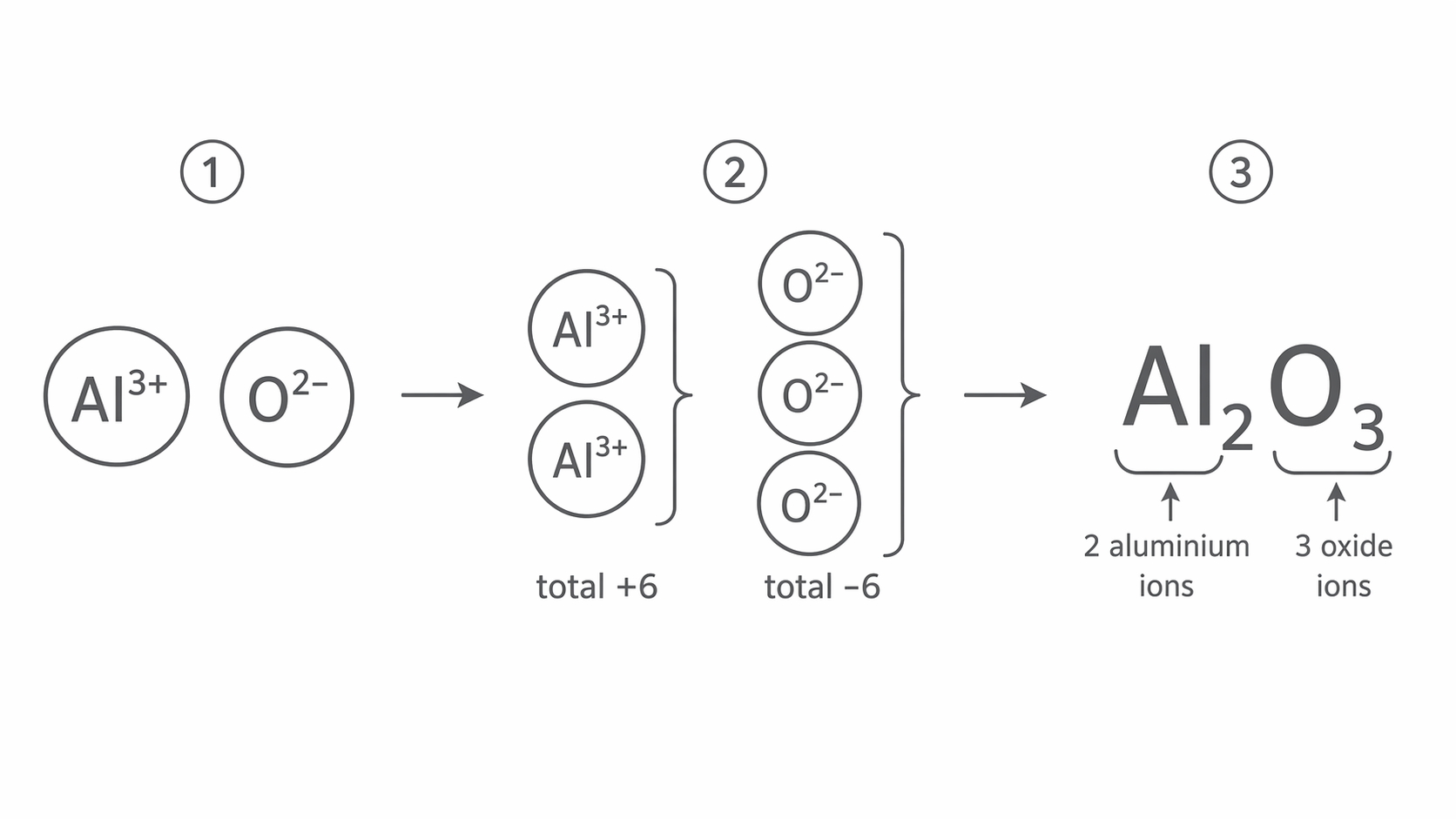
For aluminium oxide:
- ions:
Al3+andO2- - charge balance: two
Al3+give+6, and threeO2-give-6 - formula:
Al2O3
The diagram below shows that the formula Al2O3 comes directly from balancing the total positive and negative charges in the smallest whole-number ratio.
[DIAGRAM: asset_name: 1.3.1 - Ionic Bonding - Diagram 2; asset_slug: 1.3.1 - Ionic Bonding - Diagram 2; recommended_method: retained_png; description: Three-stage charge-balance diagram for aluminium oxide. Stage 1: starting ions Al3+ and O2-. Stage 2: exactly two Al3+ ions grouped with total +6 and three O2- ions grouped with total -6. Stage 3: the smallest whole-number formula Al2O3, with the 2 visually tied to aluminium ions and the 3 tied to oxide ions.]
For ammonium sulfate:
- ions:
NH4+andSO4^2- - charge balance: two
NH4+ions give+2, which balances oneSO4^2- - formula:
(NH4)2SO4
The brackets matter because there are two ammonium ions. Without brackets, NH42SO4 would mean something different and would be chemically wrong.
Two easy mistakes are worth avoiding:
- Do not leave charges in the final formula. Write
MgCl2, notMg2+Cl-2. - Do not change the inside of a compound ion. Hydroxide stays
OH, so calcium hydroxide isCa(OH)2, notCaO2H2.
If the charges already balance in a 1:1 ratio, keep the formula simple. Calcium oxide is CaO, not Ca2O2.
The big idea to remember is that an ionic formula is a charge-balance statement. If the total positive and negative charges cancel in the smallest whole-number ratio, your formula is correct.