1.3.7 Intermolecular forces
When simple molecular substances melt or boil, the covalent bonds inside each molecule are not broken. What changes is the strength of the attractions between neighboring molecules. In this lesson, you will learn how to identify the three intermolecular forces in the specification, explain how they affect melting and boiling points, and see why water behaves unusually.
Why these forces matter
Simple molecular substances often have relatively low melting and boiling points compared with ionic compounds or giant covalent structures. That is not because covalent bonds are weak. It is because melting and boiling only require the intermolecular forces between molecules to be overcome, and those forces are much weaker than the covalent bonds within each molecule.
Intermolecular force
An intermolecular force is an attraction between separate molecules. It is weaker than a covalent, ionic, or metallic bond, but it affects physical properties such as melting point and boiling point.
The big pattern is simple: stronger intermolecular forces mean more energy is needed to separate molecules, so the melting point and boiling point are higher. For similar-sized molecules, the three forces in this topic can usually be thought of in this order:
- induced dipole-dipole forces, also called London forces, dispersion forces, or van der Waals forces
- permanent dipole-dipole forces
- hydrogen bonding
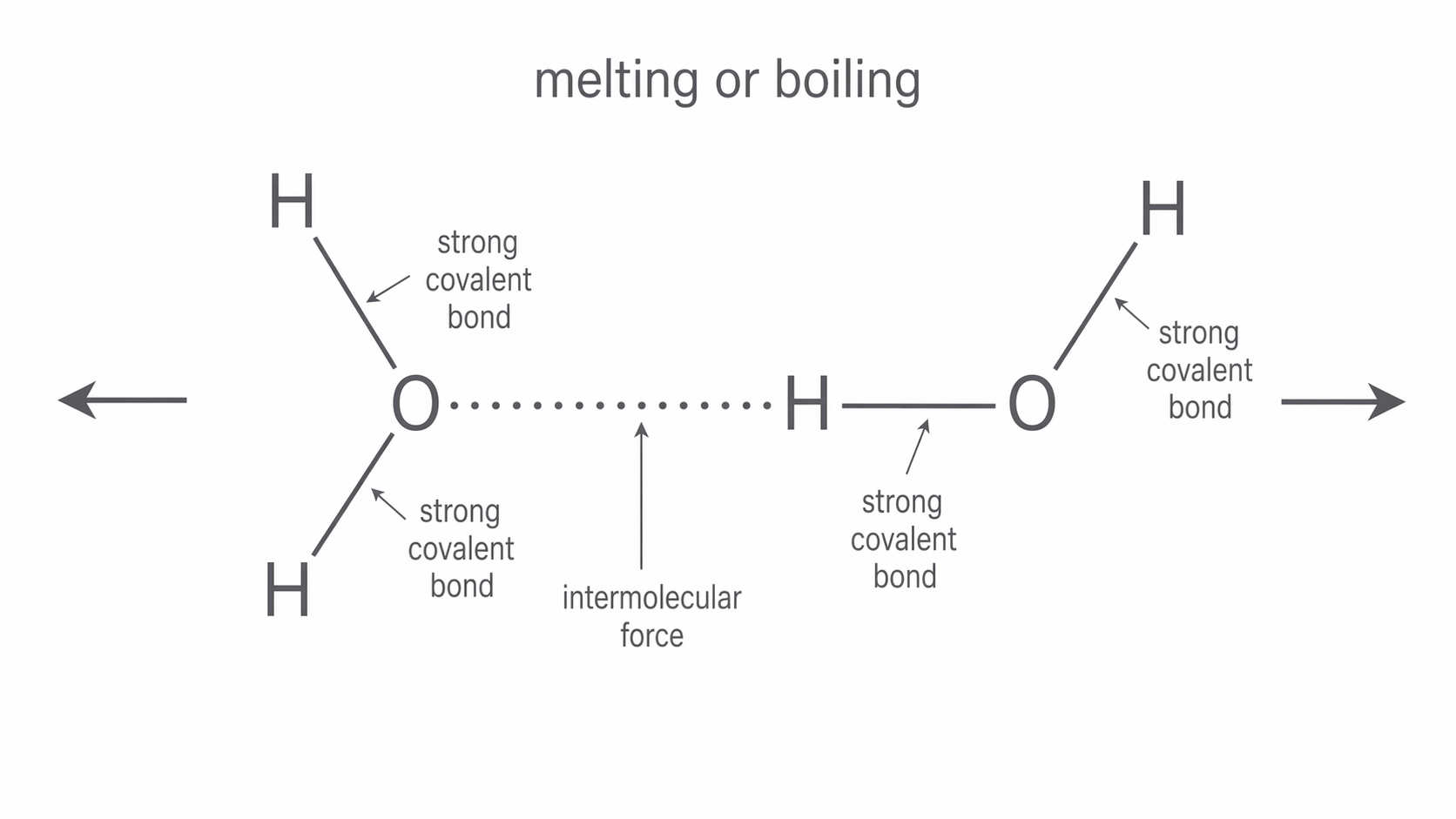
That order is a useful guide, but there is one extra detail that matters a lot: all molecules have induced dipole-dipole forces. Permanent dipole-dipole forces and hydrogen bonding are extra attractions that are present only in certain molecules. The diagram below shows the key distinction: during melting or boiling, molecules separate from one another, but the covalent O-H bonds inside each water molecule stay intact.
Induced dipole-dipole forces
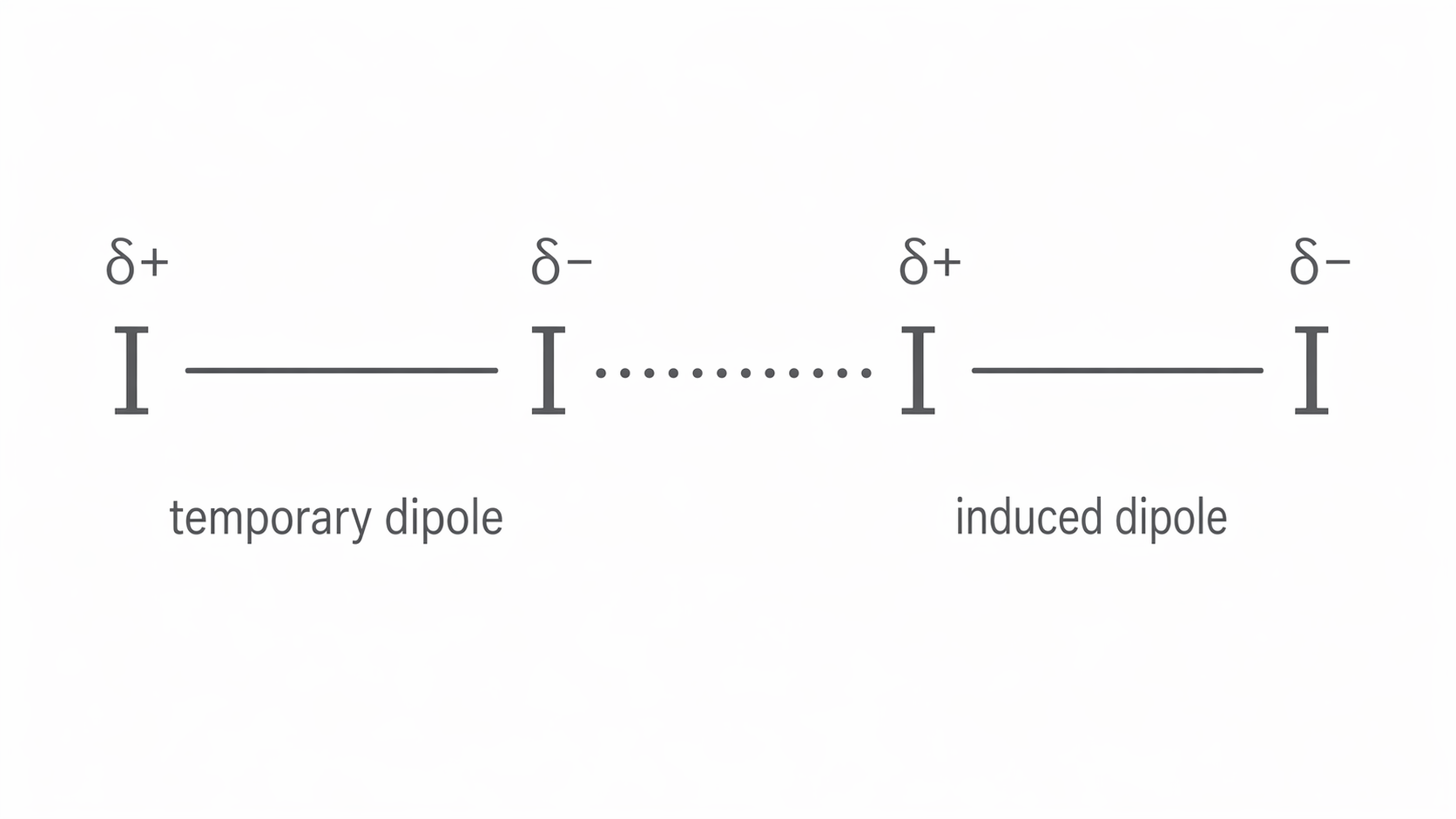
Start with the force that every atom and every molecule has. Electrons are always moving, so the electron cloud around a particle is never perfectly fixed. At any instant, the electrons may be slightly more concentrated on one side. That creates a temporary dipole: one side becomes slightly negative and the other slightly positive.
This temporary dipole can distort the electron cloud in a neighboring particle and induce a dipole there as well. The two particles then attract each other. Because the dipoles are constantly appearing and disappearing, these attractions are weak, but they are present all the time. The diagram below shows how a temporary dipole in one iodine molecule can induce a dipole in a neighboring molecule.
Induced dipole-dipole forces become stronger when electron clouds are larger and more easily distorted. That is why molecules with more electrons usually have stronger London forces and therefore higher melting and boiling points. Shape can matter too: long, less-branched molecules can make contact over a larger surface, so the attractions between them are stronger than in compact, highly branched molecules with a similar .
This same pattern explains why boiling points increase down the noble gases and why longer-chain hydrocarbons generally boil at higher temperatures than shorter ones.
Permanent dipole-dipole forces
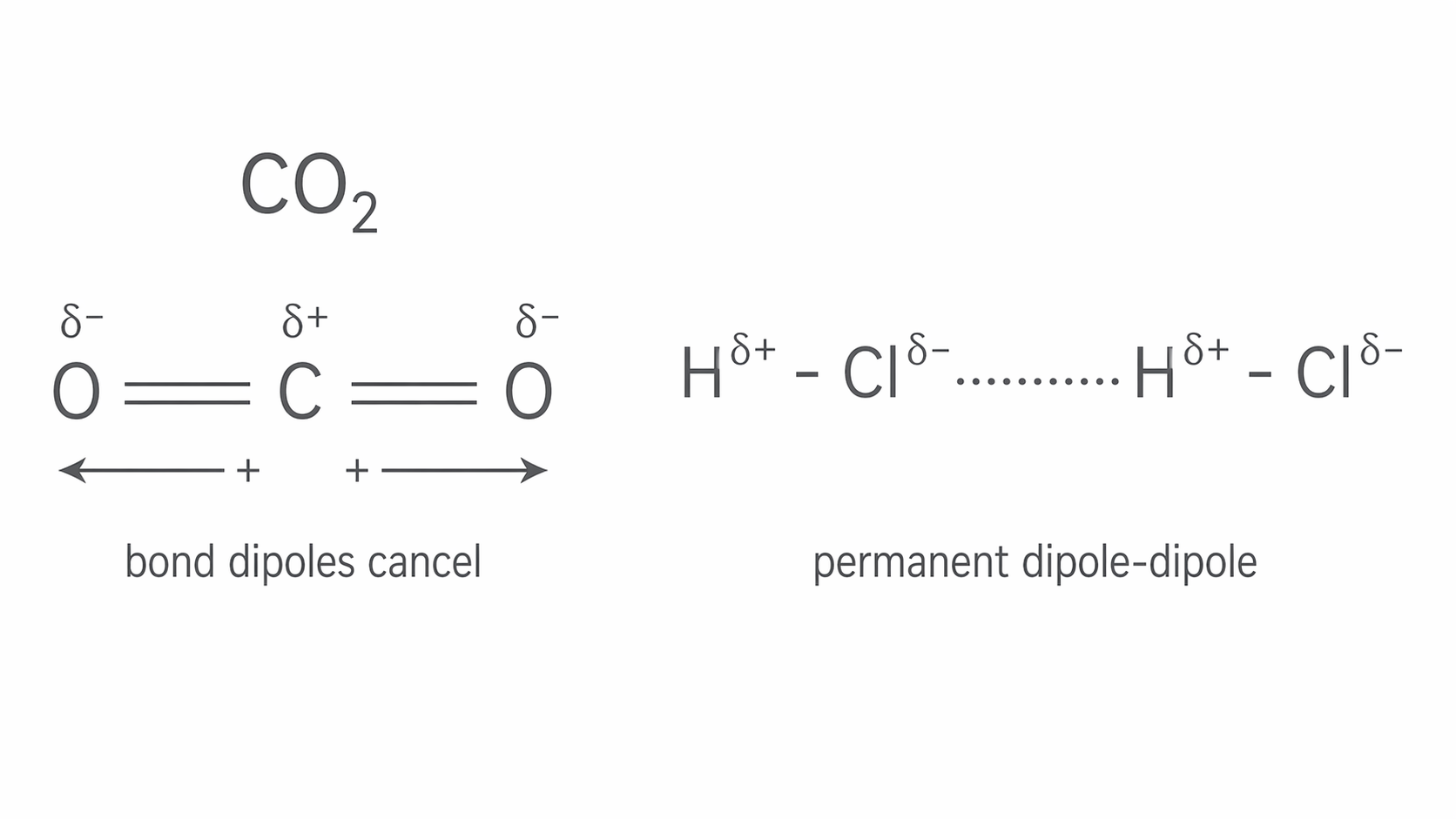
Some molecules have a permanent uneven distribution of charge. This happens when the molecule is polar overall, not just when it contains a polar bond. That distinction matters. A carbon dioxide molecule contains two polar C=O bonds, but the molecule is linear, so the bond dipoles cancel and there is no permanent dipole. Hydrogen chloride, HCl, has one polar bond and is polar overall, so it does have a permanent dipole.
When polar molecules come close together, the delta+ region of one molecule attracts the delta- region of another. This is a permanent dipole-dipole force. These attractions are stronger than London forces for molecules of similar size, so polar molecules often have higher melting and boiling points than comparable non-polar molecules.
Remember, however, that polar molecules do not lose their London forces. HCl molecules experience both induced dipole-dipole forces and permanent dipole-dipole forces. A non-polar molecule such as CO2 only has induced dipole-dipole forces. The diagram below compares these two situations directly: in CO2 the bond dipoles cancel, whereas HCl molecules can align so opposite partial charges attract.
For an unfamiliar molecule, the crucial question is whether any bond dipoles add up to a polar molecule overall. If the molecule is not polar overall, permanent dipole-dipole forces cannot act between its molecules.
Hydrogen bonding and water's unusual behavior
Hydrogen bonding is the strongest intermolecular force in this part of the course, but it only happens under specific conditions. The hydrogen atom must be covalently bonded to a very electronegative atom, and there must be a lone pair on a nitrogen, oxygen, or fluorine atom in a neighboring molecule.
Hydrogen bond
A hydrogen bond is a strong intermolecular attraction between a hydrogen atom bonded to nitrogen, oxygen, or fluorine and a lone pair of electrons on a nitrogen, oxygen, or fluorine atom in a neighboring molecule.
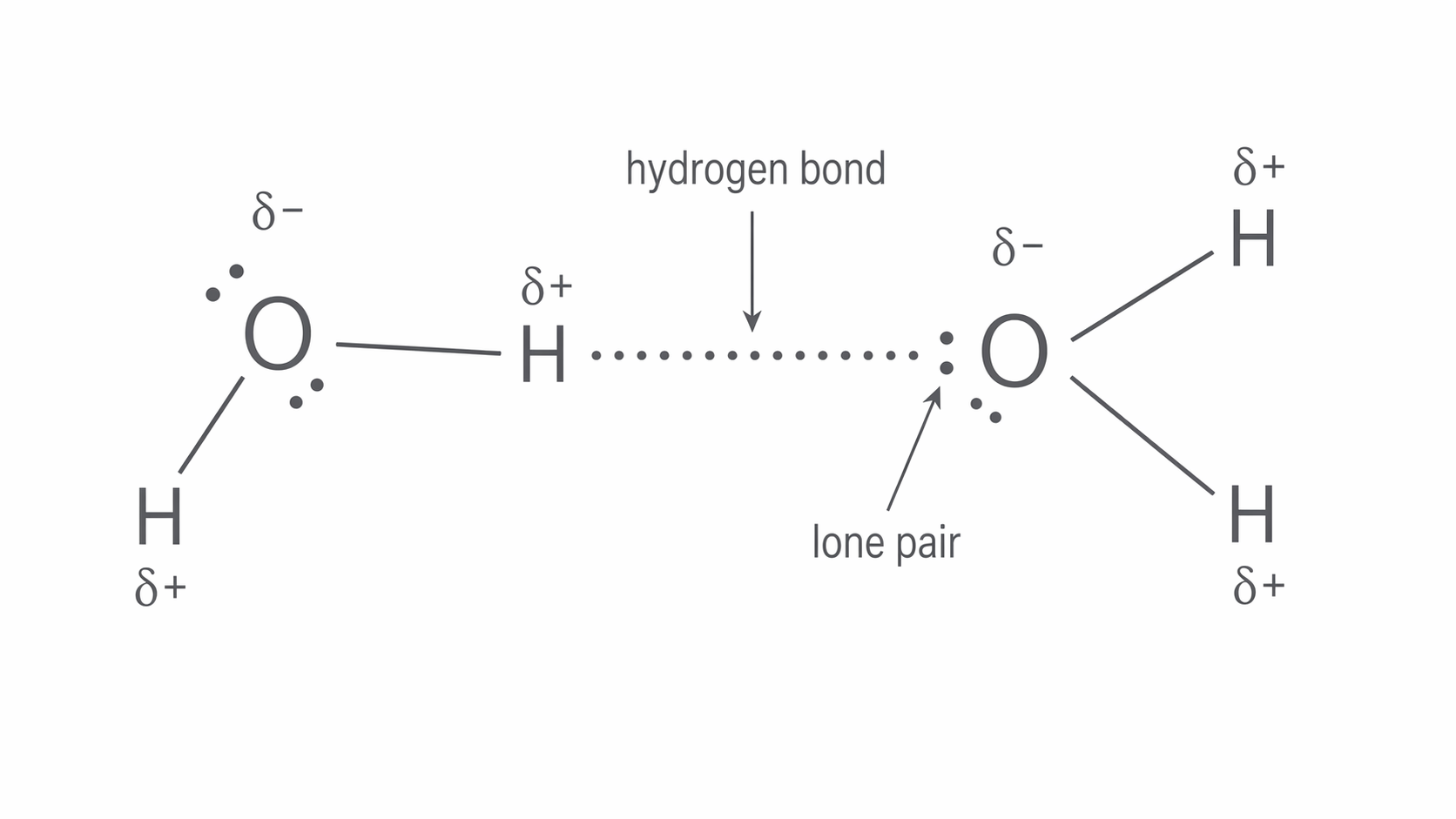
Why is this attraction especially strong? Nitrogen, oxygen, and fluorine are very electronegative, so they pull electron density away from hydrogen very strongly. That leaves the hydrogen atom with a large partial positive charge concentrated in a very small space. A lone pair on a neighboring N, O, or F atom is then strongly attracted to it. The diagram below shows this in water, where a δ+ hydrogen on one molecule is attracted to a lone pair on the oxygen of another molecule.
This is why NH3, H2O, and HF have anomalously high boiling points. If London forces were the only factor, these molecules should have lower boiling points than the larger hydrides lower down their groups. Instead, hydrogen bonding adds a much stronger attraction between molecules, so more energy is needed to separate them.
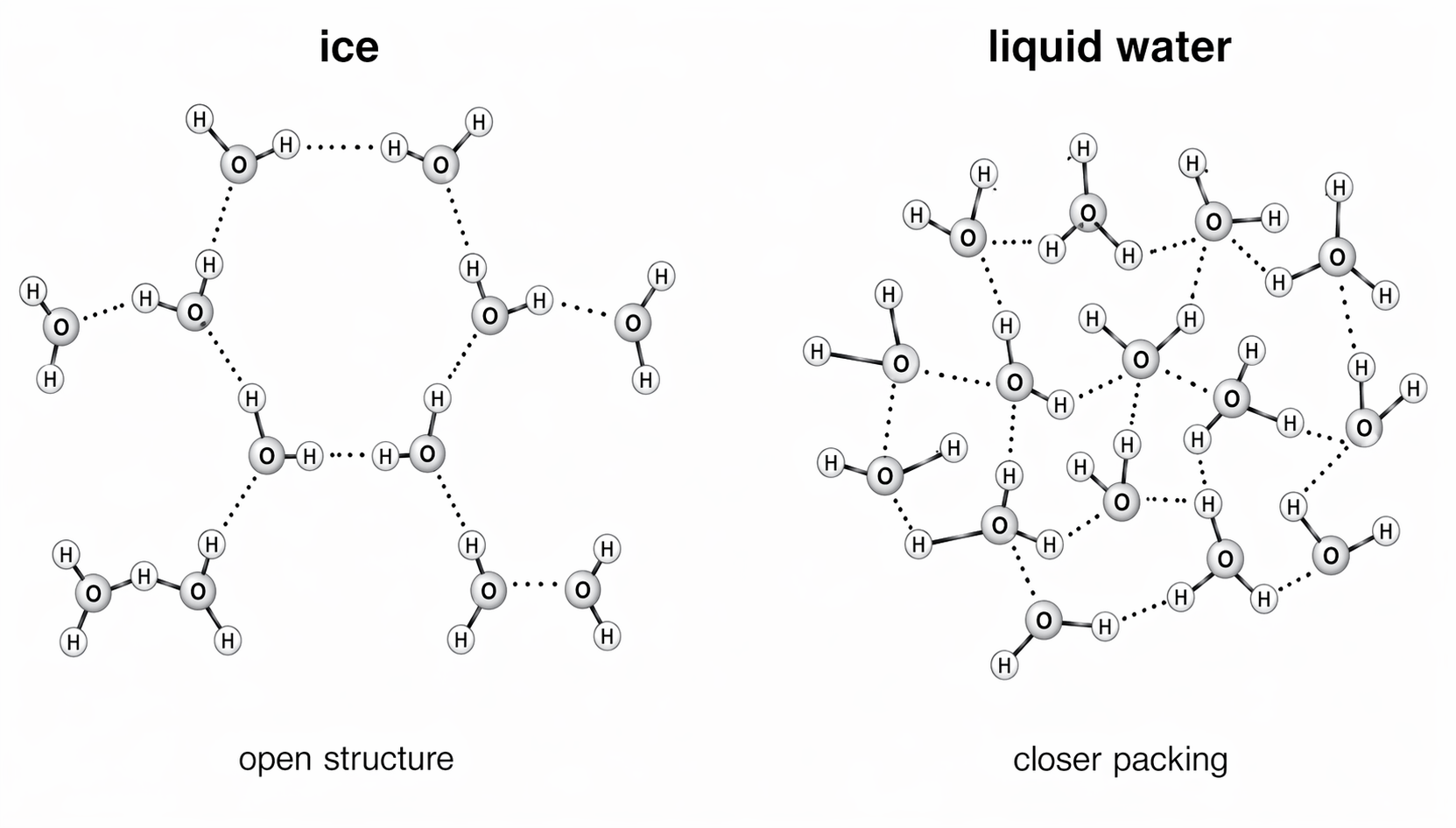
Hydrogen bonding also explains why ice is less dense than liquid water. In liquid water, hydrogen bonds are constantly breaking and reforming, so the molecules can move closer together. In ice, the hydrogen bonds hold water molecules in a more open, regular arrangement. The molecules are therefore slightly further apart, so the same mass occupies a larger volume. A larger volume for the same mass means a lower density, which is why ice floats. The diagram below compares the open hydrogen-bonded arrangement in ice with the closer packing in liquid water.
A sensible order is:
- Check whether hydrogen is bonded to N, O, or F and whether a neighboring molecule can provide a lone pair on N, O, or F. If yes, hydrogen bonding is present.
- If not, decide whether the molecule is polar overall. If yes, permanent dipole-dipole forces are present.
- In every case, include induced dipole-dipole forces, because all atoms and molecules have them.
Once you know which forces are present, link force strength to property: stronger intermolecular forces mean more energy is needed for melting or boiling, so melting points and boiling points are higher.