3.1.4.3 - Applications of Hess's Law
Some enthalpy changes are straightforward to measure directly, but many useful reactions are not. Hess's law lets us calculate the enthalpy change for a difficult reaction by linking it to reactions whose enthalpy changes are known. In this lesson you will learn how to use Hess's law with enthalpies of formation and enthalpies of combustion, and how sign changes and stoichiometric coefficients control the final value.
Why Indirect Routes Work
If a set of reactants ends up as the same products, the total enthalpy change must be the same whatever route connects them. That is because enthalpy depends only on the starting point and finishing point, not on the intermediate steps.
Hess's law
The enthalpy change for a reaction is the same whichever route is taken from reactants to products.
In practice, this means a hard-to-measure reaction can be replaced by a thermochemical cycle made from easier reactions. The cycle may be drawn as a triangle or as an enthalpy diagram, but the same rules always apply. If you reverse an equation, the sign of changes. If you multiply an equation by a number, you must multiply its value by the same number.
A useful first step is to write the balanced target equation with state symbols before doing any arithmetic. That tells you which tabulated values are needed and how many moles of each substance are involved.
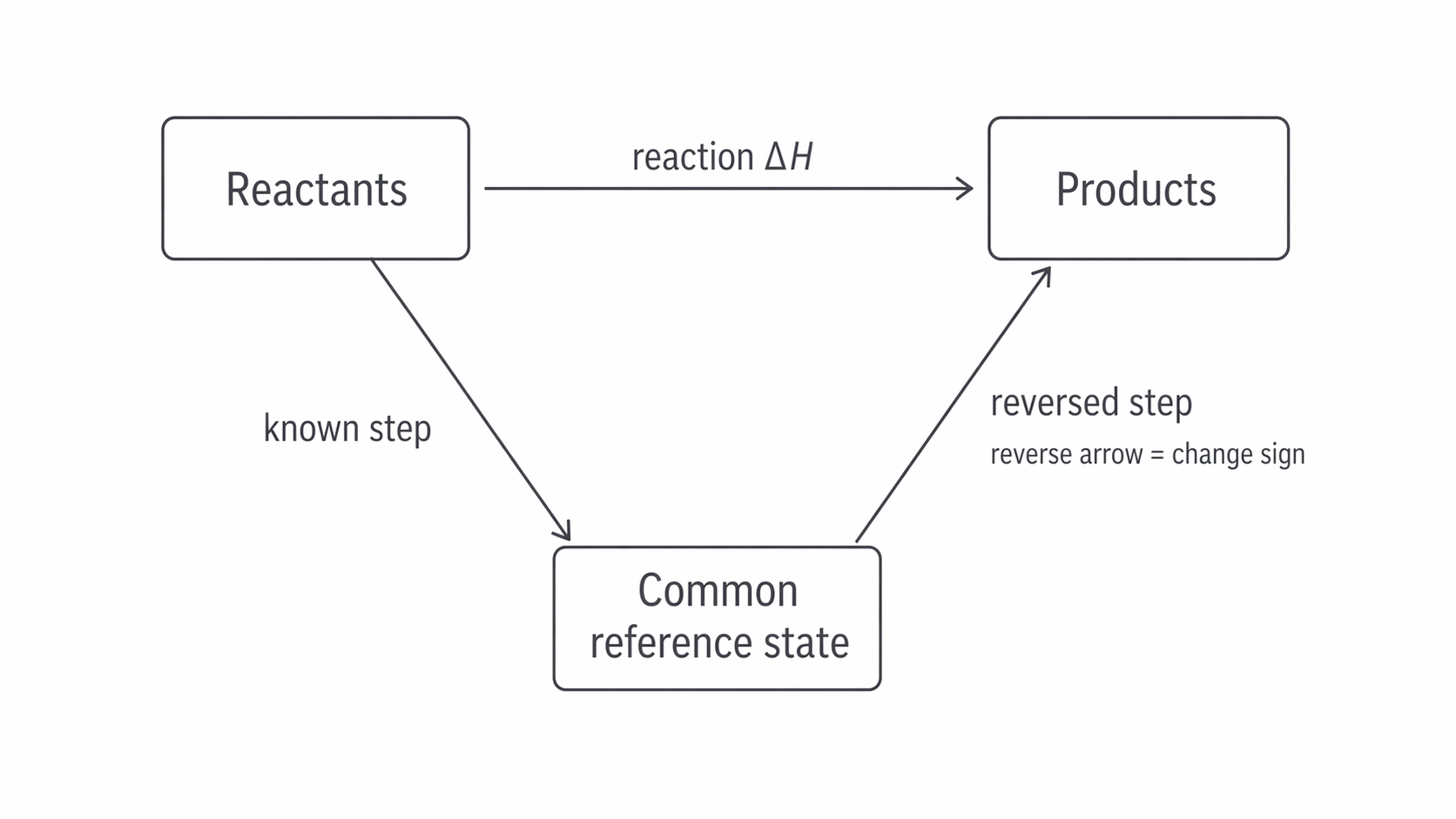
The diagram below shows the basic structure of a Hess cycle: the direct route across the top must match the total enthalpy change around the indirect route, and reversing any arrow reverses the sign attached to that step.
[DIAGRAM: asset_name: 1.4.3 - Applications of Hess's Law - Diagram 1; asset_slug: 1.4.3 - Applications of Hess's Law - Diagram 1; recommended_method: retained_png; description: Monochrome triangular Hess cycle with reactants at the top left, products at the top right, and a common reference state at the bottom. Show a direct top arrow labelled reaction ΔH, a known step down to the reference state, and a reversed step back up with a note that reversing the arrow changes the sign.]
Calculations From Enthalpies of Formation
Standard enthalpy changes of formation connect substances to their elements in standard states. That is why the lower level of a formation cycle is written in terms of elements such as C(s, graphite), H2(g), and O2(g).
Standard enthalpy change of formation
The enthalpy change when 1 mol of a compound is formed from its constituent elements under standard conditions, with all substances in their standard states.
A key consequence is that the enthalpy of formation of an element in its standard state is 0 kJ mol^-1 by definition. So for H2(g), O2(g), and C(s, graphite) is zero.
For formation data:
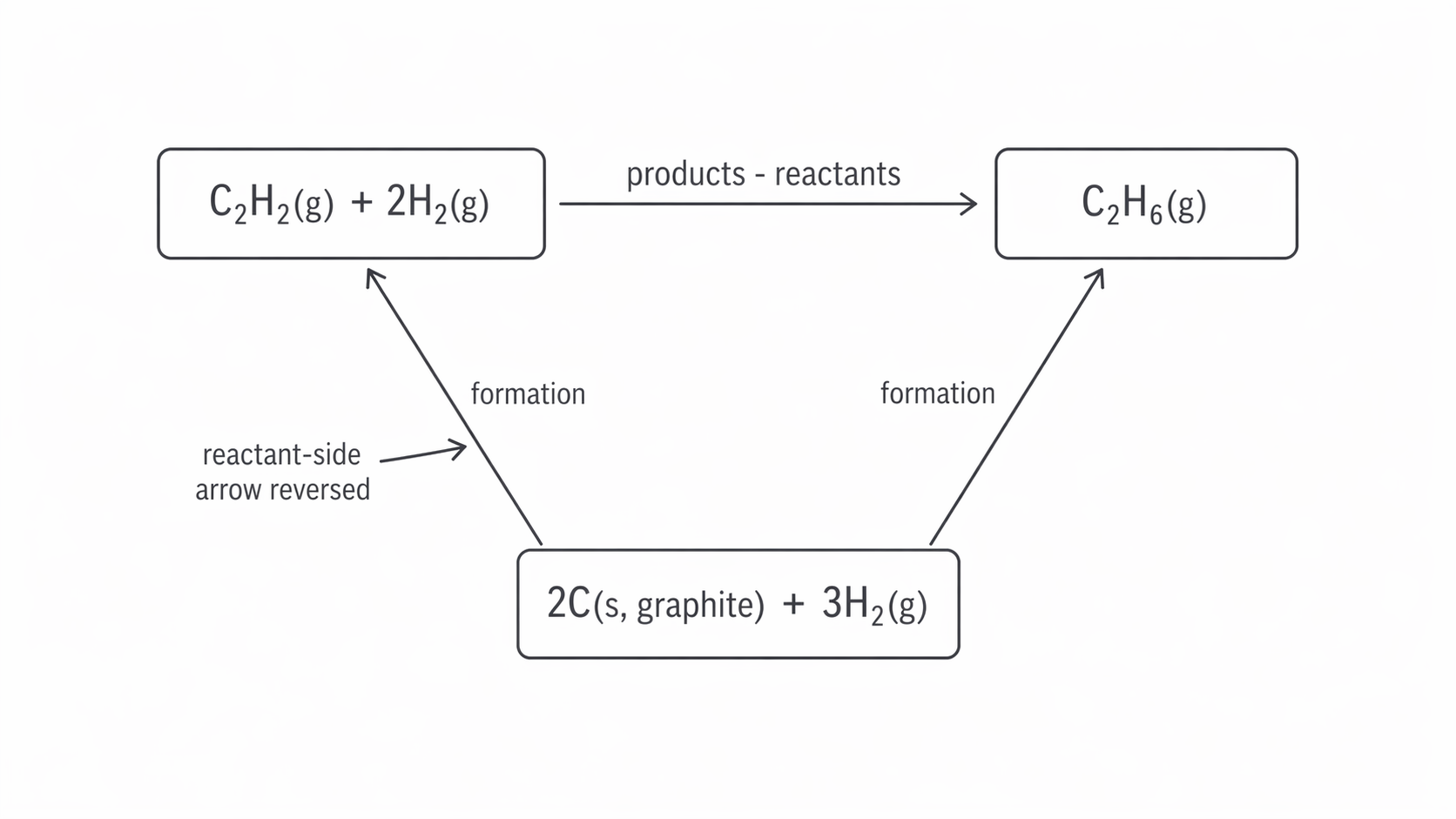
The cycle works because you imagine taking the reactants back to their elements, then forming the products from those same elements.
The diagram below shows the corresponding formation cycle. Tracing the reactants down to the elements means reversing the reactant-side formation arrow, so its sign changes during the calculation.
[DIAGRAM: asset_name: 1.4.3 - Applications of Hess's Law - Diagram 2; asset_slug: 1.4.3 - Applications of Hess's Law - Diagram 2; recommended_method: retained_png; description: Monochrome Hess cycle for C2H2(g) + 2H2(g) -> C2H6(g) using standard enthalpies of formation. Place C2H2(g) + 2H2(g) at the top left, C2H6(g) at the top right, and 2C(s, graphite) + 3H2(g) at the bottom. Show formation arrows from the elements up to both top states and indicate that the reactant-side arrow is reversed when applying products - reactants.]
Worked example:
Use , , and in kJ mol^{-1}.
The reaction is exothermic because the answer is negative. The 2(0) for hydrogen is still important: the value is zero, but the coefficient still matters because the balanced equation still matters.
Notice that Zn(s) and Cu(s) contribute zero because they are elements in their standard states.
Calculations From Enthalpies of Combustion
Sometimes formation data are unavailable, but combustion data are common because complete burning can be measured reliably. In a combustion cycle, both sides of the target equation are imagined burning down to the same combustion products, usually CO2(g) and H2O(l).
Standard enthalpy change of combustion
The enthalpy change when 1 mol of a substance is completely burned in oxygen under standard conditions.
For combustion data, the subtraction order reverses:
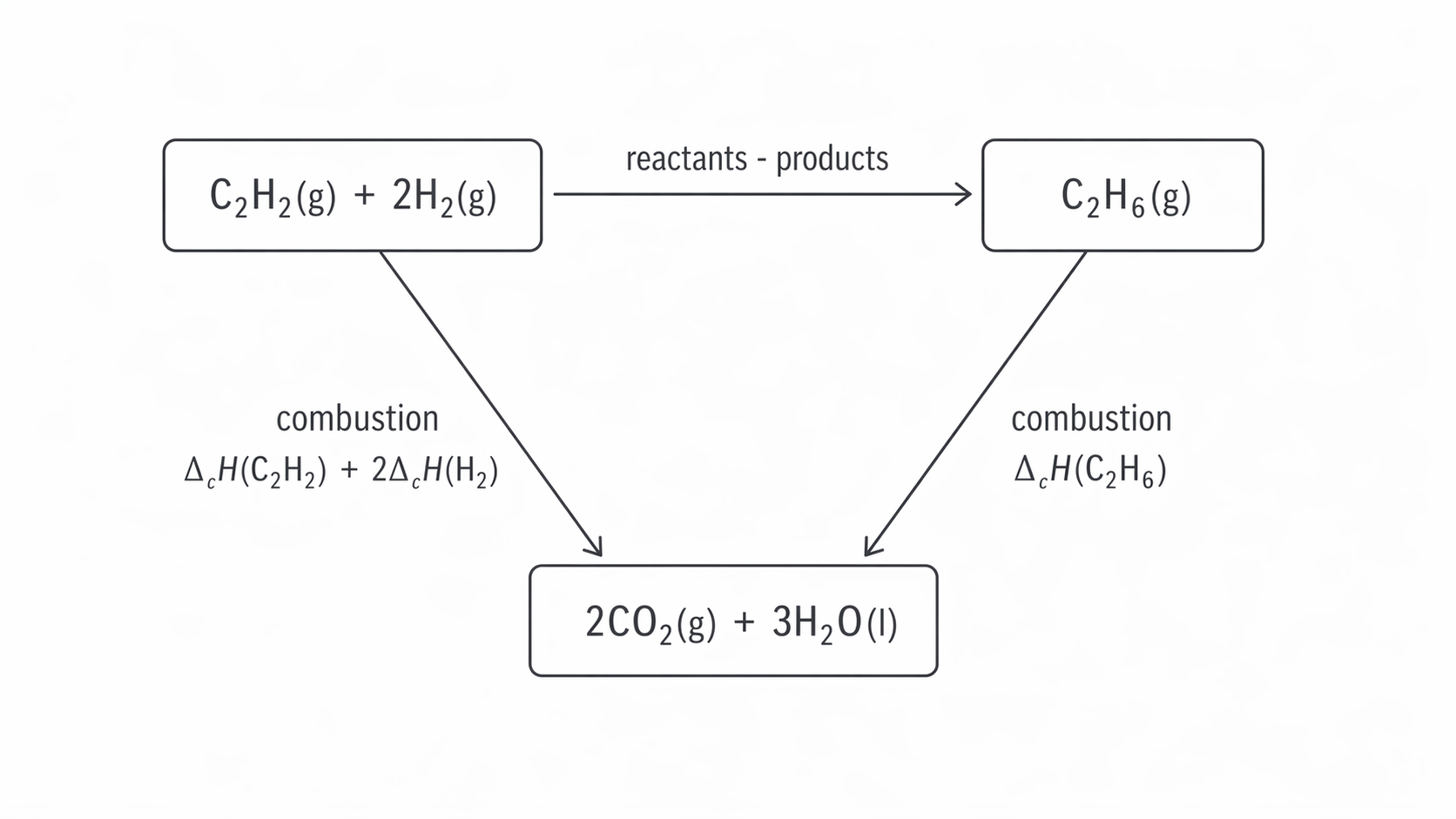
That order matters. You go down from the reactants using tabulated combustion values, then back up to the products by reversing the product combustion arrow.
The diagram below shows the same target reaction as a combustion cycle. Both sides burn to the same final combustion products, and the hydrogen combustion value is counted twice because the balanced equation contains 2H2(g).
[DIAGRAM: asset_name: 1.4.3 - Applications of Hess's Law - Diagram 3; asset_slug: 1.4.3 - Applications of Hess's Law - Diagram 3; recommended_method: retained_png; description: Monochrome Hess cycle for C2H2(g) + 2H2(g) -> C2H6(g) using standard enthalpies of combustion. Place C2H2(g) + 2H2(g) at the top left, C2H6(g) at the top right, and 2CO2(g) + 3H2O(l) at the bottom. Show combustion arrows from both top states down to the common combustion products, with the left route representing ΔcH(C2H2) + 2ΔcH(H2) and the top route labelled reactants - products.]
Worked example:
Use , , and in kJ mol^{-1}.
First find the total for the reactants:
Then subtract the total for the products:
Again the answer is -313 kJ mol^-1, exactly as Hess's law predicts. You still need to multiply by the stoichiometric coefficient, and the subtraction order must stay as written. Oxygen may appear on both sides of the cycle, but it does not change the result because it starts and finishes in the same state.
When both formation data and combustion data are available, either route should lead to the same final value for the same target reaction.
A Reliable Method
To solve a Hess's law calculation, use the same sequence every time:
- Write and balance the target equation with state symbols.
- Decide whether the data are formation values or combustion values.
- Multiply each tabulated value by the coefficient in the target equation.
- For formation data, use products minus reactants.
- For combustion data, use reactants minus products.
- Check the sign and give the final answer in
kJ mol^-1.
The diagram method should tell the same story as the shortcut equations. The shortcut is faster, but the cycle makes sign changes easier to see because reversed arrows stand out clearly. If your arithmetic seems right but the sign looks surprising, go back to the cycle and trace the route again.
That one-line sign change is a small version of the same rule behind every Hess's law calculation. If you keep the equation balanced, attach the correct sign to each step, and use the right subtraction order for the data set you were given, the whole calculation becomes very methodical.