3.1.2.3 - The Ideal Gas Equation
The ideal gas equation links together four measurable properties of a gas: pressure, volume, temperature, and amount of substance. It turns a gas sample into something you can calculate with, provided each value is written in the correct unit. This lesson focuses on using pV = nRT accurately, with all values in SI units.
What the equation means
The ideal gas equation is a single equation that connects pressure, volume, temperature, and moles for a gas:
Ideal gas equation
The ideal gas equation is pV = nRT, which relates the pressure, volume, temperature, and amount in moles of a gas when the variables are written in SI units.
The symbolic form is short, but each symbol must be interpreted with care.
Ideal Gas Equation
In this equation:
p= pressure in pascals,PaV= volume in cubic metres,m^3n= amount of gas in moles,molR= gas constantT= temperature in kelvin,K
One useful boundary to remember is that you do not need to memorise the value of R. If a calculation needs it, the value will be given.
This equation is especially useful because it gives a good model for many gases, especially at ordinary temperatures and pressures, provided you use the correct units and substitute carefully. It is still an idealised model, so you should not treat it as exact for every gas under all conditions.
The SI unit conversions that matter
Most mistakes with the ideal gas equation happen before the calculation even begins. The algebra may be right, but if the values are not in SI units, the final answer will be wrong.
SI units
SI units are the standard scientific units used in calculations. For the ideal gas equation, these are Pa, m^3, mol, and K.
The three conversions you need most often are:
- pressure:
kPatoPaby multiplying by1000 - volume:
dm^3tom^3by dividing by1000 - volume:
cm^3tom^3by multiplying by1.0 x 10^-6 - temperature:
degrees CtoKby adding273
These unit choices are not arbitrary. R is usually given in J K^-1 mol^-1, and 1 J = 1 Pa m^3, so using Pa, m^3, mol, and K keeps the units on both sides of pV = nRT consistent.
Worked example:
A gas has pressure 95.0 kPa, volume 250 cm^3, and temperature 27 degrees C.
p = 95.0 kPa = 95 000 PaV = 250 cm^3 = 250 x 10^-6 m^3 = 2.50 x 10^-4 m^3T = 27 degrees C = 300 K
The diagram below summarises the unit conversions you should check before substituting values into pV = nRT.
[DIAGRAM: asset_name: 1.2.3 - The Ideal Gas Equation - Diagram 1; asset_slug: 1.2.3 - The Ideal Gas Equation - Diagram 1; recommended_method: retained_png; description: A 16:9 landscape SI-unit conversion checklist for pV = nRT with a centred header box Use SI units in pV = nRT above three evenly spaced vertical panels labelled pressure, volume, and temperature. In the pressure panel show kPa x 1000 -> Pa and the example 95.0 kPa -> 95 000 Pa. In the volume panel show dm^3 / 1000 -> m^3, cm^3 x 1.0 x 10^-6 -> m^3, and the example 250 cm^3 -> 2.50 x 10^-4 m^3. In the temperature panel show degrees C + 273 -> K and the example 27 degrees C -> 300 K. Add a footer note Check units before rearranging or substituting. Use white background, thin grey lines, light sans-serif labels, and a clean uncluttered revision-card layout.]
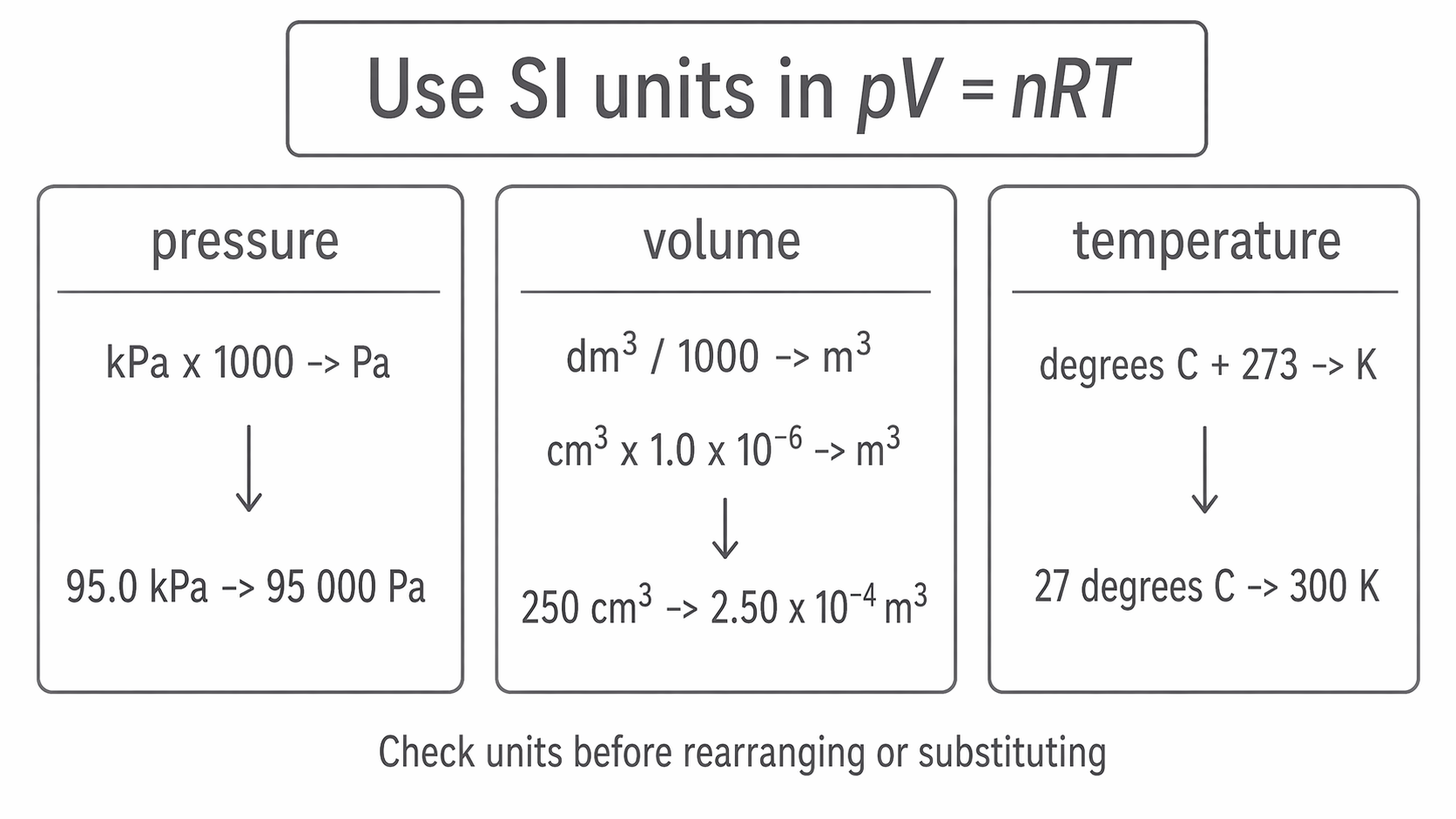
The best habit is to rewrite every value in SI units before rearranging the equation or reaching for a calculator.
Finding the number of moles
A very common use of the equation is to calculate the amount of gas present. To do that, rearrange the equation so that n is the subject:
This is a good place to work methodically:
- convert all values into SI units
- write the rearranged equation
- substitute with units
- give the answer to a sensible number of significant figures
Worked example:
Calculate the number of moles of gas in 500 cm^3 at 100 000 Pa and 25 degrees C.
First convert the units:
V = 500 cm^3 = 5.00 x 10^-4 m^3T = 25 degrees C = 298 K
Now substitute into the equation:
The step students most often miss is the volume conversion. 500 cm^3 is not 0.500 m^3; it is 5.00 x 10^-4 m^3.
This reflection matters because the chemistry is usually simple here, but one careless unit slip changes the whole answer.
Rearranging for volume or pressure
The same equation can be rearranged for other quantities. For example:
and
This means the ideal gas equation can be used to find:
- the volume occupied by a known amount of gas
- the pressure exerted by a known amount of gas
- the number of moles present in a measured sample
If the pressure stays the same, increasing temperature increases volume. If the volume stays the same, increasing temperature increases pressure. The equation helps you calculate those changes rather than just describing them.
Worked example:
Find the volume of 0.250 mol of gas at 300 K and 1.00 x 10^5 Pa.
So the gas occupies 6.23 x 10^-3 m^3, which is 6.23 dm^3.
If pressure is the unknown, rearrange to p = nRT/V and check the volume is in m^3 before substituting.
Worked example:
Find the pressure of 0.200 mol of gas at 300 K in 5.00 dm^3.
First convert the volume:
V = 5.00 dm^3 = 5.00 x 10^-3 m^3
Now substitute into the equation:
So the pressure is 9.97 x 10^4 Pa, which is about 1.00 x 10^5 Pa.
In the ideal gas equation, two habits matter most: choose the correct rearrangement and make sure every substituted value is in SI units.
You can treat that as a checklist to run through before pressing =.
These calculations are usually short, but they reward disciplined method. If you choose the correct rearrangement and keep the units visible throughout, the result is usually very dependable.