3.1.4.2 - Calorimetry
Calorimetry lets you estimate an enthalpy change from something you can measure directly: a temperature change in a substance of known mass. The heart of the topic is learning what q = mcΔT is really telling you, then linking that energy change to the amount of reaction that took place. Once that link is clear, the calculations stop feeling like a recipe and start feeling like a description of energy flow.
What q = mcΔT actually measures
The equation q = mcΔT links the energy transferred to a substance with the temperature change you observe. In practice, that substance is often water or a reaction mixture in a cup calorimeter. If the temperature rises, that substance has gained energy. If the temperature falls, it has lost energy.
Specific Heat Capacity
Specific heat capacity is the energy needed to raise the temperature of 1 g of a substance by 1 K.
That definition explains the units in the equation. m is the mass of the substance whose temperature changes, in grams. c is the specific heat capacity, usually given in J g^-1 K^-1. ΔT is the temperature change, found from final temperature - initial temperature. For temperature changes, a rise of 1 K is the same size as a rise of 1 °C, so you can use either scale for ΔT.
Calorimetry Equation
Here, the value of c is usually supplied, so the important thing is using it correctly rather than memorising it. A very common value is 4.18 J g^-1 K^-1 for water or dilute aqueous solutions.
Suppose 100.0 g of water warms by 5.0 K and c = 4.18 J g^-1 K^-1. Then
That is the energy transferred to the water. The equation is simple, but it only works if the mass, units, and temperature difference are all chosen carefully.
From heat change to molar enthalpy change
In calorimetry, q is only the first step. To find a molar enthalpy change, you then need to work out how many moles of reaction that energy change corresponds to.
Molar Enthalpy Change
The molar enthalpy change is the enthalpy change when the amounts of reactants shown in the balanced equation react, expressed in kJ mol^-1.
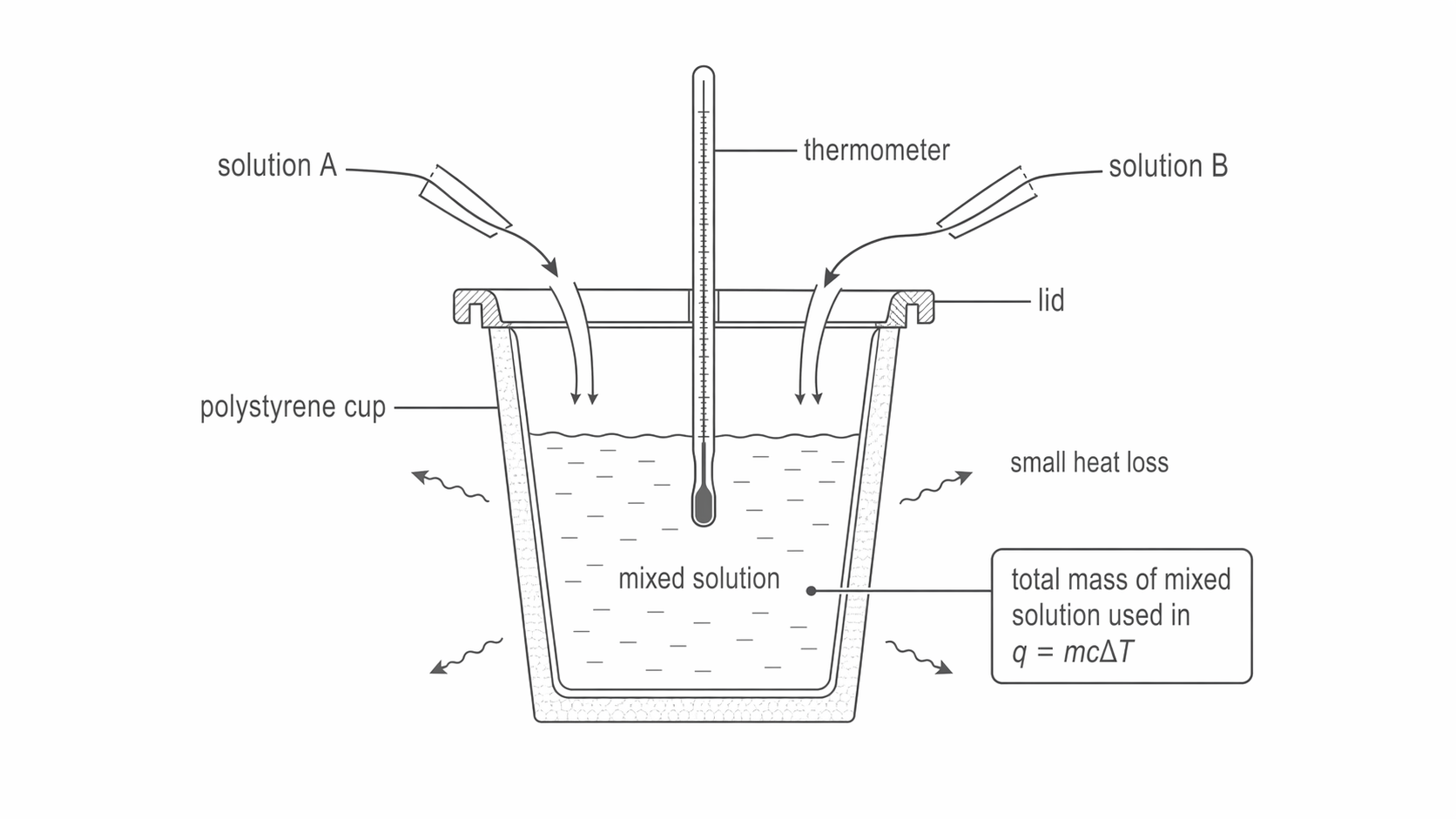
For reactions in solution, the mass is usually taken from the total volume mixed, because dilute solutions have a density close to 1.0 g cm^-3. So 50.0 cm^3 of acid mixed with 50.0 cm^3 of alkali is treated as 100.0 g of solution. That total mass is used in q = mcΔT, not the volume of just one reactant.
If the reaction is exothermic, the solution gets warmer. The measured q for the solution is positive because the solution gained energy, but the enthalpy change of the reaction is negative because the reaction released that energy. A reliable method is:
- calculate
q - convert to kJ if needed
- find the number of moles reacting from the balanced equation
- apply the sign that matches the reaction
Worked example:
40.0 cm^3 of 1.50 mol dm^-3 hydrochloric acid is mixed with 40.0 cm^3 of 1.50 mol dm^-3 sodium hydroxide. The temperature rises by 10.0 K. Take c = 4.18 J g^-1 K^-1.
Mass of solution = 80.0 g
Reaction:
Moles of HCl reacting:
The alkali is also 0.0600 mol, so the reaction as written occurs for 0.0600 mol.
The diagram below shows a simple cup calorimeter and highlights why the total mass of the mixed solution is used in the calculation.
[DIAGRAM: asset_name: 1.4.2 - Calorimetry - Diagram 1; asset_slug: 1.4.2 - Calorimetry - Diagram 1; recommended_method: retained_png; description: Monochrome polystyrene cup calorimeter shown in section with a lid and thermometer. Two aqueous solutions labelled solution A and solution B are shown entering and mixing inside the cup, the liquid is labelled mixed solution, small arrows show limited heat loss to the surroundings, and a callout on the liquid states that the mass used in q = mcΔT is the total mass of the mixed solution.]
Notice the three key details here: the total mass was used, the moles came from the balanced equation, and the final answer was given a negative sign because the reaction was exothermic.
Related calculations and details that matter
The same equation can be rearranged for related calculations. For example,
That rearrangement lets you find the temperature rise produced by a known energy change, or the mass of water needed to absorb a certain amount of energy. The chemistry does not change; only the subject of the equation changes.
A few details are worth checking every time:
- Use the mass of the substance whose temperature changes.
- Treat
cm^3as g only when the solution can reasonably be taken to have a density of about1.0 g cm^-3. - Keep energy units consistent. If
qis in joules and your answer needskJ mol^-1, divide by1000before or after the mole step. - Match the sign to the reaction: exothermic means negative
ΔH, endothermic means positiveΔH.
In real experiments, some energy escapes to the surroundings, so measured values are often less exothermic than the true value. That does not change the calculation method, but it does explain why experimental results may differ from data-book values.
If you can identify the correct mass, calculate q, find the relevant number of moles, and then choose the correct sign, you have covered the core skill of this topic. That same routine works for a cup calorimeter, for burning a fuel, or for a rearranged version of the equation.