3.1.5.1 - Collision Theory
Collision theory explains reaction rate by focusing on what happens when particles meet. A reaction does not happen just because particles are present near each other: they must actually collide, and that collision has to be good enough to start chemical change. In this lesson, we will pin down what activation energy means and why most collisions still fail to produce products.
Collisions Must Cross an Energy Barrier
Particles in a gas or solution are moving all the time, so collisions happen constantly. However, a chemical reaction only starts when a collision supplies enough energy for bonds in the reactants to begin breaking. Until that barrier is crossed, the particles simply separate again as unchanged reactants.
Activation energy
Activation energy is the minimum energy that colliding particles must have for a reaction to occur.
The wording matters because activation energy is not just any energy involved in a reaction. It is the minimum energy carried by colliding particles so that the reaction can begin.
The diagram below contrasts a collision that does not overcome the activation energy with one that does.
[DIAGRAM: asset_name: 1.5.1 - Collision Theory - Diagram 1; asset_slug: 1.5.1 - Collision Theory - Diagram 1; recommended_method: retained_png; description: Wide two-panel collision-theory diagram in a simple monochrome particle model. Left boxed panel labelled "Below activation energy" shows a left-to-right sequence where particle A and particle B move together, collide, and then bounce apart unchanged, ending with the label "no reaction". Right boxed panel labelled "At or above activation energy" shows particle A and particle B moving together, colliding, and forming a joined AB product particle, ending with the label "reaction occurs". Include clear motion arrows in both panels.]
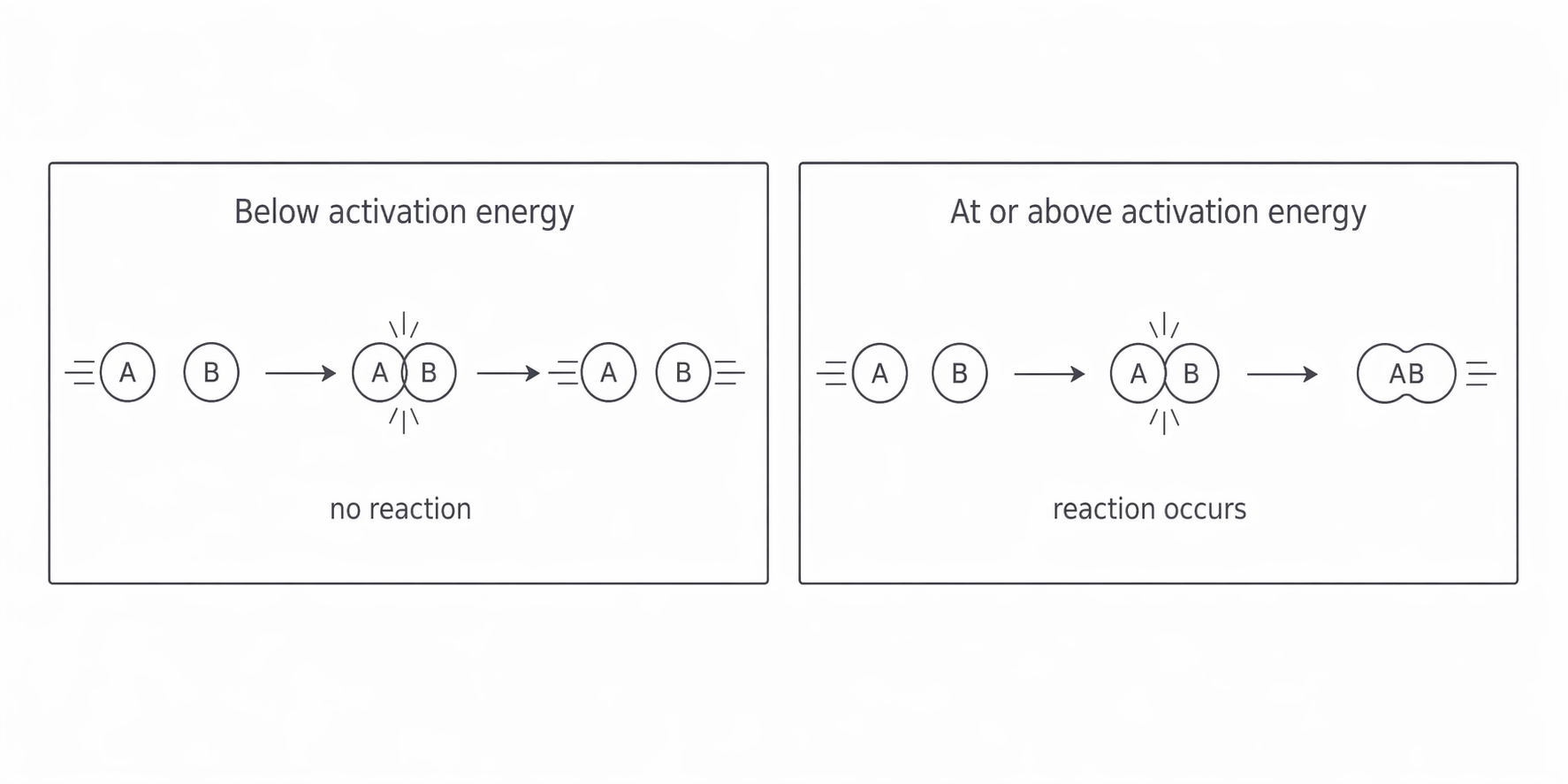
You can think of activation energy as the threshold that separates ordinary collisions from successful ones. If the particles do not reach that threshold, the collision may still happen, but no chemical change follows.
Why Most Collisions Do Not Lead to Reaction
Most collisions fail for one of two reasons. The first is that the particles do not have enough energy. In that case, the collision is too weak to start breaking the bonds that must be broken before new ones can form.
The second reason is orientation. In many reactions, especially those involving molecules, the particles must hit in a suitable arrangement. If the reactive parts of the molecules do not line up properly, the collision will not lead to products even if the particles have enough energy.
This means that a successful collision needs both conditions at once:
- enough energy to overcome the activation energy
- the correct orientation so the reacting parts meet properly
That is why "particles collide" is not the same as "particles react". A beaker can contain millions of collisions each second, but only a fraction of them are successful collisions.
To explain this fully, include both ideas: many collisions are too weak to start bond breaking, and some are simply badly aligned.
Linking Activation Energy to Reaction Success
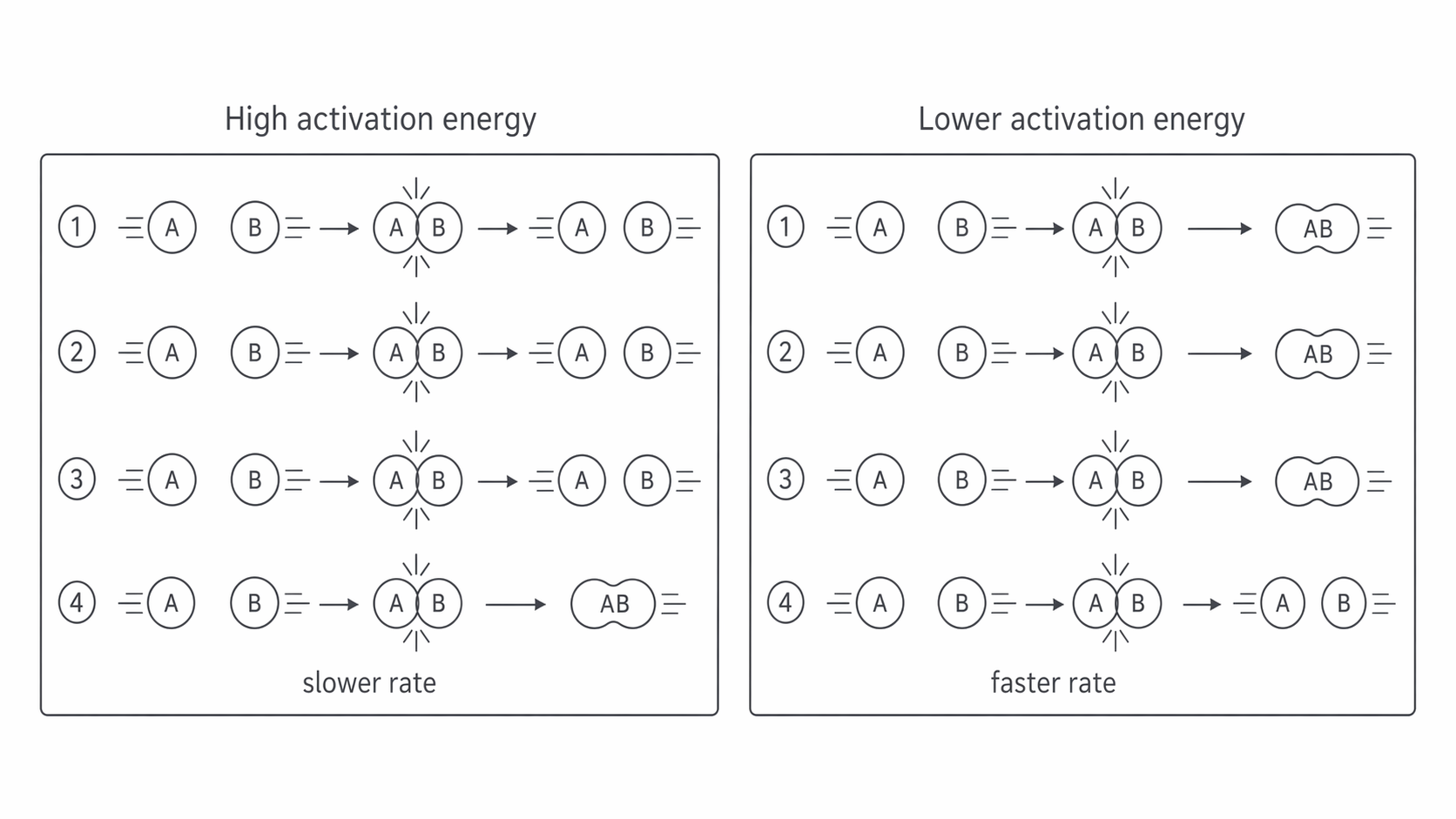
Collision theory also helps explain why some reactions are fast and others are slow. If the activation energy is high, only a small proportion of collisions will have enough energy to be successful. If the activation energy is lower, a larger proportion of collisions can lead to reaction under the same conditions.
The important idea is that reaction rate depends on the number of successful collisions, not just the total number of collisions. A reaction can involve frequent collisions but still be slow if most of those collisions do not overcome the activation energy or happen in the wrong orientation.
The diagram below compares the same collision frequency in two cases, showing why a lower activation energy gives more successful collisions.
[DIAGRAM: asset_name: 1.5.1 - Collision Theory - Diagram 2; asset_slug: 1.5.1 - Collision Theory - Diagram 2; recommended_method: retained_png; description: Wide two-panel particle-model comparison showing the same collision frequency in both cases. Left boxed panel labelled "High activation energy" contains four numbered collision attempts; in three attempts A and B collide and separate unchanged, and in only one attempt they form a joined AB product. Right boxed panel labelled "Lower activation energy" also contains four numbered collision attempts; in three attempts A and B form a joined AB product and in only one attempt they separate unchanged. Add the short captions "slower rate" under the high-activation-energy panel and "faster rate" under the lower-activation-energy panel.]
This also helps with a common misconception. A reaction may release energy overall, but it still needs an initial collision with enough energy to get started. Activation energy is about starting the reaction, not about whether the reaction is exothermic or endothermic.
Keep the core picture in focus: activation energy is a precise threshold, and failed collisions usually come down to energy, orientation, or both.