3.1.1.1 - Fundamental Particles
Chemists did not discover the structure of the atom in one step. The model changed as new evidence appeared, and each new model explained observations better than the one before it. In this lesson, you will learn how atomic ideas developed, what the three fundamental particles are, and how they are arranged inside an atom.
How atomic models changed
Chemistry depends on models, and a model is only kept while it matches the evidence. Early scientists thought atoms were tiny indivisible particles, but later experiments showed that atoms contain smaller particles.
One useful sequence to remember is:
- Dalton: atoms exist and are different for different elements.
- Thomson: atoms contain negatively charged electrons.
- Thomson's plum pudding model: electrons were embedded in a sphere of positive charge.
- Rutherford: most of the mass and all the positive charge are concentrated in a tiny central nucleus.
- Chadwick: the nucleus also contains neutrons.
The important idea is that scientific knowledge changes when better evidence appears. The exact historical detail matters less than the pattern: an older model survives only until observations force a better one.
Plum pudding model
An early atomic model in which electrons were thought to be embedded within a sphere of positive charge.
The diagram below summarises the main stages in this change and the key structural idea added at each step.
[DIAGRAM: asset_name: 1.1.1 - Fundamental Particles - Diagram 1; asset_slug: 1.1.1 - Fundamental Particles - Diagram 1; recommended_method: retained_png; description: A clean horizontal timeline of atomic models with four evenly spaced stages labelled Dalton, Thomson, Rutherford, and Chadwick. Show Dalton as a plain solid sphere; Thomson as a plum pudding sphere of positive charge with embedded electrons; Rutherford as a tiny dense central nucleus with electrons outside and mostly empty space; and Chadwick as electrons outside a nucleus containing both protons and neutrons. Connect the stages with thin arrowed timeline lines and keep labels short.]
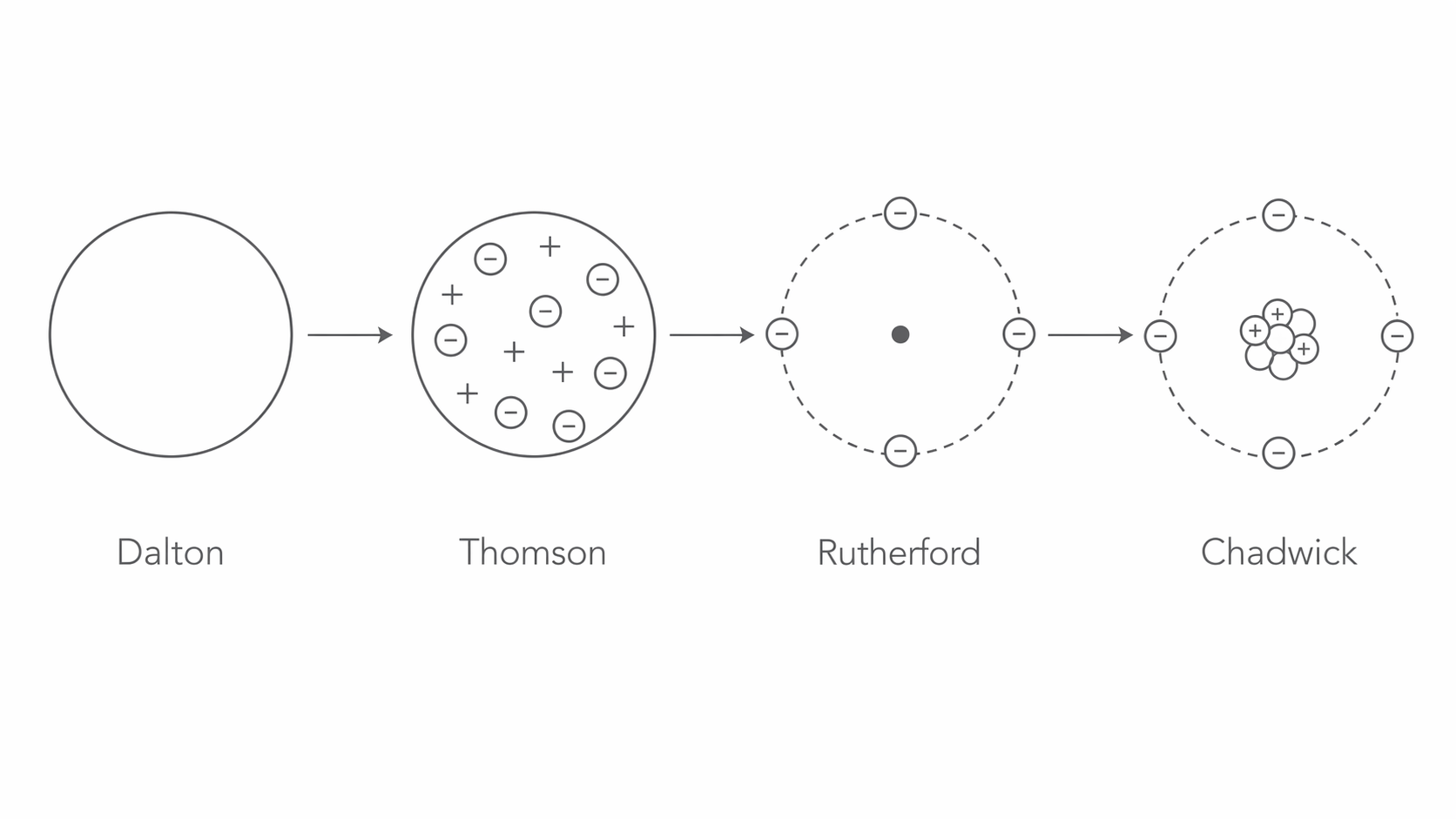
Rutherford's work was especially important because it showed that the atom is mostly empty space, with a very small nucleus at the centre. That was a major change from the plum pudding model, which spread positive charge throughout the atom.
The three fundamental particles
Atoms are made from three fundamental particles: protons, neutrons, and electrons. To describe atomic structure clearly, you need their relative charges and relative masses accurately.
Proton
A positively charged sub-atomic particle found in the nucleus, with relative charge +1 and relative mass 1.
The proton gives the nucleus its positive charge. Because its relative mass is 1, it makes a major contribution to the mass of the atom.
Neutron
A sub-atomic particle found in the nucleus with no charge, relative charge 0, and relative mass 1.
Neutrons add mass to the nucleus but do not affect the charge of the atom.
Electron
A negatively charged sub-atomic particle found outside the nucleus, with relative charge -1 and relative mass 1/1840.
Electrons have a much smaller mass than protons and neutrons, so almost all of the atom's mass is concentrated in the nucleus.
| Particle | Relative charge | Relative mass | Position |
|---|---|---|---|
| Proton | +1 | 1 | In the nucleus |
| Neutron | 0 | 1 | In the nucleus |
| Electron | -1 | 1/1840 | Outside the nucleus |
For mass, think proton = 1, neutron = 1, electron = tiny. For charge, think proton = +1, neutron = 0, electron = -1.
A common mistake is to mix up charge and mass. The electron has charge -1, but its relative mass is not -1. Charge and mass are different properties and must be learned separately.
How the particles are arranged in an atom
The arrangement of the particles matters just as much as knowing their names. Protons and neutrons are packed together in the nucleus at the centre of the atom. Electrons are found outside the nucleus.
That means an atom has two very different regions:
- a tiny central nucleus containing almost all of the mass
- electrons surrounding the nucleus
The diagram below pulls those two regions together in one simple picture.
[DIAGRAM: asset_name: 1.1.1 - Fundamental Particles - Diagram 2; asset_slug: 1.1.1 - Fundamental Particles - Diagram 2; recommended_method: retained_png; description: A simple atom diagram with a compact central nucleus and several electrons outside it. Within the nucleus, label one proton and one neutron. Add thin leader-line labels identifying the nucleus, that positive charge is concentrated in the nucleus, and that almost all the mass is in the nucleus, and label one outer particle as an electron.]
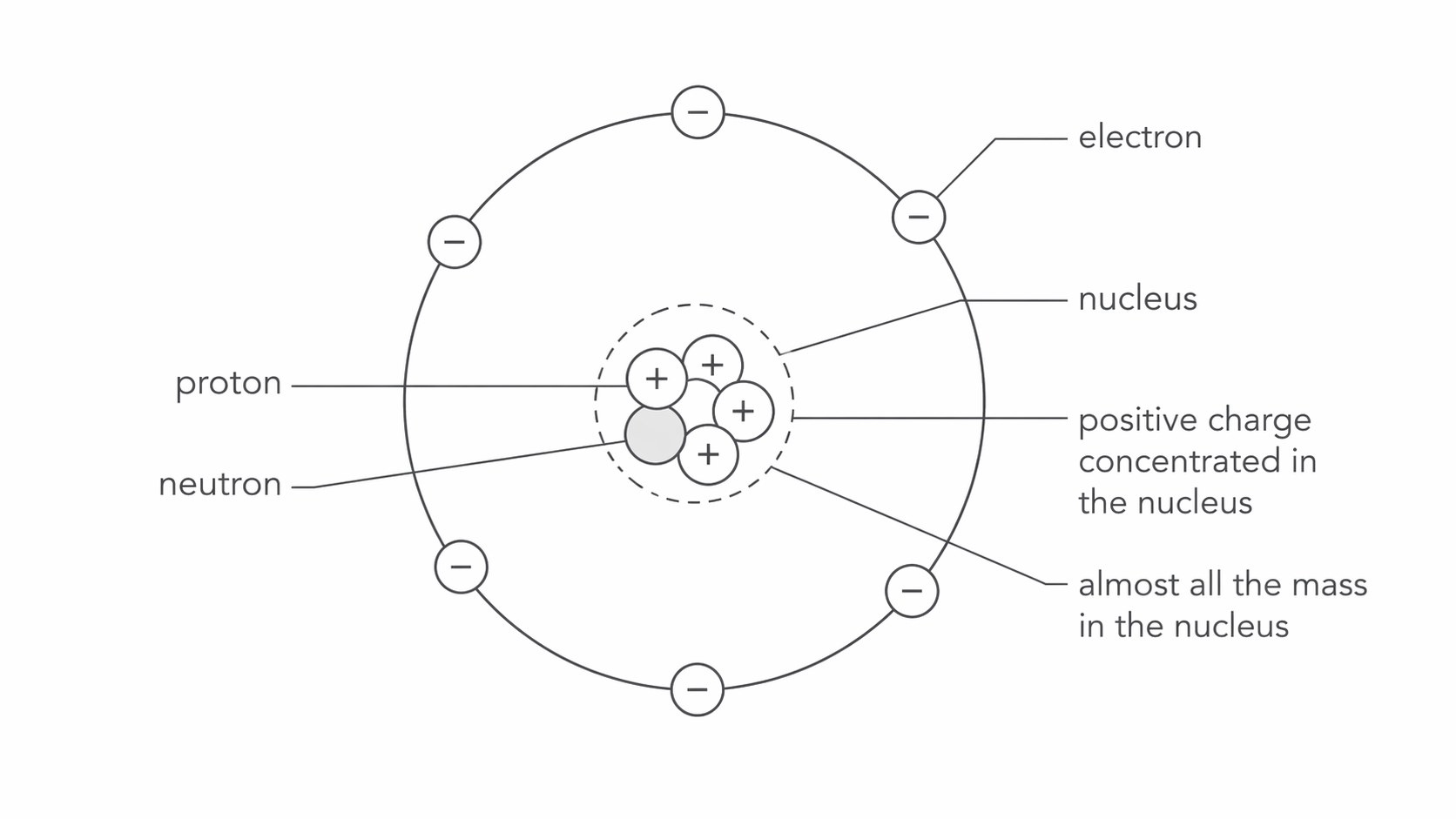
In a neutral atom, the number of protons equals the number of electrons. This is because the positive charge of each proton is equal in size and opposite in sign to the negative charge of each electron. If the numbers are equal, the charges cancel overall.
Worked example: a neutral atom has 8 protons. Its total positive charge is +8 in relative terms, so it must also have 8 electrons to give a total negative charge of -8. The overall charge is then 0.
Students sometimes say that neutrons "balance" the charge. They do not. Neutrons have no charge, so they affect mass but not the overall charge.
This arrangement also explains why the nucleus is described as dense. The protons and neutrons are all concentrated in a very small region, rather than spread throughout the whole atom.
Using particle facts precisely
Most of the mass of an atom is in the nucleus because protons and neutrons both have relative mass 1, whereas electrons have relative mass 1/1840. That is why it is misleading to think of the mass as spread evenly through the whole atom.
When comparing particles, keep the contrast sharp. For example:
- proton and neutron: same relative mass, different charge
- proton and electron: opposite charges, very different relative masses
- neutron and electron: different charge, very different relative masses, different positions in the atom
The history of the atomic model also makes more sense when you link each change to evidence. It is not enough to say that scientists changed their minds; the key point is that new experimental evidence showed the earlier model was incomplete, so a better model was developed.
By the end of this topic, you should be able to picture a small nucleus containing protons and neutrons, with electrons outside it, and you should be able to recall the relative charge and relative mass of all three particles without hesitation.