3.1.1.2 - Mass Number and Isotopes
This lesson links simple atomic structure to one of chemistry's most useful analytical tools. Particle counts, isotope notation, and mass spectra are different ways of describing the same atoms, so the ideas make most sense when you connect them. By the end, you should be able to explain isotopes, work out the particles in atoms and ions, and use simple mass spectra to identify elements and calculate relative atomic mass.
Counting particles correctly
Atoms are described by two important numbers. The atomic number, also called the proton number, tells you how many protons are in the nucleus. The mass number tells you the total number of protons and neutrons in the nucleus.
Atomic number
The atomic number, , is the number of protons in the nucleus of an atom.
The atomic number fixes the identity of the element. Any particle with 6 protons is carbon; any particle with 8 protons is oxygen. Changing the number of neutrons does not change the element, but changing the number of protons does.
Mass number
The mass number, , is the total number of protons and neutrons in the nucleus.
From these definitions:
- number of protons = atomic number
- number of neutrons = mass number - atomic number
- number of electrons = number of protons for an atom, then adjusted for any charge on an ion
For ions, remember that charge comes from gaining or losing electrons only. The nucleus does not change when a simple ion forms. For example, an ion has 13 protons, 14 neutrons, and 10 electrons.
The diagram below shows how each part of the nuclide notation tells you something different about the ion.
[DIAGRAM: asset_name: 1.1.2 - Mass Number and Isotopes - Diagram 1; asset_slug: 1.1.2 - Mass Number and Isotopes - Diagram 1; recommended_method: retained_png; description: Standard nuclide notation for an aluminium ion, with Al in the centre, 27 as the left superscript, 13 as the left subscript, and 3+ as the right superscript. Add thin leader lines labelling mass number, atomic number, element symbol, and ionic charge.]
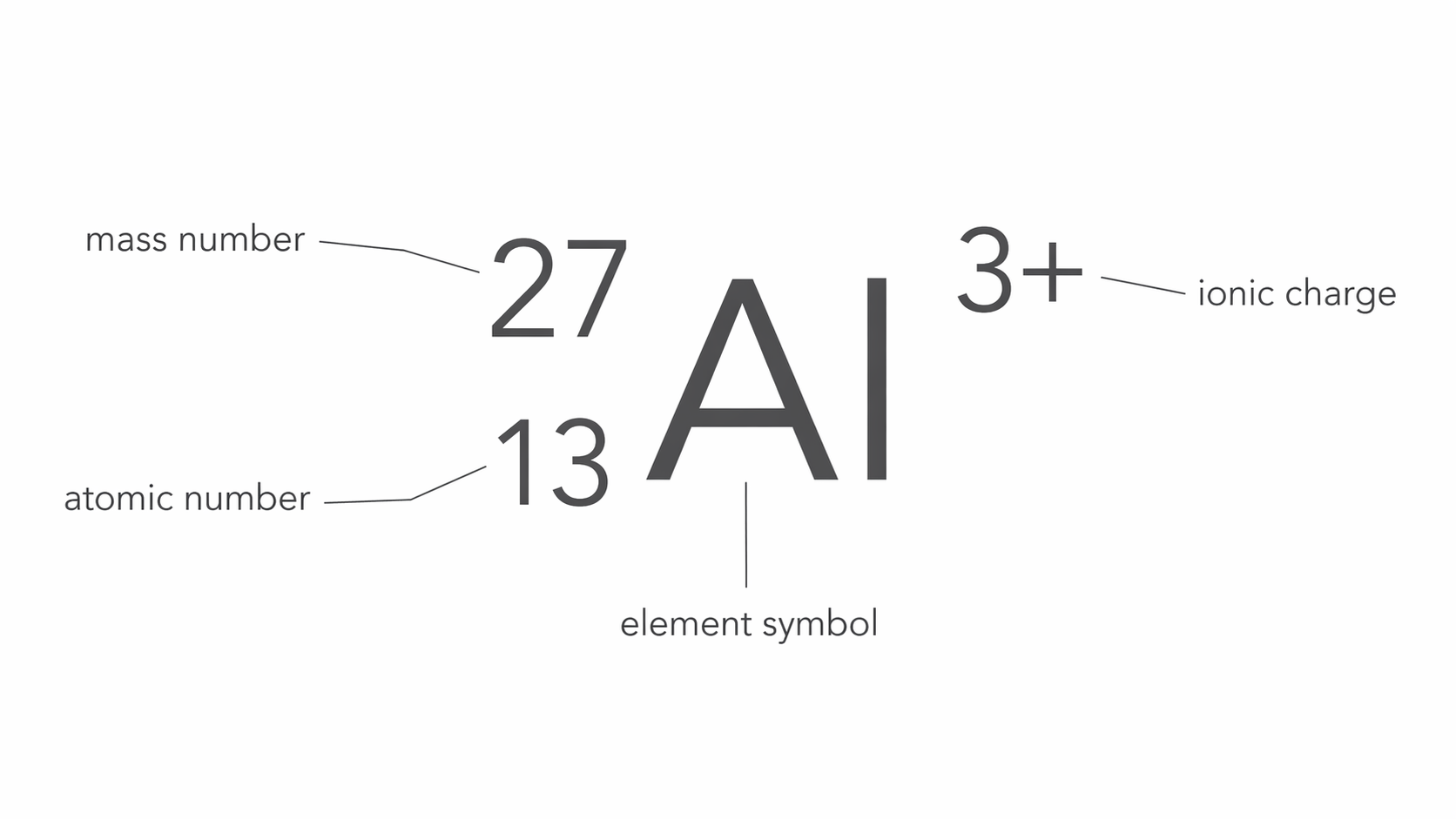
One common mistake is to subtract the ionic charge from the mass number. Do not do that. Charge only changes the electron count.
What isotopes are and why they exist
Isotopes are atoms of the same element with different numbers of neutrons. They have the same atomic number but different mass numbers.
Isotope
Isotopes are atoms of the same element with the same number of protons but different numbers of neutrons.
This happens because nuclei can exist in more than one stable arrangement of protons and neutrons. The proton number must stay the same for the element to stay the same, but the neutron number can vary.
Isotopes of the same element have very similar chemical properties because chemical reactions involve electrons, especially the outer-shell arrangement. Since isotopes of the same element have the same number of electrons, they react in the same way chemically. Their physical properties can differ because their masses are different.
For example, chlorine-35 and chlorine-37 both have 17 protons and 17 electrons, so they take part in bonding in the same way. However, they do not have the same mass, because one has 18 neutrons and the other has 20.
That same logic is why the explanation should mention electron arrangement rather than just saying "they are similar atoms". The chemical behaviour comes from the electrons, not from the neutron number.
The simple time of flight mass spectrometer
Mass spectrometry allows chemists to separate ions by their mass-to-charge ratio, written as . In this part of the course, you only need the simple time of flight model.
Mass-to-charge ratio
The mass-to-charge ratio, , is the mass of an ion divided by its charge.
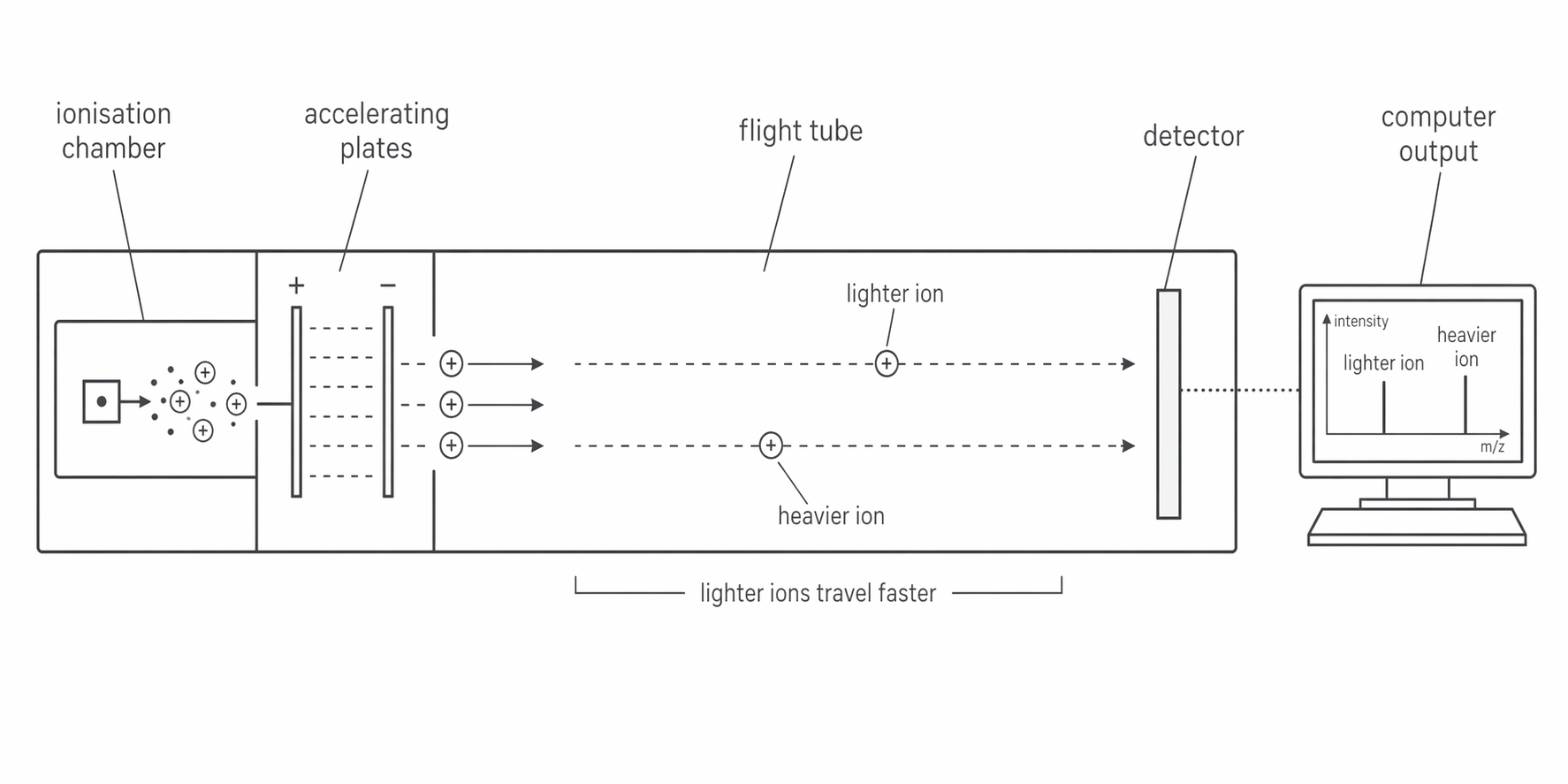
In a simple TOF mass spectrometer, the sequence is:
- ionisation
- acceleration
- ion drift
- detection
- data analysis
The sample is first ionised to form positive ions. For atoms, this often means each atom loses one electron to form a ion. The ions are then accelerated by an electric field so that all ions are given the same kinetic energy.
This point matters. If all ions have the same kinetic energy, lighter ions must move faster than heavier ions:
The ions then pass into the flight tube and drift toward the detector. Because lighter ions travel faster, they reach the detector sooner. When ions hit the detector, they gain electrons and produce a small current. The size of the current depends on how many ions arrive, so it tells us about relative abundance.
The computer uses the flight times and detector signal to produce a mass spectrum. The horizontal axis shows . The vertical axis shows relative abundance.
The diagram below shows the simplified TOF layout and why lower-mass ions reach the detector first.
[DIAGRAM: asset_name: 1.1.2 - Mass Number and Isotopes - Diagram 2; asset_slug: 1.1.2 - Mass Number and Isotopes - Diagram 2; recommended_method: retained_png; description: A left-to-right schematic of a simple time-of-flight mass spectrometer with labelled ionisation chamber, accelerating plates, flight tube, detector, and computer output. Show positive ions moving through the apparatus, with a lighter ion further along the flight tube than a heavier ion at the same moment, and a short label making clear that lighter ions travel faster in the drift region.]
In low-resolution spectra, a singly charged ion has numerically equal to its mass number. That is why isotopes often appear at whole-number positions such as 20 and 22 for neon. More precisely, the instrument is measuring relative isotopic mass, which is not always an exact whole number.
Reading elemental mass spectra
Each isotope of an element produces a separate peak because each isotope has a different mass. The position of the peak tells you the value, and the height or area of the peak tells you the relative abundance.
This means a mass spectrum can identify an element. An element has a characteristic isotopic pattern. For example, chlorine has peaks at and in about a ratio. That pattern is distinctive.
Relative atomic mass
Relative atomic mass, , is the weighted mean mass of an atom of an element compared with one twelfth of the mass of an atom of carbon-12.
To calculate from a simple elemental spectrum, use a weighted average:
This method is limited here to mononuclear ions, meaning each ion contains just one atom.
Worked example: A sample of neon gives peaks at 20 and 22 with relative abundances 90 and 10.
The answer is not 21, because there are far more atoms of neon-20 than neon-22.
When you interpret a spectrum, always link the peak positions to isotopes and the peak sizes to abundance. Students often describe the tallest peak as the heaviest isotope, but that is not always true. The tallest peak is simply the most abundant isotope.
Molecular ions and relative molecular mass
Mass spectrometry is also useful for finding relative molecular mass, . If a molecule forms a molecular ion with a charge of , its value is usually equal to its relative molecular mass.
Relative molecular mass
Relative molecular mass, , is the weighted mean mass of a molecule compared with one twelfth of the mass of an atom of carbon-12.
For an elemental sample, peaks usually come from isotopic ions of atoms. For a molecular sample, there may also be a molecular ion peak from the whole molecule. That peak can be used to determine .
Chlorine provides a helpful pattern. Because chlorine has two common isotopes, and , chlorine molecules can form three molecular-ion combinations:
- at
- at
- at
These peaks appear in a predictable ratio because the isotopes have different abundances. Even without calculating the exact ratio, the cluster of peaks helps identify chlorine-containing molecules.
Mass spectrometers are carried on space probes and used in forensic laboratories because the pattern of peaks acts like a fingerprint. A chemist can use those peaks to identify elements present in a sample and, for molecules, estimate the relative molecular mass.
When you read a spectrum, first decide whether the sample is an element or a molecule. That tells you whether to think about isotopic peaks of atoms, or a molecular-ion peak that can be used to read off .
This kind of pattern recognition is powerful because it lets you move from raw peaks to a chemical conclusion very quickly.
Mass spectra connect atomic structure to real data: peak position tells you , peak size tells you abundance, and the full pattern lets you identify isotopes, calculate , and sometimes determine .