1.6.2 Equilibrium constant Kc
gives chemists a numerical way to describe the position of equilibrium. In this lesson, you will build expressions, calculate from equilibrium data, use in further calculations, and predict how temperature changes affect it. The central idea is simple: is a ratio of equilibrium concentrations, and that ratio only changes when the temperature changes.
Building the expression
For this topic, we deal with homogeneous equilibria, where all the reacting species are in the same phase.
Homogeneous system
A homogeneous system is an equilibrium mixture in which all reactants and products are in the same phase.
That means the substances can all be described using concentrations in mol dm^-3, shown by square brackets such as [X].
If the balanced equation is:
aA + bB ⇌ cC + dD
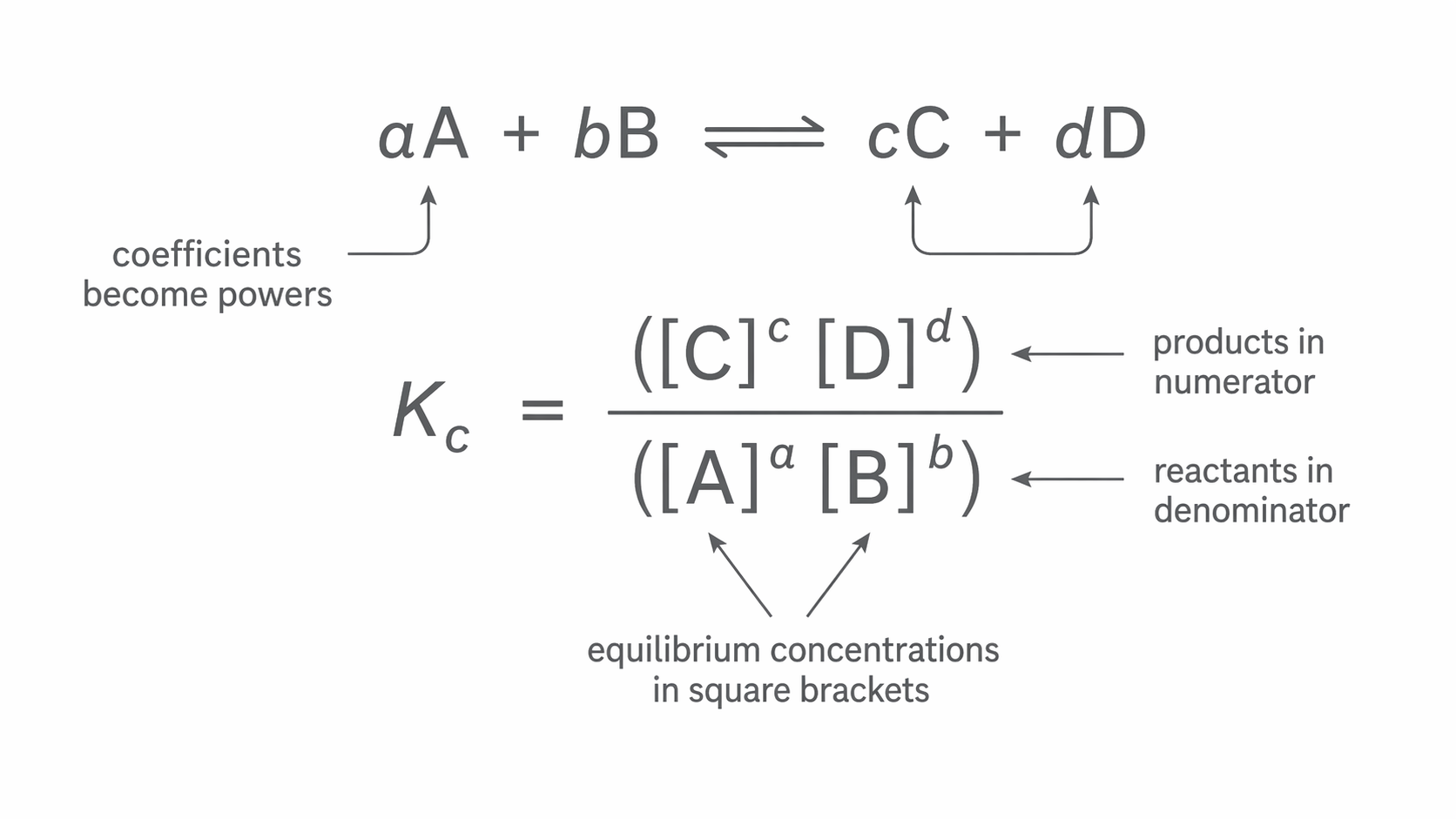
then the equilibrium constant is:
General Kc Expression
There are three details that matter every time:
- use the balanced equation
- use equilibrium concentrations, not starting concentrations
- turn the stoichiometric coefficients into powers
So if a substance has coefficient 2 in the equation, its concentration is squared in the expression. If the coefficient is 1, we usually do not write the power.
The diagram below shows the structure of a expression: products go in the numerator, reactants go in the denominator, and coefficients become powers.
What tells you about equilibrium
is not just a formula to calculate. It also tells you where the equilibrium lies.
Equilibrium constant
The equilibrium constant, , is the constant value of the ratio of equilibrium concentrations of products to reactants for a reversible reaction at a fixed temperature.
Because the expression is always a ratio of products over reactants:
- if is much greater than 1, products predominate and the equilibrium lies to the right
- if is much less than 1, reactants predominate and the equilibrium lies to the left
- if is around 1, appreciable amounts of both reactants and products are present
This does not tell you how fast equilibrium is reached. A large means the equilibrium position favours products, but a slow reaction can still take a long time to get there.
At constant temperature, changing concentration does not change the value of . Instead, the equilibrium position shifts until the ratio returns to the same value. Adding a catalyst also does not change ; it speeds up the forward and reverse reactions by the same proportion, so equilibrium is reached faster but the final ratio is unchanged.
In ester manufacture, removing water as it forms can improve the equilibrium yield of ester. The system shifts right to replace some of the removed water, but the value of at that temperature stays the same.
Calculating from equilibrium concentrations
In calculations like these, the hardest step is often not the substitution. It is finding the equilibrium concentrations correctly before you substitute them.
Worked example:
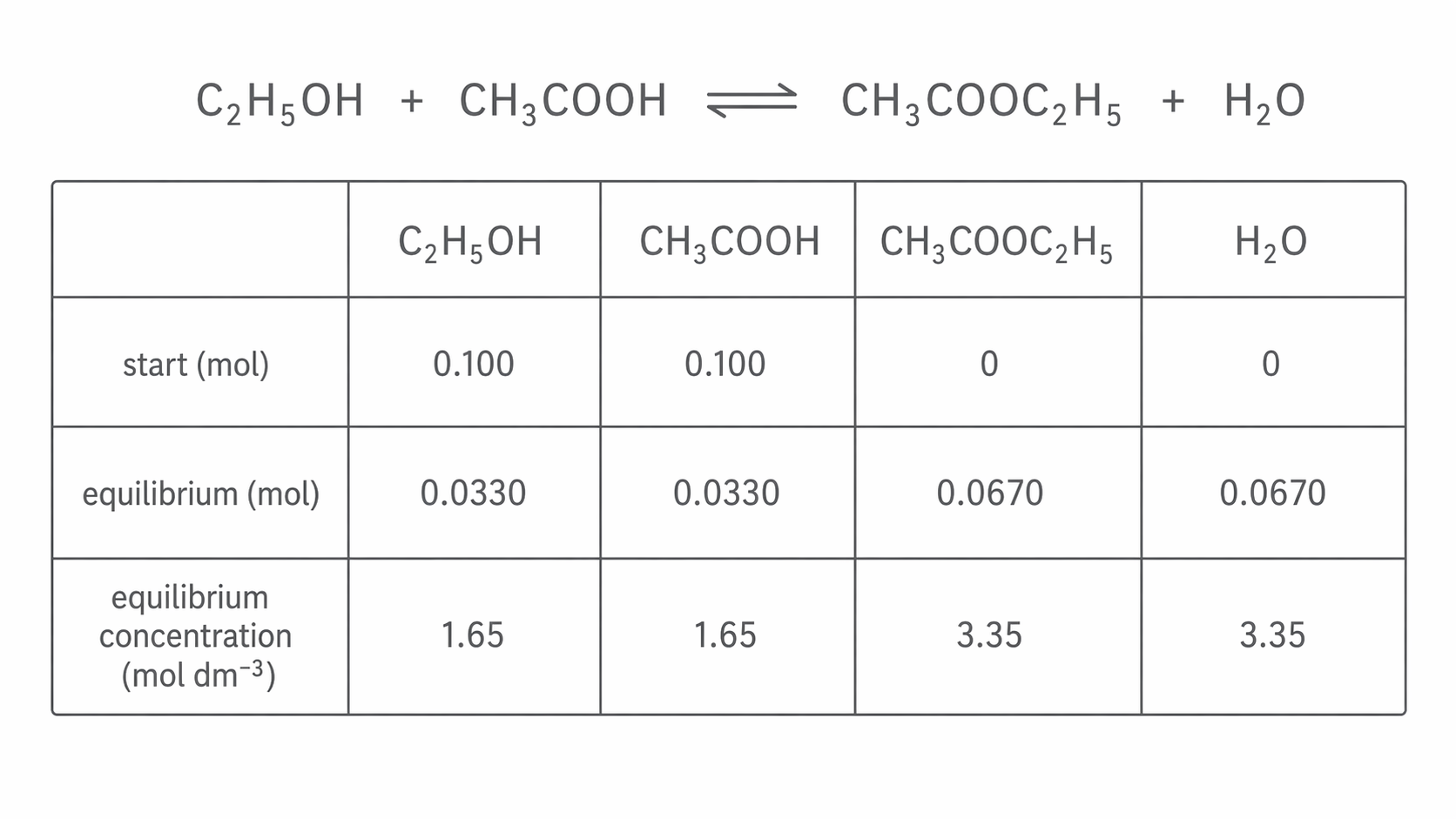
Initially, 0.100 mol of ethanol and 0.100 mol of ethanoic acid are mixed. The total volume is 0.0200 dm^3. At equilibrium, analysis shows that 0.0330 mol of ethanoic acid remains.
Step 1: use the stoichiometry.
Because the equation is 1 : 1 : 1 : 1:
- ethanol remaining =
0.0330 mol - ethanoic acid used =
0.100 - 0.0330 = 0.0670 mol - ester formed =
0.0670 mol - water formed =
0.0670 mol
Step 2: convert equilibrium amounts to equilibrium concentrations.
[C_2H_5OH] = 0.0330 / 0.0200 = 1.65 mol dm^-3[CH_3COOH] = 0.0330 / 0.0200 = 1.65 mol dm^-3[CH_3COOC_2H_5] = 0.0670 / 0.0200 = 3.35 mol dm^-3[H_2O] = 0.0670 / 0.0200 = 3.35 mol dm^-3
Step 3: substitute into the expression.
So to 2 significant figures.
The diagram below organises the worked example into an equilibrium table so you can see the route from starting amounts to equilibrium concentrations clearly.
The units of depend on the equation. You find them by substituting mol dm^-3 into the expression and cancelling. In this esterification example, the units cancel completely, so has no units.
Performing calculations involving
Sometimes you are given and the starting amounts, and you must work out the equilibrium composition. The standard method is to call the change x, write the equilibrium amounts in terms of x, then substitute into the expression.
Worked example:
Initially:
[A] = 1.00 mol dm^-3[B] = 1.00 mol dm^-3[C] = 0[D] = 0
At this temperature, .
Let the equilibrium concentration of C formed be x mol dm^-3. Then:
[A] = 1.00 - x[B] = 1.00 - x[C] = x[D] = x
Substitute into :
Taking the square root gives:
So the equilibrium mixture contains:
[C] = [D] = 0.667 mol dm^-3[A] = [B] = 0.333 mol dm^-3
The chemistry point underneath the algebra is important: a larger pushes the equilibrium mixture toward products, so x ends up greater than the amount left behind as reactant.
Predicting temperature effects on
Temperature is the one change in this topic that really does alter the value of . The direction of the change depends on whether the forward reaction is exothermic or endothermic.
If the forward reaction is exothermic, heat behaves like a product. Increasing temperature favours the endothermic reverse reaction, so the equilibrium shifts left and decreases. Decreasing temperature favours the exothermic forward reaction, so the equilibrium shifts right and increases.
If the forward reaction is endothermic, heat behaves like a reactant. Increasing temperature favours the forward reaction, so increases. Decreasing temperature makes decrease.
This is worth learning as a pair of linked rules:
- increase temperature: increases for an endothermic forward reaction, decreases for an exothermic forward reaction
- decrease temperature: the opposite happens
Be careful not to mix this up with concentration changes. Changing concentration can shift the equilibrium position, but it does not change the numerical value of unless the temperature changes as well.
is an equilibrium ratio at a fixed temperature. Build the expression from the balanced equation, use equilibrium concentrations, and remember that only temperature changes the value of .