3.1.4.1 - Enthalpy Change
Chemical reactions do not just rearrange atoms; they also transfer energy between the reacting system and its surroundings. In this lesson, you will pin down what ΔH means, how to tell whether a reaction is exothermic or endothermic, and how to define the standard enthalpy of combustion and standard enthalpy of formation with the precision chemistry needs.
Exothermic and endothermic reactions
When a reaction transfers heat to the surroundings, the surroundings warm up. When a reaction takes heat in from the surroundings, the surroundings cool down. That simple contrast is the starting point for the whole topic.
Exothermic reaction
A reaction that transfers heat energy to the surroundings.
In an exothermic reaction, the products end up at a lower enthalpy than the reactants because energy has left the reacting system. Combustion reactions are common examples.
Endothermic reaction
A reaction that takes in heat energy from the surroundings.
In an endothermic reaction, the products end up at a higher enthalpy than the reactants because the reacting system has gained energy. Thermal decomposition of calcium carbonate is a good example. Bond breaking needs energy, while bond making releases energy, so the overall balance between those processes decides whether a reaction is exothermic or endothermic. The diagram below compares the two enthalpy level patterns directly, showing that exothermic reactions finish at lower enthalpy than they start, whereas endothermic reactions finish at higher enthalpy.
[DIAGRAM: asset_name: 1.4.1 - Enthalpy Change - Diagram 1; asset_slug: 1.4.1 - Enthalpy Change - Diagram 1; recommended_method: retained_png; description: Two simple monochrome enthalpy level diagrams side by side. Left diagram labelled exothermic, with reactants on a higher horizontal enthalpy line than products, both lines labelled, a downward arrow labelled ΔH with a minus sign, a vertical axis labelled enthalpy, and a horizontal axis labelled progress of reaction. Right diagram labelled endothermic, with reactants on a lower horizontal enthalpy line than products, both lines labelled, an upward arrow labelled ΔH with a plus sign, and the same axes.]
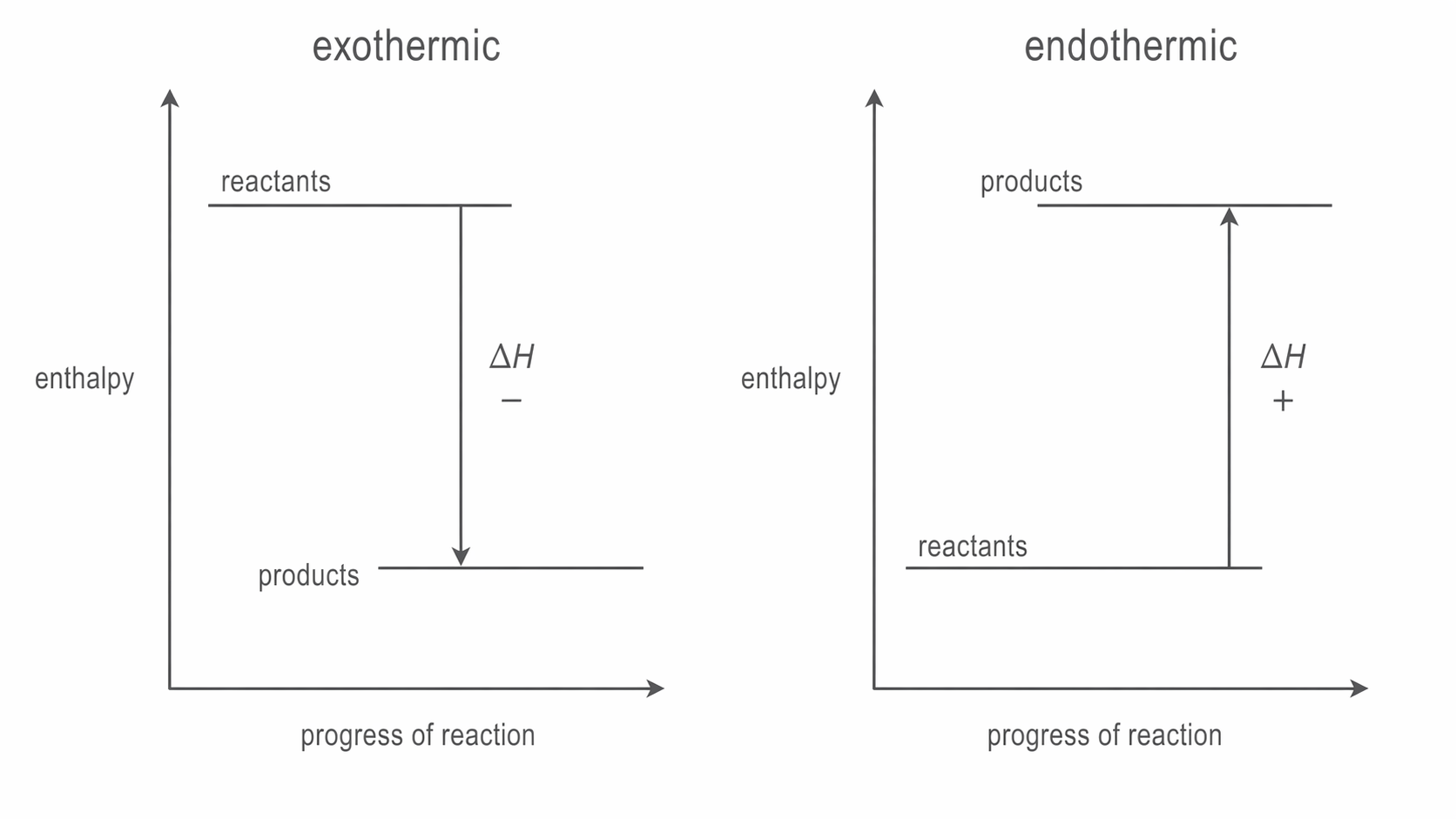
The sign of ΔH matches this pattern. Exothermic reactions have negative ΔH values because energy is released. Endothermic reactions have positive ΔH values because energy is absorbed.
A common trap is to mix up the sign with what you feel. If the reaction mixture gets colder, that usually means the reaction has taken in heat, so ΔH is positive.
What enthalpy change means
In chemistry, enthalpy change is not just any energy change. It has a specific measurement condition attached to it.
Enthalpy change
The heat energy change measured under conditions of constant pressure.
That constant-pressure condition matters because gases can expand or contract as a reaction happens. In school and laboratory chemistry, reactions are often measured open to the atmosphere, so constant pressure is a sensible standard way to compare reactions.
Standard enthalpy changes are quoted under standard conditions: a pressure of 100 kPa and a stated temperature, usually 298 K. If you see ΔH°298, the ° tells you the value is a standard enthalpy change and the 298 tells you the temperature used.
State symbols still matter. For example, H2O(l) and H2O(g) do not have the same enthalpy, so a thermochemical equation must show the correct physical states.
Read a thermochemical equation and the ΔH value together. The equation tells you the amount of substance involved and the state symbols, and the ΔH value tells you the heat change for that exact equation.
Standard enthalpy of combustion
One standard enthalpy change you meet very often is combustion, because fuels are compared by how much energy they release when they burn completely.
Standard enthalpy of combustion
The enthalpy change when one mole of a substance is burned completely in oxygen under standard conditions, with all substances in their standard states.
Three details matter here. First, it must be one mole of the substance being burned. Second, the combustion must be complete, so carbon-containing substances form CO2 rather than CO. Third, the equation must use the correct states for standard conditions, so water is usually written as H2O(l) at 298 K.
Worked example: the standard enthalpy of combustion of methane is represented by
CH4(g) + 2O2(g) -> CO2(g) + 2H2O(l)
This equation is valid because one mole of methane burns completely in oxygen and all substances are shown in their standard states.
If the product water were written as H2O(g), or if carbon monoxide were formed, it would no longer represent the standard enthalpy of combustion as defined here.
Standard enthalpy of formation
Standard enthalpy of formation can look deceptively similar to combustion at first, but the starting point is completely different: you build the substance from its elements.
Standard enthalpy of formation
The enthalpy change when one mole of a substance is formed from its constituent elements under standard conditions, with all substances in their standard states.
The phrase from its constituent elements does the real work here. It means you start with the elements that make up the substance, each in its standard state. For example, the standard enthalpy of formation of carbon dioxide is:
C(s, graphite) + O2(g) -> CO2(g)
Worked example: for liquid water, the correct formation equation is
H2(g) + 1/2 O2(g) -> H2O(l)
Fractional coefficients are fine in enthalpy equations, because the priority is to form exactly one mole of the substance. Writing 2H2(g) + O2(g) -> 2H2O(l) would form two moles of water, so it would not match the definition of standard enthalpy of formation.
So the two standard definitions differ in the starting point. Combustion starts with a substance and oxygen and looks at complete burning. Formation starts with the elements and looks at making exactly one mole of the substance. If you keep those two ideas separate, the definitions feel much less alike and the equations become much easier to build correctly.