3.1.3.2 - Nature of Covalent and Dative Covalent Bonds
Covalent bonding is really about electron pairs: who is sharing them, how many pairs are shared, and how we represent that clearly on paper. Once that idea is secure, every line and every arrow starts to carry real meaning rather than just looking like notation. In this lesson, we will build that notation carefully so every bond symbol makes chemical sense.
Shared pairs in covalent bonds
A covalent bond forms when two atoms share a pair of electrons. The most important phrase is "shared pair". If you keep that idea in mind, the diagrams and definitions all become much easier to understand.
Covalent bond
A covalent bond is a shared pair of electrons between two atoms.
In a normal single covalent bond, one electron usually comes from each atom. Those two electrons are then shared between the two nuclei. That shared pair holds the atoms together.
When chemists stop drawing every electron individually, they replace each shared pair with a line. So a line is not just a convenient mark on the page: it stands for one shared pair of electrons.
H-Hshows one shared pair, so it is a single bond.O=Oshows two shared pairs, so it is a double bond.N≡Nshows three shared pairs, so it is a triple bond.
That means multiple bonds contain multiple shared pairs of electrons. A double bond is two shared pairs. A triple bond is three shared pairs. In a dot-and-cross diagram you can see the electrons themselves; in a displayed formula the lines are a quicker shorthand for exactly the same bonding idea.
The diagram below compares the same bonding idea in two forms, so you can see that the number of lines in a displayed formula matches the number of shared pairs in the dot-and-cross version.
[DIAGRAM: asset_name: 1.3.2 - Nature of Covalent and Dative Covalent Bonds - Diagram 1; asset_slug: 1.3.2 - Nature of Covalent and Dative Covalent Bonds - Diagram 1; recommended_method: retained_png; description: Three side-by-side panels labelled single bond, double bond, and triple bond, with H2, O2, and N2 centred in the matching panels. In each panel, show a dot-and-cross diagram above and the matching displayed formula below. The H2 panel must show one shared pair made from one dot and one cross. The O2 panel must show two shared pairs between the oxygen atoms and two lone pairs on each oxygen. The N2 panel must show three shared pairs between the nitrogen atoms and one lone pair on each nitrogen. The displayed formulae below must be H-H, O=O, and N≡N.]
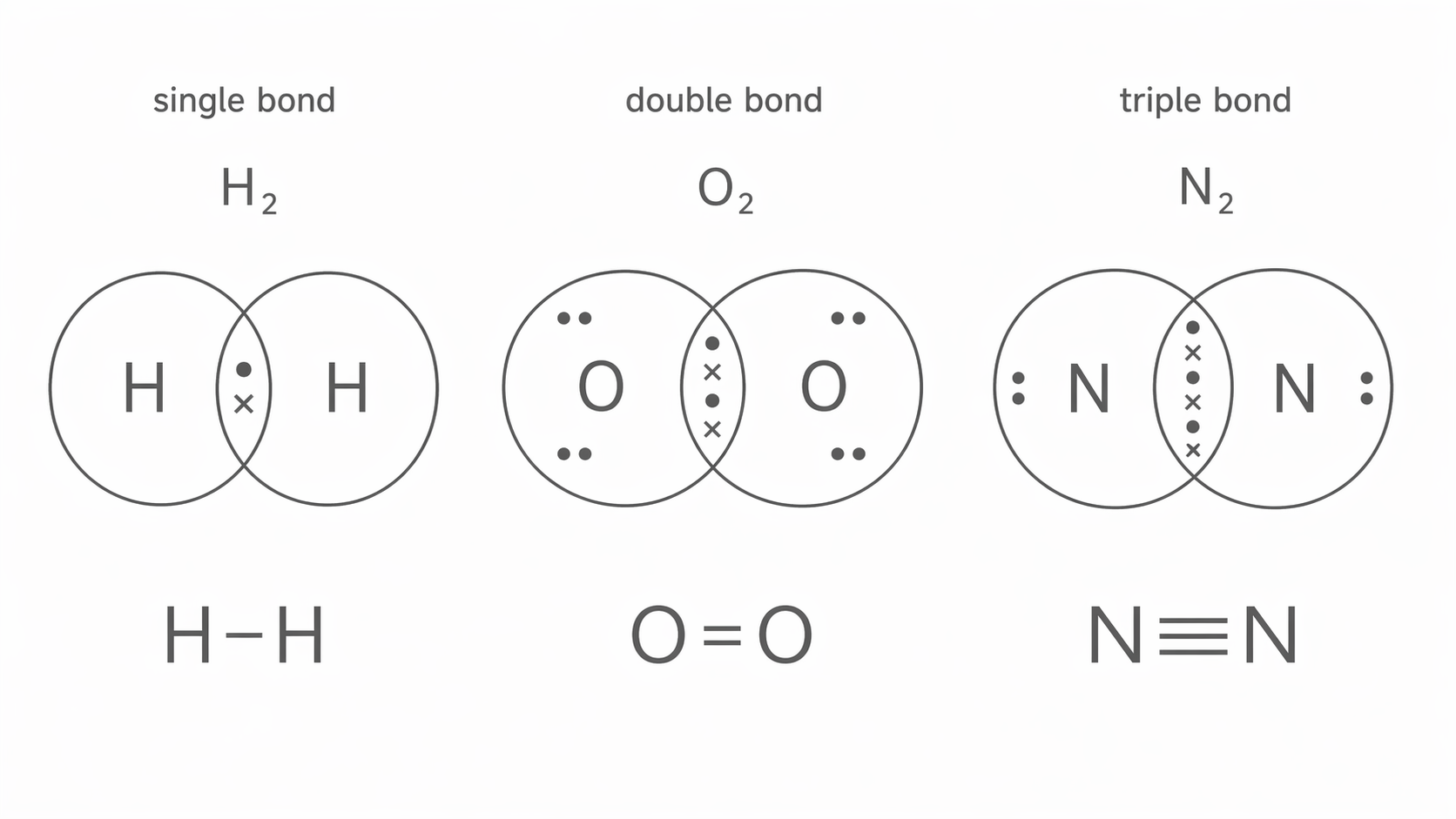
A common mistake is to say "a covalent bond is a line". That is not precise enough. The accurate statement is that a covalent bond is a shared pair of electrons, and we often represent that shared pair with a line.
How a dative covalent bond forms
Most covalent bonds form with one electron contributed by each atom. A co-ordinate bond is different only in how the shared pair is formed. Both electrons in the shared pair come from the same atom.
Co-ordinate (dative covalent) bond
A co-ordinate bond is a shared pair of electrons in which both electrons are supplied by one atom.
For this to happen, one atom must have a lone pair available to donate. A lone pair is a pair of outer-shell electrons that is not currently being used in bonding. The atom or ion receiving that pair must be able to accept it. This is often an electron-deficient species.
Ammonia is a useful example. In NH3, the nitrogen atom has a lone pair. A hydrogen ion, H+, has no electrons at all, so it can accept a pair of electrons from nitrogen. Nitrogen donates both electrons, and a new shared pair forms between N and H.
The diagram below shows the lone pair on nitrogen in ammonia being donated to H+, and then the ammonium ion, [NH4]+, with the co-ordinate bond drawn as N→H.
[DIAGRAM: asset_name: 1.3.2 - Nature of Covalent and Dative Covalent Bonds - Diagram 2; asset_slug: 1.3.2 - Nature of Covalent and Dative Covalent Bonds - Diagram 2; recommended_method: retained_png; description: Two-panel diagram of co-ordinate bond formation. Left panel labelled Before bond forms: ammonia with nitrogen in the centre, three ordinary N-H covalent bonds, one lone pair on nitrogen, and a nearby H+; show an arrow from the lone pair toward the hydrogen ion. Right panel labelled After bond forms: the ammonium ion drawn in square brackets with the overall + charge outside the brackets, three ordinary N-H bonds, and one co-ordinate bond shown as an arrow from nitrogen to hydrogen; add a label stating that both electrons in the new shared pair came from nitrogen.]
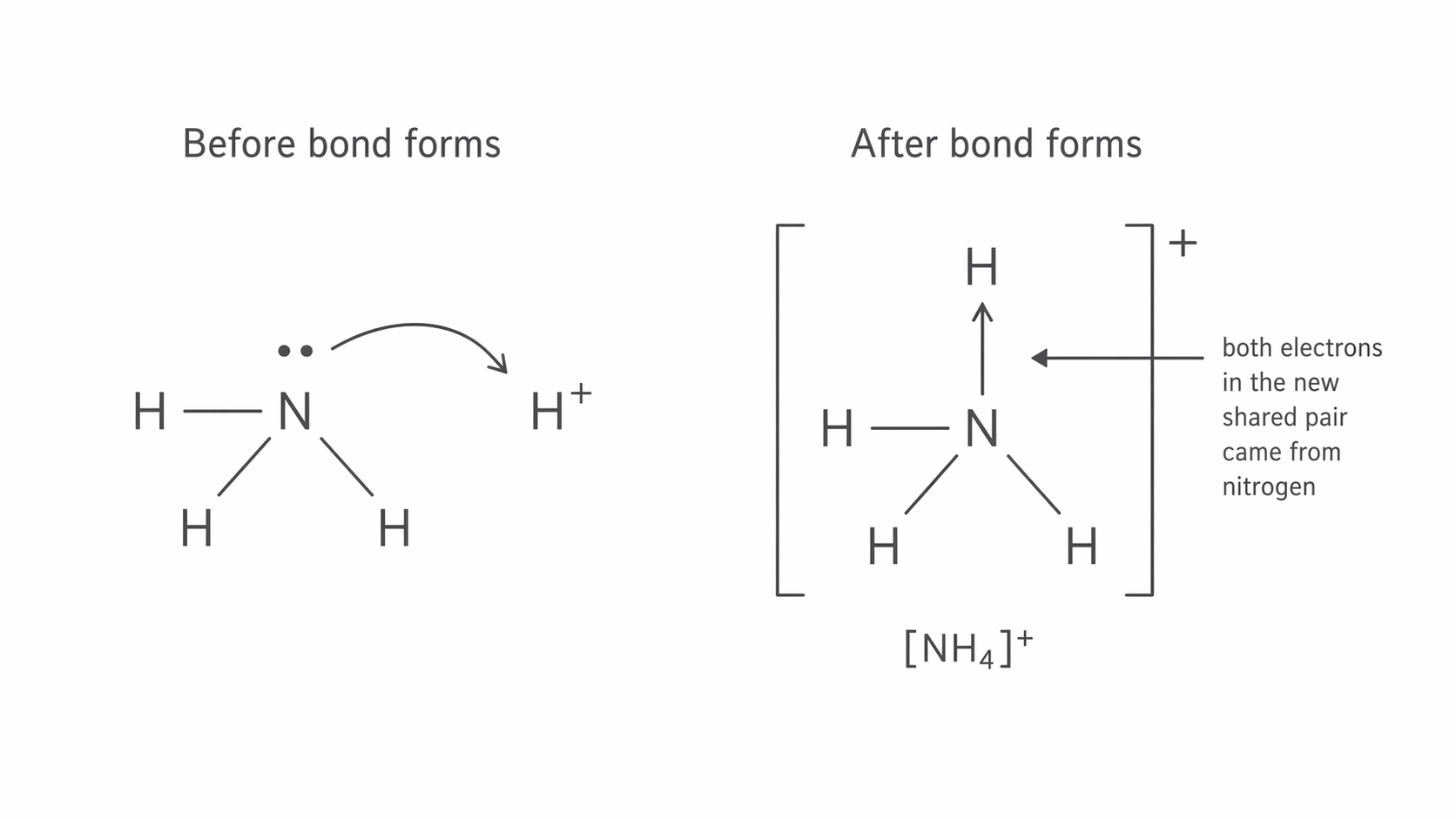
This new bond is shown using an arrow from the donor to the acceptor: N→H. The arrow points in the direction the electron pair was donated. It does not mean electrons are permanently moving along the bond. It simply shows how that shared pair was formed.
After the bond has formed, it is still a shared pair of electrons between two atoms. So a dative bond is still a covalent bond. The special feature is only the source of the two electrons in the shared pair.
Getting the representations right
When you draw these bonds, keep the electron-pair logic clear: a covalent bond is shown with a line, and a co-ordinate bond is shown with an arrow.
For a normal covalent bond, each line stands for one shared pair. If you see two lines, that means two shared pairs. If you see three lines, that means three shared pairs. Counting lines is therefore the same as counting shared pairs.
For a co-ordinate bond, the arrow must point from the atom donating the lone pair to the atom accepting it. In the ammonium ion, the arrow goes from nitrogen to hydrogen, not the other way round.
Be careful with charges as well. The ammonium ion is written as [NH4]+, with the charge applying to the whole ion. Do not leave the charge off, and do not put the charge on just one bond.
Another common mistake is to think a co-ordinate bond is a completely different kind of force from a covalent bond. It is not. Both involve a shared pair of electrons between two atoms. The difference is simply this:
- in an ordinary covalent bond, each atom usually provides one electron
- in a co-ordinate bond, one atom provides both electrons in the shared pair
If you can explain where the shared pair comes from and then represent it with the correct line or arrow, you have the whole idea in place.