3.1.2.5 - Balanced Equations and Associated Calculations
Every chemical calculation in this topic starts with one idea: a balanced equation tells you the exact mole ratio in which particles react. If the equation is wrong, every mass, gas volume, concentration, yield, and atom economy answer built from it will also be wrong. In this lesson, you will learn how to balance full and ionic equations and then turn those coefficients into reliable calculations.
Building balanced and ionic equations
A chemical equation must show the correct substances first and the correct numbers second. That means you start by writing the right formula for each reactant and product, and only then adjust the coefficients in front of them.
Stoichiometry
The stoichiometry of a reaction is the simple whole-number ratio in which substances react and are formed, as shown by the coefficients in a balanced equation.
For example, aluminium reacts with oxygen to form aluminium oxide:
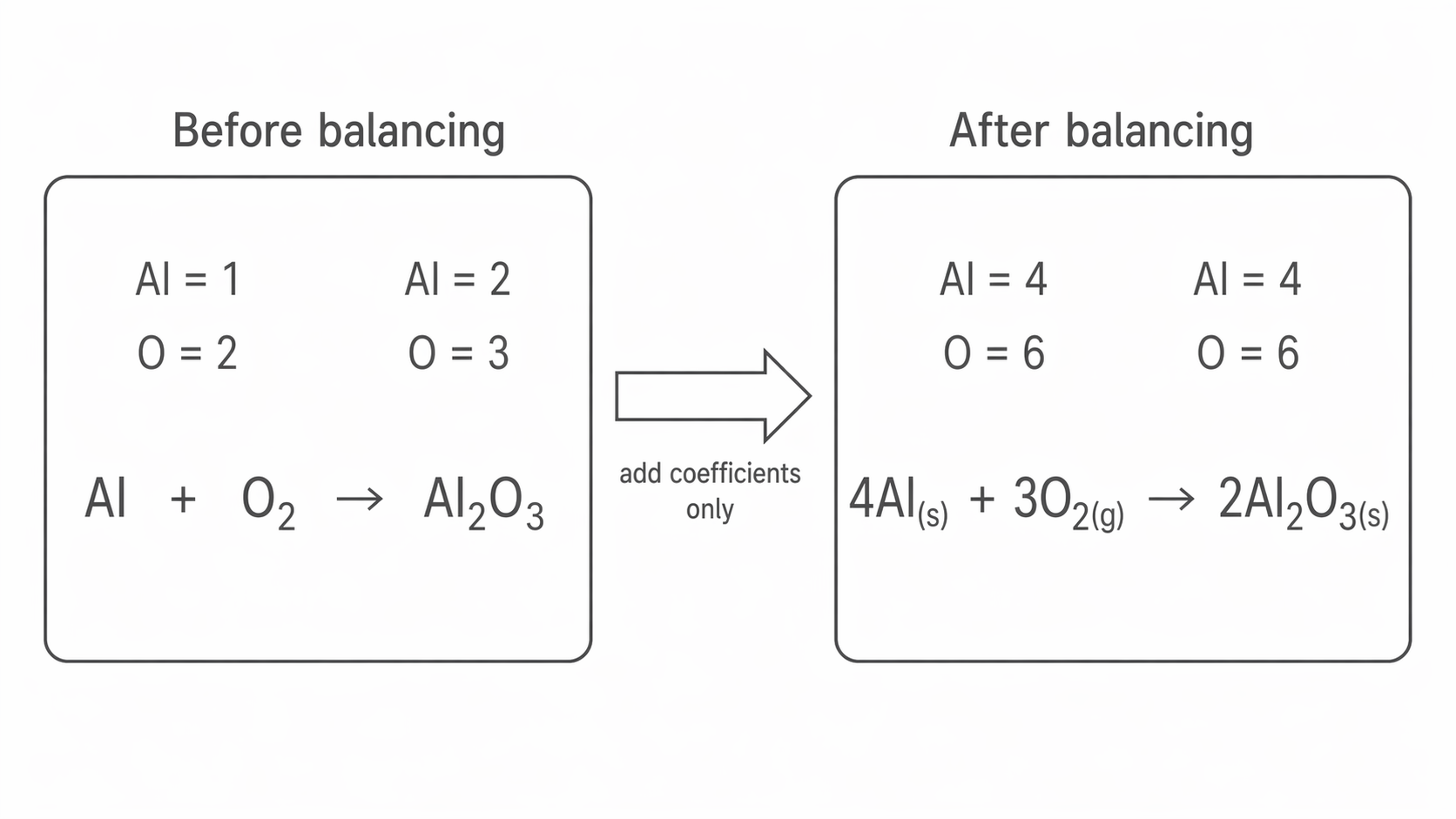
This is not balanced. There are 2 aluminium atoms on the right but only 1 on the left, and there are 3 oxygen atoms on the right but only 2 on the left. The balanced equation is:
The coefficients 4 : 3 : 2 are the useful part for later calculations. They tell you that 4 mol of aluminium react with 3 mol of oxygen to make 2 mol of aluminium oxide. The diagram below compares the same aluminium oxide equation before and after balancing so you can see how the atom counts match once the coefficients are corrected.
[DIAGRAM: asset_name: 1.2.5 - Balanced Equations and Associated Calculations - Diagram 1; asset_slug: 1.2.5 - Balanced Equations and Associated Calculations - Diagram 1; recommended_method: retained_png; description: Monochrome side-by-side balancing comparison for Al + O2 -> Al2O3. The left panel is titled "Before balancing" and shows atom counts Al = 1, O = 2 on the left and Al = 2, O = 3 on the right above the unbalanced equation Al + O2 -> Al2O3. The right panel is titled "After balancing" and shows atom counts Al = 4, O = 6 on both sides above the balanced equation 4Al(s) + 3O2(g) -> 2Al2O3(s). A central arrow is labelled "add coefficients only".]
When you balance unfamiliar equations, use this routine:
- Write the correct formulae first.
- Count atoms of each element on both sides.
- Change coefficients only. Never change a subscript inside a formula.
- Recheck atoms at the end.
- If the equation is ionic, recheck charge balance as well.
State symbols matter because they tell you whether a species is solid, liquid, gas, or aqueous. In an ionic equation, they also help you decide what can be split into ions.
A full equation shows every species present. An ionic equation removes spectator ions so that only the particles actually changing remain. For neutralisation:
The aqueous substances can be written as ions:
HCl(aq)givesH^+(aq)andCl^-(aq)NaOH(aq)givesNa^+(aq)andOH^-(aq)NaCl(aq)givesNa^+(aq)andCl^-(aq)
So the ionic equation becomes:
Na^+ and Cl^- are spectator ions because they appear unchanged on both sides. A useful final check is that both atoms and total charge balance in the ionic equation. If all the coefficients in an ionic equation can be divided by the same number, simplify them to the smallest whole-number ratio.
Using mole ratios for masses, gases, and solutions
Once an equation is balanced, the coefficients become mole ratios. Every calculation in this topic follows the same backbone:
- Convert the known quantity into moles.
- Use the balanced equation to find moles of the substance you want.
- Convert those moles into the final unit you need.
Three quick formulae do most of the numerical work in this lesson:
Core Stoichiometry Methods
For masses, use:
For gases at room temperature and pressure, use the molar gas volume from the amount of substance topic:
So:
For solutions, use:
Here, V must be in dm^3, so 25.0 cm^3 = 0.0250 dm^3.
Worked example: magnesium reacts with excess hydrochloric acid.
If 0.120 g of Mg reacts, first find moles of magnesium:
The ratio Mg : H_2 is 1 : 1, so:
Now convert moles of hydrogen into gas volume at RTP:
That is also 119 cm^3. The easy place to slip is the mole ratio in the middle. It is tempting to jump straight from grams to volume without using the coefficients, but the balanced equation is what links the two.
The same middle step also lets you move straight from one mass to another. If 5.00 g of calcium carbonate decomposes,
then . The ratio is 1 : 1, so , and the mass of calcium oxide is . The chemistry is still the same three-step route: convert, use the ratio, convert back.
The same logic works for solution calculations. Suppose sulfuric acid reacts with sodium hydroxide:
If 25.0 cm^3 of 0.100 mol dm^{-3} sulfuric acid neutralises sodium hydroxide, then:
From the 1 : 2 ratio, the sodium hydroxide moles are:
If the NaOH volume was 20.0 cm^3 = 0.0200 dm^3, its concentration is:
If quantities of two reactants are given, the reactant that would run out first fixes the maximum amount of product. So balanced equations let you move between masses, gas volumes, and solution data, as long as you keep the units consistent.
Theoretical yield and percentage yield
A balanced equation can tell you the maximum amount of product you should be able to make. That value is called the theoretical yield. Real laboratory and industrial results are usually smaller, because product can be lost during transfer, filtration, purification, or because the reaction does not go to completion.
Percentage yield
Percentage yield is the percentage of the theoretical amount of product that is actually obtained.
The calculation is:
So the method always has two stages:
- Use the balanced equation to work out the theoretical yield.
- Compare the actual yield with that theoretical value.
Worked example:
From the equation, 1 mol of calcium carbonate produces 1 mol of calcium oxide.
If 10.0 g of CaCO_3 is heated:
M_r(CaCO_3) = 100.0- moles of
CaCO_3 = 10.0/100.0 = 0.100 mol
So the theoretical amount of CaO is also 0.100 mol.
With M_r(CaO) = 56.0, the theoretical mass of calcium oxide is:
If the actual mass collected was 4.20 g, then:
This is why yield is about practical efficiency, not just the equation itself. A reaction may have a sensible balanced equation but still give a low percentage yield because some product is lost or because the reaction is reversible. You can calculate percentage yield using either masses or moles, as long as both values refer to the same product.
A very useful check is this: if your calculated percentage yield is above 100%, the chemistry is not magically excellent. It usually means the product was impure, wet, or the measurements were wrong.
Atom economy and choosing better processes
Percentage yield tells you how much of the desired product you actually obtained. Atom economy asks a different question: how much of the reactants end up in the desired product in the first place?
Atom economy
Atom economy is the percentage of reactant atoms that end up in the desired product.
It helps to keep atom economy and percentage yield side by side, because they answer different questions. For atom economy, the balanced equation still controls the calculation, which means the coefficients matter.
Yield and Atom Economy
Because it comes from the equation itself, atom economy is a theoretical measure. It does not depend on spills, filtering losses, or careless technique.
That wording matters. In , the numerator is , not just one . The denominator is . So atom economy must always be read from the balanced equation, not from one copy of each formula.
For example, if calcium oxide is the desired product in
then:
So 44.0% of the mass of the reactant ends up in a different product. That is why decomposition reactions often have lower atom economies than addition reactions that make a single product.
Now compare that with:
All of the reactant atoms appear in the one product, so the atom economy is 100%.
That difference matters beyond the maths. A high atom economy usually means less waste, lower costs for raw materials, less money spent separating or disposing of unwanted by-products, and less environmental damage caused by waste treatment. It can also be argued that wasting fewer finite resources is ethically better for society, because the process places a smaller burden on other people and on future generations.
One easy way to keep the two ideas separate is:
- percentage yield compares actual product with theoretical product
- atom economy compares desired product with total reactants
The calculation itself is usually straightforward. The more important idea is that atom economy and percentage yield are not measuring the same thing.
Once that distinction is clear, you can look at a process and describe both how much product was collected and how efficiently the reactant atoms were used.