3.1.3.3 - Metallic Bonding
Metallic bonding explains why a piece of metal behaves as one joined-up structure rather than a pile of separate atoms. In this lesson, the focus stays tightly on the model itself: positive ions arranged in a lattice, delocalised electrons, and the attraction between them. By the end, you should be able to picture that structure clearly and describe it precisely.
The Metallic Bonding Model
In a pure metal, there are only metal atoms present, so electrons are not transferred to a non-metal as they are in ionic bonding. Instead, the outer electrons become shared across the whole structure. That leaves behind positive metal ions arranged in a regular lattice.
Metallic bonding
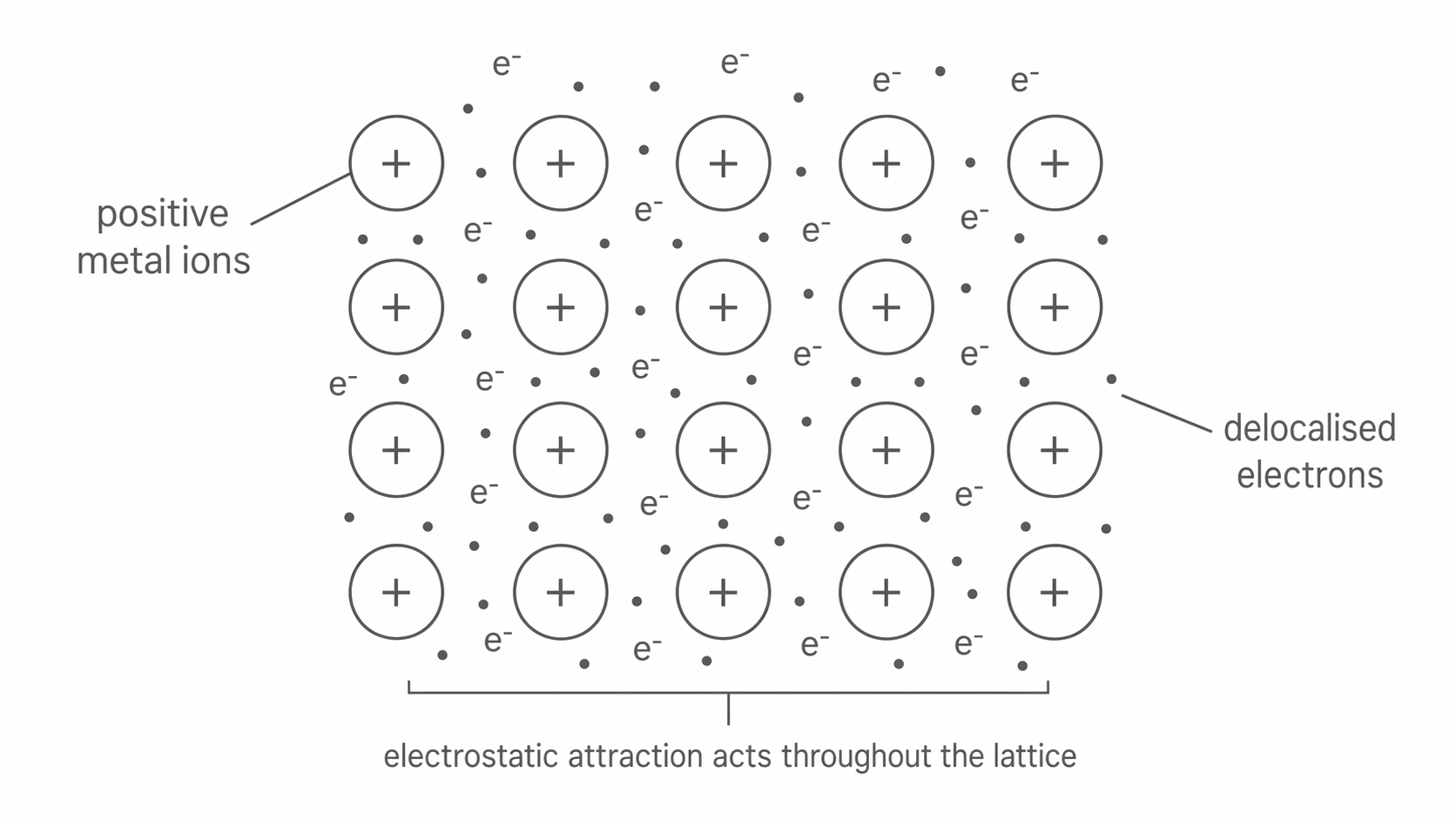
Metallic bonding is the electrostatic attraction between positive metal ions and delocalised electrons in a giant lattice.
The phrase "sea of electrons" is often used as a model for this structure. That is useful, as long as you remember that the electrons are not attached to one particular ion and can move throughout the metal.
Delocalised electrons
Delocalised electrons are electrons that are free to move through the whole structure and are not associated with one specific atom or ion.
So a metal is best pictured as a giant lattice of positive ions surrounded by mobile electrons. The attraction acts throughout the structure, not just between one pair of particles. That is why metallic bonding gives metals a giant structure.
The diagram below shows this model in the simplest useful way: a regular lattice of positive ions with delocalised electrons moving throughout the structure.
[DIAGRAM: asset_name: 1.3.3 - Metallic Bonding - Diagram 1; asset_slug: 1.3.3 - Metallic Bonding - Diagram 1; recommended_method: retained_png; description: A clean 2D slice of a regular metal lattice, with identical positive metal ions arranged in repeating rows and many small delocalised electrons shown between and around the ions across the whole structure. Label positive metal ions, label delocalised electrons, and add the note electrostatic attraction acts throughout the lattice.]
Making The Model Precise
The word lattice matters. It tells you that the positive ions are arranged in a regular, repeating pattern throughout the metal.
Lattice
A lattice is a regular, repeating three-dimensional arrangement of particles.
This helps avoid two common mistakes. A metal is not made of separate molecules, and it is not best described as a set of neutral atoms with their outer electrons still attached. The structure contains positive ions in fixed positions, while the delocalised electrons move throughout the whole lattice.
The strength of metallic bonding depends on the strength of the electrostatic attraction between these two parts of the structure. Higher-charge ions attract the delocalised electrons more strongly. Smaller ions also give stronger attraction because the positive charge is closer to the delocalised electrons.
Pulling The Model Together
Now pull the whole model together. A complete description needs positive ions, a lattice, delocalised electrons, and attraction between the opposite charges.
Metallic bonding involves attraction between delocalised electrons and positive ions arranged in a lattice.
If you can picture a lattice of positive ions, electrons moving throughout it, and electrostatic attraction between the two, you have the core model of metallic bonding.