3.1.2.4 - Empirical and Molecular Formula
When chemists know how much of each element is present in a substance, they can work backwards to its formula. That turns a list of masses or percentages into a genuine clue about what the substance is. In this lesson, you will learn how to turn composition data into an empirical formula, then how to use relative molecular mass to scale that result up to the molecular formula.
What each formula means
An empirical formula and a molecular formula do not tell you exactly the same thing, so it is worth separating the ideas before doing any calculations.
Empirical Formula
The empirical formula is the simplest whole-number ratio of atoms of each element in a compound.
The key word is simplest. If a substance has carbon and hydrogen in a 2:6 ratio, that can be simplified to 1:3, so its empirical formula would be .
Molecular Formula
The molecular formula gives the actual number of atoms of each element in one molecule.
So ethene has molecular formula , but its empirical formula is . By contrast, carbon dioxide has molecular formula and empirical formula because the ratio is already in its simplest form.
This gives the key relationship between the two ideas: the molecular formula is always a whole-number multiple of the empirical formula. Later in the lesson, we will find that multiple by comparing with the mass of one empirical-formula unit.
Finding empirical formula from masses
To calculate an empirical formula from mass data, always follow the same sequence:
- Write down the mass of each element.
- Convert each mass into moles using .
- Divide every mole value by the smallest mole value.
- If needed, multiply the ratio so that every number becomes a whole number.
Converting Mass to Moles
Here, is the amount in mol, is the mass in g, and is the relative atomic mass of the element. The most common mistake is to compare masses directly. Formulae come from mole ratios, not mass ratios.
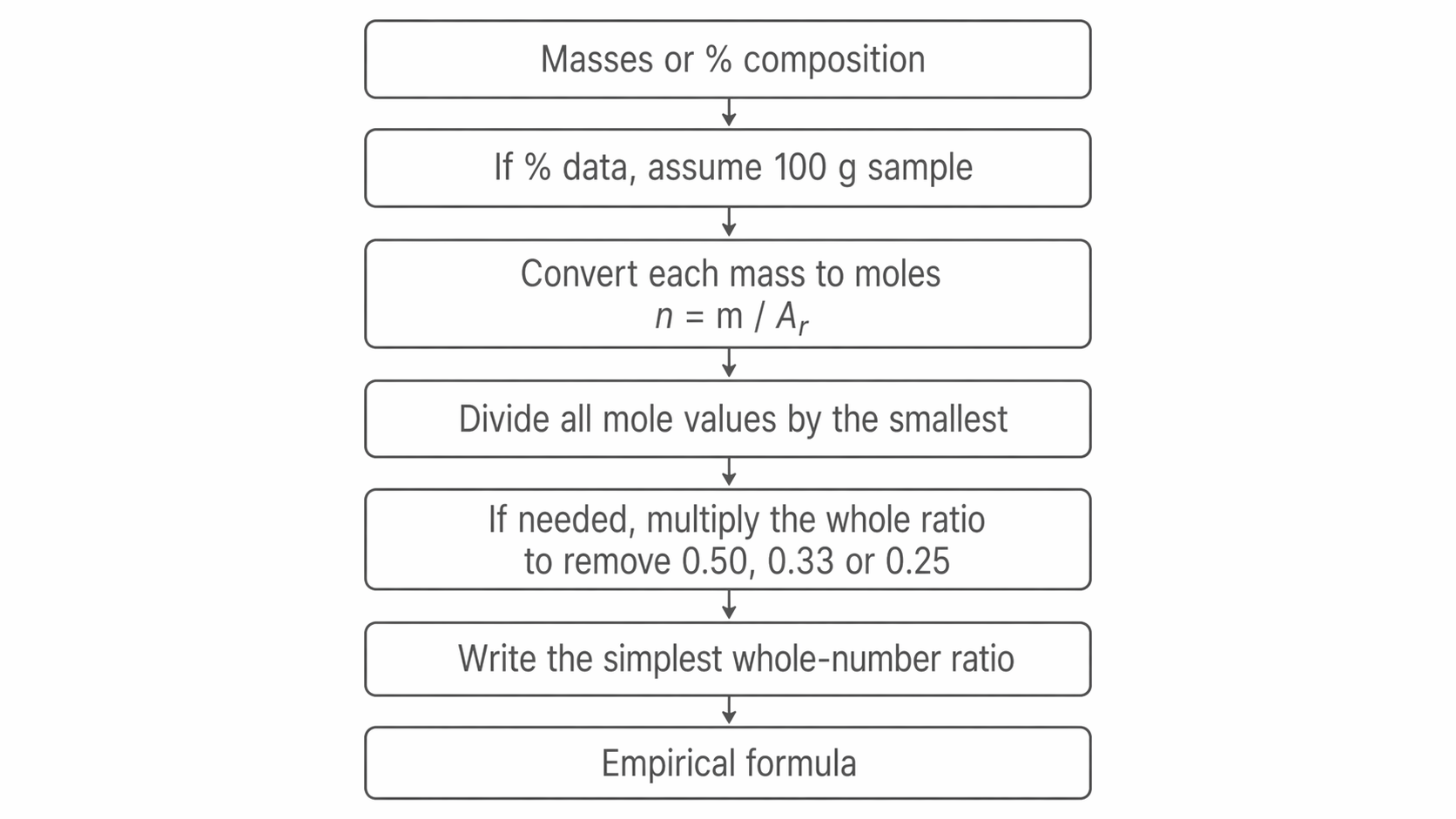
The diagram below summarises the standard sequence for turning composition data into an empirical formula, and following the same order each time helps prevent ratio mistakes.
[DIAGRAM: asset_name: 1.2.4 - Empirical and Molecular Formula - Diagram 1; asset_slug: 1.2.4 - Empirical and Molecular Formula - Diagram 1; recommended_method: retained_png; description: Monochrome vertical flowchart on a landscape page for finding an empirical formula from composition data. The boxes read, top to bottom: "Masses or % composition", "If % data, assume 100 g sample", "Convert each mass to moles, n = m / A_r", "Divide all mole values by the smallest", "If needed, multiply the whole ratio to remove 0.50, 0.33 or 0.25", "Write the simplest whole-number ratio", and "Empirical formula".]
Worked example: a compound contains 4.01 g calcium, 1.20 g carbon, and 4.80 g oxygen.
| Element | Mass / g | Moles | Divide by smallest |
|---|---|---|---|
| Ca | 4.01 | 1 | |
| C | 1.20 | 1 | |
| O | 4.80 | 3 |
The simplest ratio is therefore Ca : C : O = 1 : 1 : 3, so the empirical formula is .
Notice that it is sensible to keep a few decimal places until the ratio stage. If you round too early, the final ratio can come out wrong.
Using percentage composition and awkward ratios
Percentage composition questions use exactly the same chemistry. The only extra step is to imagine a 100 g sample, so each percentage becomes a mass in grams. For example, 43.7% phosphorus means 43.7 g phosphorus in 100 g of the compound.
Suppose a compound is 43.7% phosphorus and 56.3% oxygen by mass:
- P moles
- O moles
Now divide by the smallest value:
- P : O
That is not a whole-number ratio yet, so you must scale the whole ratio. Multiplying both numbers by 2 gives 2 : 5, so the empirical formula is .
This is another place where ratios can go wrong. If you see 1 : 1.5, do not round 1.5 to 2. Instead, multiply the entire ratio by 2 to get 2 : 3. The same idea applies to values close to 1.33 or 1.25, which often need multiplying by 3 or 4.
For both mass data and percentage data, the route is the same: convert to moles, divide by the smallest, then scale to whole numbers if needed.
If the question only gives percentages for some of the elements, first work out the missing percentage by subtracting from 100. That missing percentage can then be treated as a mass in a 100 g sample.
From empirical formula to molecular formula
Once you know the empirical formula, finding the molecular formula is a scaling problem. First calculate the mass of one empirical-formula unit. Then compare that value with the given .
For a molecular substance:
The multiplier must be a whole number. You then multiply every subscript in the empirical formula by that number.
Worked example: a compound has empirical formula and .
- Empirical formula mass
- Multiplier
- Multiply every subscript in by 2
- Molecular formula
If the multiplier is 1, then the molecular formula and empirical formula are the same. Also remember that is a relative quantity, so it has no unit.
In analytical chemistry, elemental composition data can be used to find an empirical formula, while mass spectrometry can provide . Putting those two results together lets chemists identify the molecular formula of an unknown substance much more quickly.
One final trap to avoid: do not add atoms one by one. If the empirical formula is and the multiplier is 2, the molecular formula is not something like . Every subscript must be multiplied by the same whole number.