3.1.2.1 - Relative Atomic Mass and Relative Molecular Mass
Chemists do not usually work with the actual masses of individual atoms and molecules because those masses are far too small to handle conveniently. Instead, they compare particles against a fixed standard and use relative values. In this lesson, you will learn exactly what A_r and M_r mean, why carbon-12 is the reference standard, and why ionic compounds use the term relative formula mass instead of relative molecular mass.
The Carbon-12 Standard and Relative Atomic Mass
Chemistry needs a common reference point for comparing masses. The agreed standard is the carbon-12 atom, written as ^12C. Instead of saying how many grams one atom has, chemists compare the mass of a particle with one twelfth of the mass of a carbon-12 atom.
That fixed reference matters because "relative" only makes sense if every chemist is comparing against the same standard. In a precise definition, relative mass must be tied to carbon-12, not to hydrogen or to an unspecified standard.
Relative Atomic Mass (`A_r`)
The relative atomic mass of an element is the mean mass of an atom of that element compared with one twelfth of the mass of an atom of carbon-12.
Two words in that definition do most of the heavy lifting.
First, mean mass. Many elements exist as a mixture of isotopes, so the value for A_r is an average across the atoms found naturally.
Second, one twelfth of the mass of an atom of carbon-12. If you leave out the fraction 1/12 or just write "compared with carbon-12", the definition becomes incomplete.
The diagram below makes that comparison more concrete by showing the carbon-12 standard alongside the mean mass of an element's atoms.
[DIAGRAM: asset_name: 1.2.1 - Relative Atomic Mass and Relative Molecular Mass - Diagram 1; asset_slug: 1.2.1 - Relative Atomic Mass and Relative Molecular Mass - Diagram 1; recommended_method: retained_png; description: Comparison diagram for relative atomic mass. On the left, draw one carbon-12 atom as a large circle divided into 12 equal sectors with one sector clearly highlighted and labelled 1/12. On the right, show a grouped cluster of atoms labelled mean mass of atoms of the element. Connect the two sides with a comparison arrow and include a clear caption stating that relative atomic mass compares the mean mass of the element's atoms with 1/12 of carbon-12.]
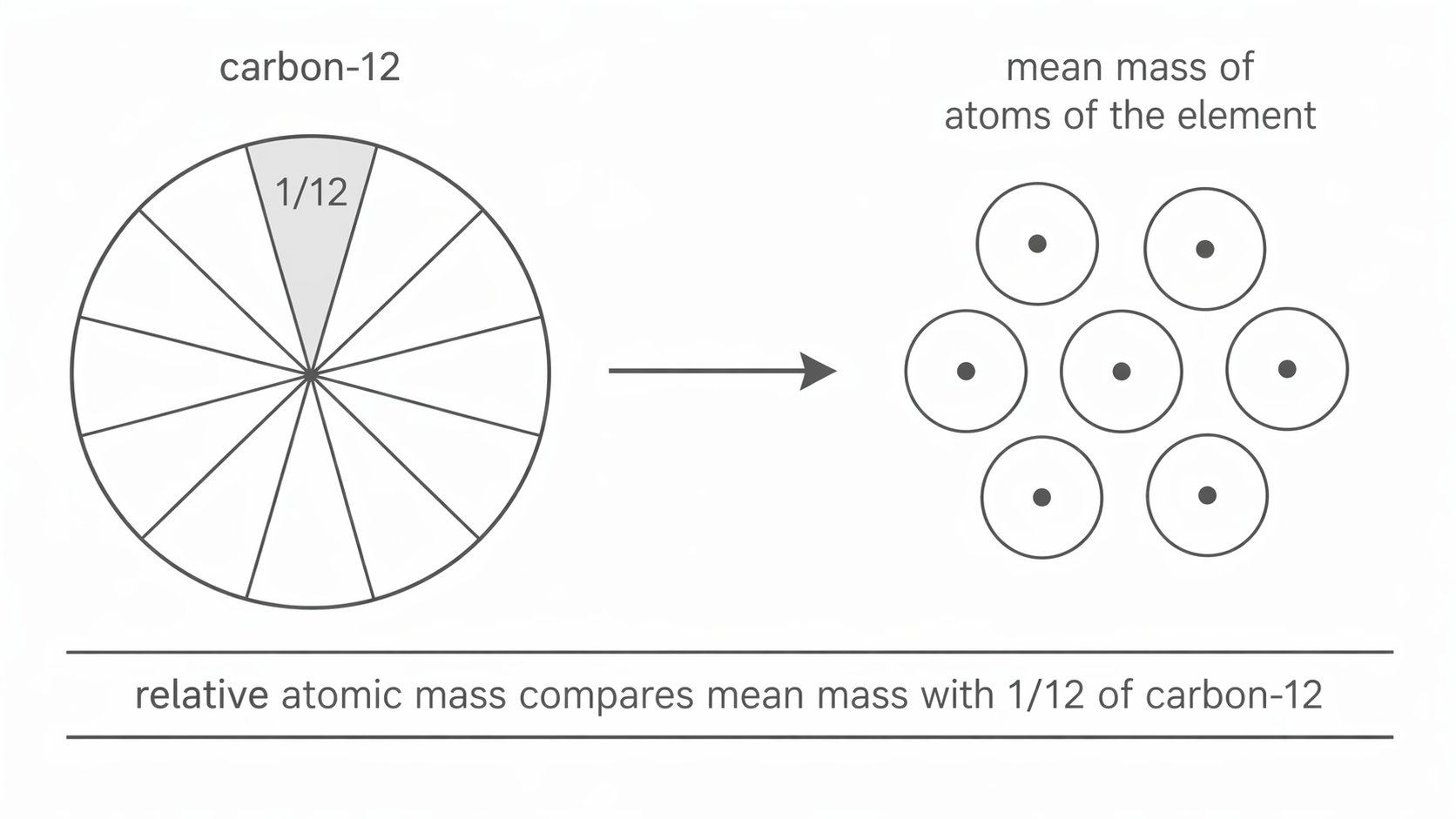
You can think of A_r as answering the question: "How heavy is an average atom of this element relative to the carbon-12 standard?" Because it is a relative value, it has no unit.
Relative Molecular Mass
The same comparison idea can be extended from atoms to molecules.
Relative Molecular Mass (`M_r`)
The relative molecular mass of a molecule is the mean mass of that molecule compared with one twelfth of the mass of an atom of carbon-12.
This definition is very similar to the one for A_r, but there is one key difference: A_r is for an atom of an element, while M_r is for a molecule.
In practice, you usually find M_r by adding together the A_r values of all the atoms shown in the molecular formula.
Worked example:
For water, H2O:
A_r(H) = 1.0A_r(O) = 16.0M_r(H2O) = (2 × 1.0) + 16.0 = 18.0
That calculation works because the molecule contains two hydrogen atoms and one oxygen atom.
Notice that the calculation is straightforward only if you read the formula carefully. A common error is to forget a subscript and count the wrong number of atoms.
Relative Formula Mass for Ionic Compounds
There is one important language rule in chemistry: not every substance is made of molecules.
Ionic compounds such as sodium chloride, NaCl, form giant ionic lattices. They contain ions arranged in a repeating structure, not separate molecules. For that reason, chemists use the term relative formula mass for ionic compounds.
Relative Formula Mass
Relative formula mass is the sum of the relative atomic masses of the atoms shown in the formula of an ionic compound. The term is used because ionic compounds do not exist as molecules.
The symbol used is still often M_r, but the wording matters. If the substance is ionic, "relative molecular mass" is not the best term because there are no molecules to refer to.
Worked example:
For sodium chloride, NaCl:
A_r(Na) = 23.0A_r(Cl) = 35.5- Relative formula mass =
23.0 + 35.5 = 58.5
For magnesium chloride, MgCl2:
- Relative formula mass =
24.3 + (2 × 35.5) = 95.3
In both cases, the calculation method looks like an M_r calculation, but the correct name is relative formula mass because the compounds are ionic.
Getting the Language Right
This topic is short, but it depends on precise definitions and careful choice of terminology. A small change in wording can change the meaning.
Here is the pattern to keep in mind:
A_rrefers to an atom of an elementM_rrefers to a molecule- relative formula mass refers to an ionic compound
- all relative masses are defined using one twelfth of the mass of an atom of carbon-12
The key phrase running through these definitions is "compared with one twelfth of the mass of an atom of carbon-12."
Common mistakes include:
- missing out the words mean mass
- forgetting to mention one twelfth
- saying an ionic compound has a relative molecular mass
- giving a unit such as
gorg mol^-1toA_rorM_r, even though relative masses are unitless
If you can write both definitions exactly and choose the right term for molecular versus ionic substances, you have the language of this topic under control.