3.1.3.4 - Bonding and Physical Properties
Bonding determines how particles are arranged in a solid, and that arrangement controls what happens when you heat the substance or try to make it conduct electricity. In this lesson, you will compare the four crystal structures in the specification using sodium chloride, magnesium, iodine, ice, diamond, and graphite, then turn those ideas into clear structure-property explanations and accurate sketches.
Structure, melting, and conductivity
Solids with a crystal structure have particles arranged in a regular pattern. Those particles may be ions, atoms, or molecules, and the attractions between them are what give the solid its physical properties.
Crystal structure
A regular, repeating arrangement of particles in a solid.
When a solid melts, energy is absorbed because the particles need more freedom to move. What must be overcome depends on the structure:
- in giant ionic, metallic, and macromolecular crystals, strong attractions or bonds within the giant structure must be overcome
- in molecular crystals, only intermolecular forces between molecules are overcome
The energy absorbed on melting is the enthalpy change of melting, or fusion. When a liquid vaporises, even more energy is needed because the particles must become much farther apart. The energy absorbed on boiling is the enthalpy change of vaporisation. Stronger attractions between particles therefore usually mean both a higher melting temperature and larger energy changes for melting and vaporisation.
The reverse changes release energy. Freezing and condensing are exothermic because attractions form again as particles become closer together and more ordered.
Two simple checks unlock most of the patterns in this topic:
- how much energy is needed to separate the particles?
- are there any mobile ions or delocalised electrons present?
Those two checks explain most melting-point and conductivity patterns in this topic.
You do not need a separate states-of-matter sketch to answer the bonding questions here. The key chemistry point is simply that melting and vaporisation require energy to overcome the attractions holding the particles together, while freezing and condensing release energy as those attractions form again.
Giant ionic and metallic crystals
Start with sodium chloride and magnesium because both are giant structures with high melting temperatures, but they conduct differently.
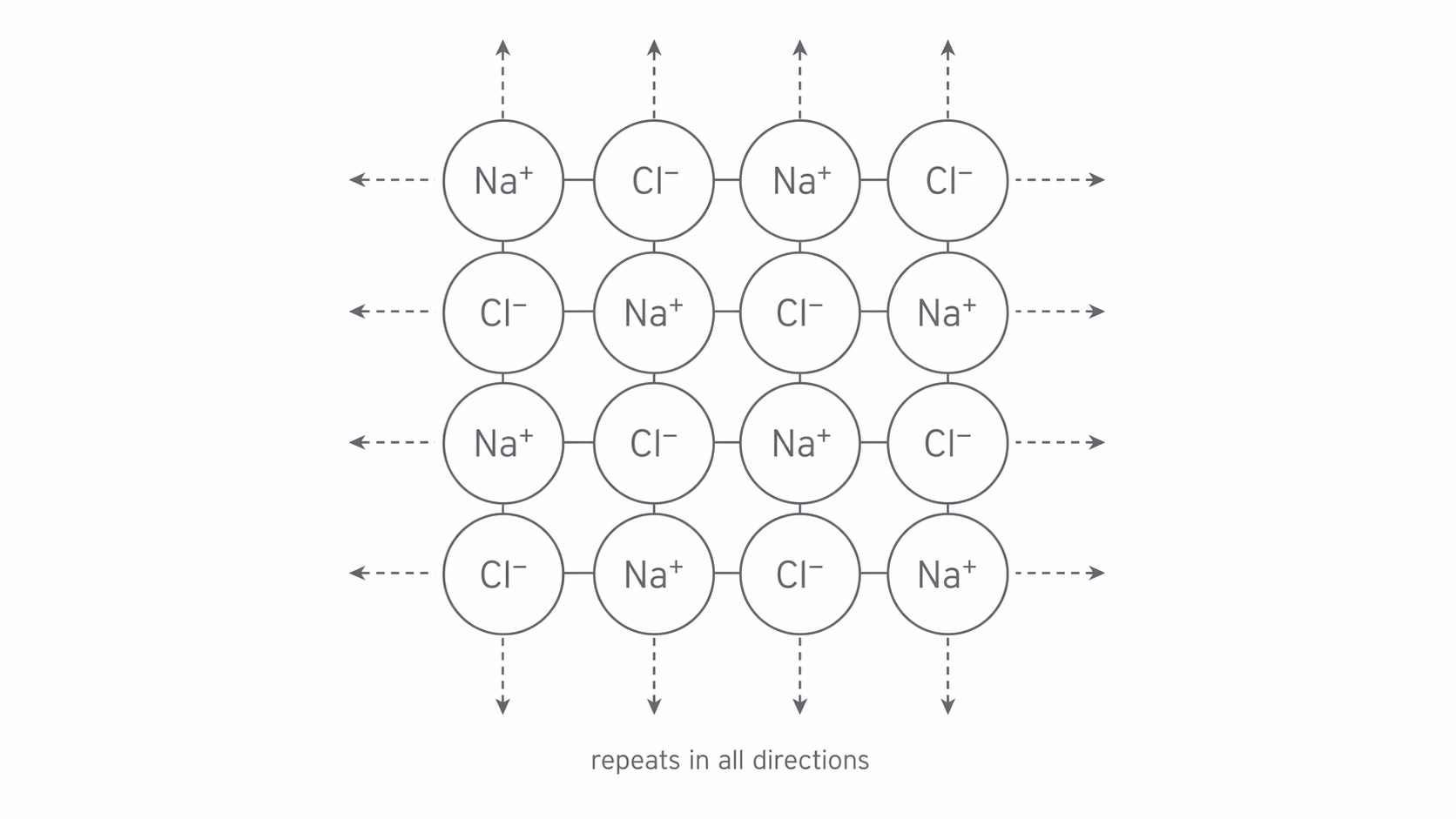
Sodium chloride is a giant ionic lattice of Na+ and Cl- ions. Each positive ion is surrounded by negative ions and vice versa, so there are strong electrostatic attractions throughout the crystal. A large amount of energy is needed to separate these ions, so sodium chloride has a high melting point.
In the solid, sodium chloride does not conduct electricity because the ions are fixed in place. Once molten, or dissolved in water, the ions can move and carry charge.
The diagram below shows a simple 2D slice of the sodium chloride lattice, with the alternating pattern continuing in all directions through the crystal.
[DIAGRAM: asset_name: 1.3.4 - Bonding and Physical Properties - Diagram 1; asset_slug: 1.3.4 - Bonding and Physical Properties - Diagram 1; recommended_method: retained_png; description: A clean 2D slice of a sodium chloride giant ionic lattice in a regular 4 by 4 checkerboard grid with 16 touching ions, alternating Na+ and Cl- throughout. Label both ion types clearly and add small continuation arrows at the edges to show that the lattice repeats in all directions.]
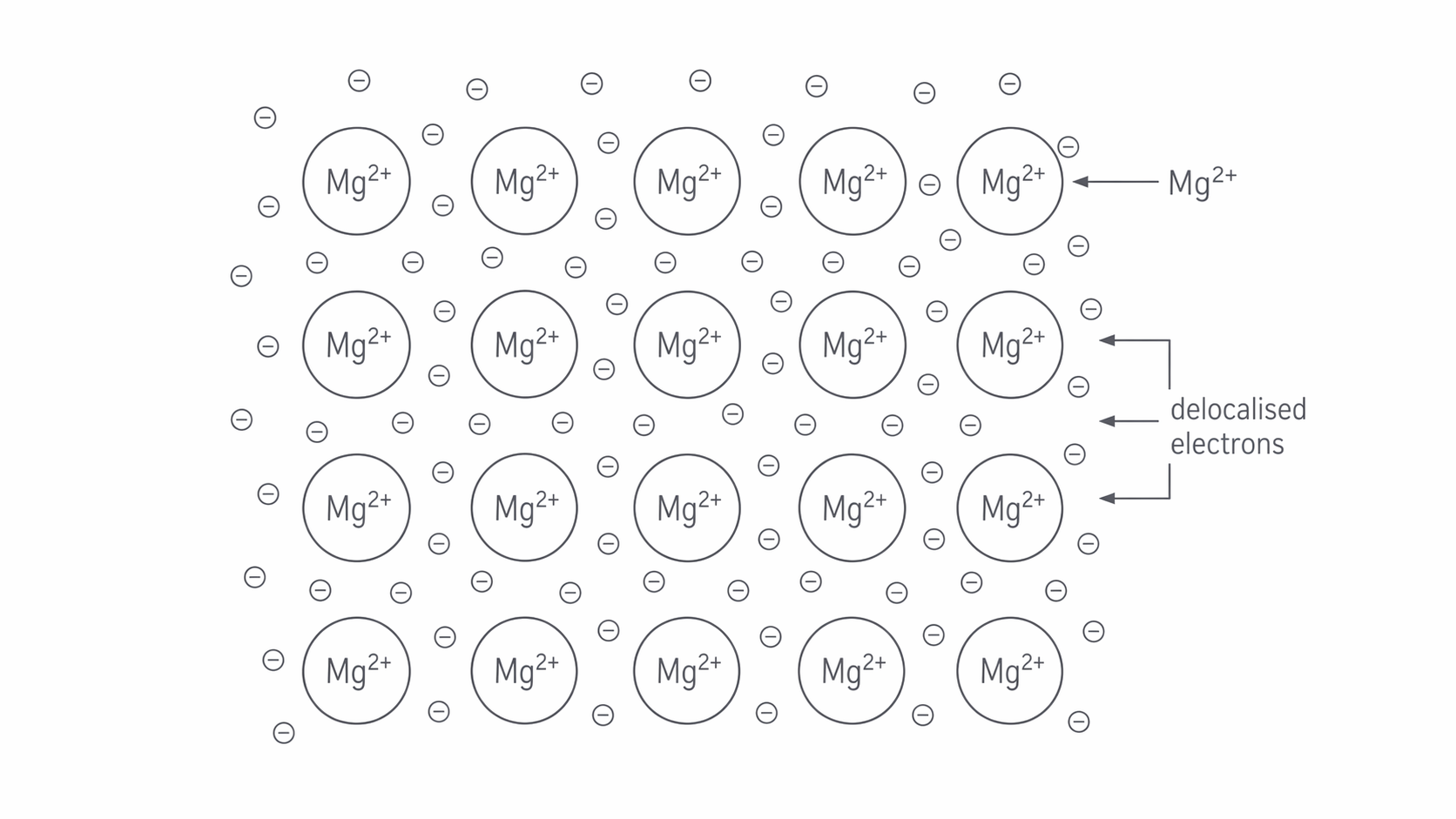
Magnesium is a metallic crystal. Each magnesium atom contributes its outer electrons to a shared pool, leaving a lattice of positive ions.
Delocalised electron
An electron that is free to move through a structure rather than being tied to one bond or one atom.
The strong attraction between Mg2+ ions and delocalised electrons gives magnesium a high melting temperature. Magnesium conducts electricity in both the solid and liquid states because the delocalised electrons are mobile.
This is the key comparison:
- sodium chloride conducts only when ions can move
- magnesium conducts because electrons can move even while the metal is solid
The diagram below shows the metallic lattice model for magnesium, where mobile delocalised electrons move through the whole structure.
[DIAGRAM: asset_name: 1.3.4 - Bonding and Physical Properties - Diagram 2; asset_slug: 1.3.4 - Bonding and Physical Properties - Diagram 2; recommended_method: retained_png; description: A metallic lattice model for magnesium with evenly spaced rows of Mg2+ ions and many small delocalised electrons shown between and around the ions as a shared mobile electron cloud extending across the whole structure. Label Mg2+ ions and delocalised electrons clearly.]
For conductivity, always identify the particle that moves. Writing only "it has charges" is too vague.
Molecular crystals: iodine and ice
Iodine and ice are both molecular crystals. That means they contain discrete molecules arranged in a regular pattern. The covalent bonds inside each molecule are strong, but the forces between molecules are much weaker than the bonds in giant ionic, metallic, or macromolecular structures.
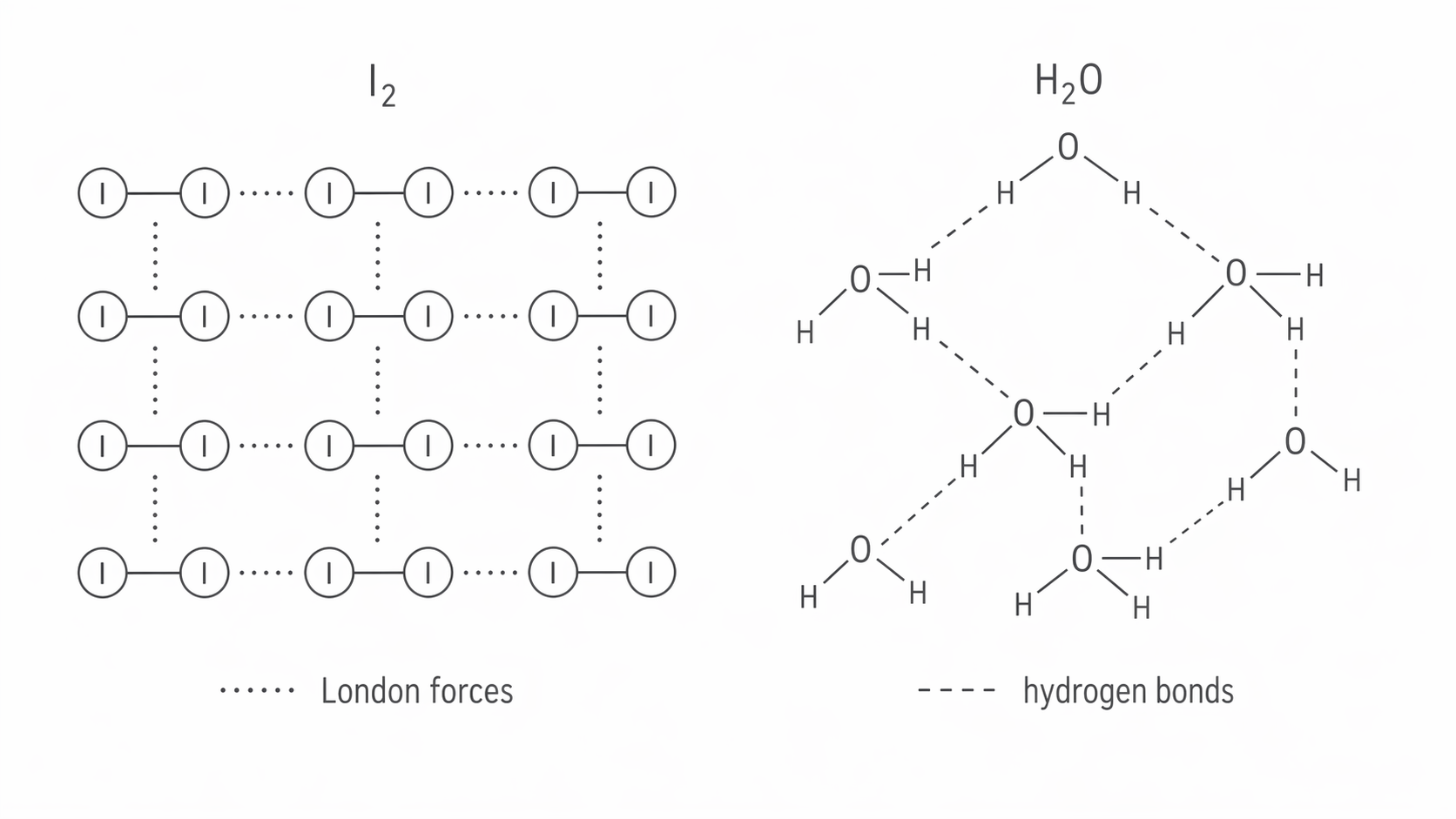
Solid iodine contains I2 molecules. Each molecule has a strong covalent bond, but neighbouring molecules are held together only by London forces. The iodine molecules are large, so these forces are strong enough to make iodine a solid, but they are still much weaker than the forces in giant structures. That is why iodine melts relatively easily and can sublime: when iodine changes state, the intermolecular forces are overcome, not the I-I covalent bonds.
Ice is also a molecular crystal, but its molecules are H2O. In ice, each water molecule is hydrogen bonded to four neighbours in an open arrangement.
Hydrogen bond
A strong intermolecular force formed between a hydrogen atom bonded to N, O, or F and a lone pair on an N, O, or F atom in another molecule.
Hydrogen bonds are stronger than ordinary London forces for molecules of similar size, which is why water has unusually high melting and boiling temperatures for a small molecule. Even so, ice still melts at a much lower temperature than sodium chloride or diamond because melting ice only requires intermolecular forces to be overcome, not a giant lattice of strong bonds.
Neither iodine nor pure ice conducts electricity. They have no mobile ions and no delocalised electrons. The fact that they are covalent substances does not make them conductors; conductivity depends on mobile charged particles.
The diagram below compares the two molecular crystals directly: iodine is held together by London forces between I2 molecules, whereas ice has an open lattice held together by hydrogen bonds between H2O molecules.
[DIAGRAM: asset_name: 1.3.4 - Bonding and Physical Properties - Diagram 3; asset_slug: 1.3.4 - Bonding and Physical Properties - Diagram 3; recommended_method: retained_png; description: Two side-by-side molecular crystal sketches. Left: several I2 molecules arranged closely in a regular pattern, with dotted attractions between neighbouring molecules labelled London forces. Right: several bent H2O molecules in an open ice lattice, with dashed O-H...O hydrogen bonds linking each water molecule to neighbours. Label London forces and hydrogen bonds clearly.]
For ice in particular, remember what does not happen on melting: the O-H covalent bonds inside water molecules remain. The structure changes because hydrogen bonds are disrupted and rearranged.
Macromolecular crystals: diamond and graphite
Diamond and graphite are both macromolecular forms of carbon. They are made only of carbon atoms, but the atoms are arranged differently, so their properties are very different.
Macromolecular structure
A giant covalent structure in which a very large number of atoms are joined by covalent bonds in a continuous network.
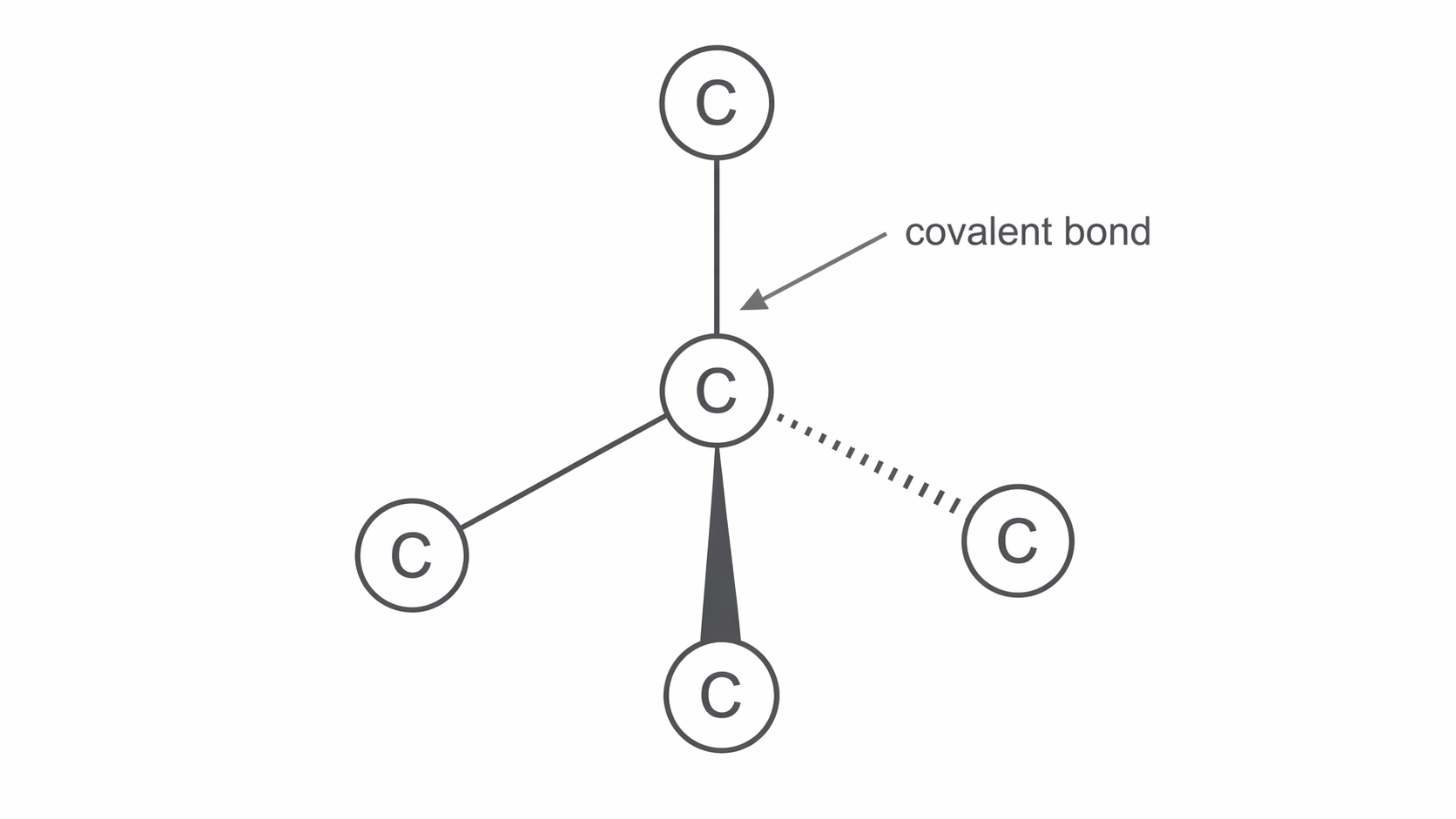
In diamond, each carbon atom forms four covalent bonds in a tetrahedral arrangement. The result is a rigid three-dimensional network of strong covalent bonds. A very large amount of energy is needed to break enough of these bonds for diamond to melt, so diamond has a very high melting temperature. Diamond does not conduct electricity because all four outer electrons of each carbon atom are used in covalent bonds, so there are no mobile charge carriers.
The diagram below shows the local bonding pattern in diamond: each carbon atom is bonded to four others in a tetrahedral arrangement.
[DIAGRAM: asset_name: 1.3.4 - Bonding and Physical Properties - Diagram 4; asset_slug: 1.3.4 - Bonding and Physical Properties - Diagram 4; recommended_method: retained_png; description: A local 3D section of diamond with one central carbon atom covalently bonded to four surrounding carbon atoms in a tetrahedral arrangement. Use wedge-and-line depth so the four bonds clearly point to a tetrahedron, and label carbon atoms plus one covalent bond.]
In graphite, each carbon atom forms three covalent bonds. That creates flat hexagonal layers. The fourth outer electron from each carbon is delocalised within the layer, so graphite can conduct electricity along the layers.
The covalent bonds within each layer are still very strong, so graphite also has a very high melting temperature. However, the layers are held together only by weak forces, so they can slide over each other. That is why graphite is soft even though it has a giant covalent structure.
The diagram below shows why graphite behaves differently from diamond: the layers contain delocalised electrons, but only weak forces act between neighbouring layers.
[DIAGRAM: asset_name: 1.3.4 - Bonding and Physical Properties - Diagram 5; asset_slug: 1.3.4 - Bonding and Physical Properties - Diagram 5; recommended_method: retained_png; description: Two stacked graphite layers made from hexagonal carbon rings. Within each layer, show every carbon bonded to three others, with delocalised electrons spread above and below the layer. Between the layers, add a label for weak forces and make the larger spacing between layers clear.]
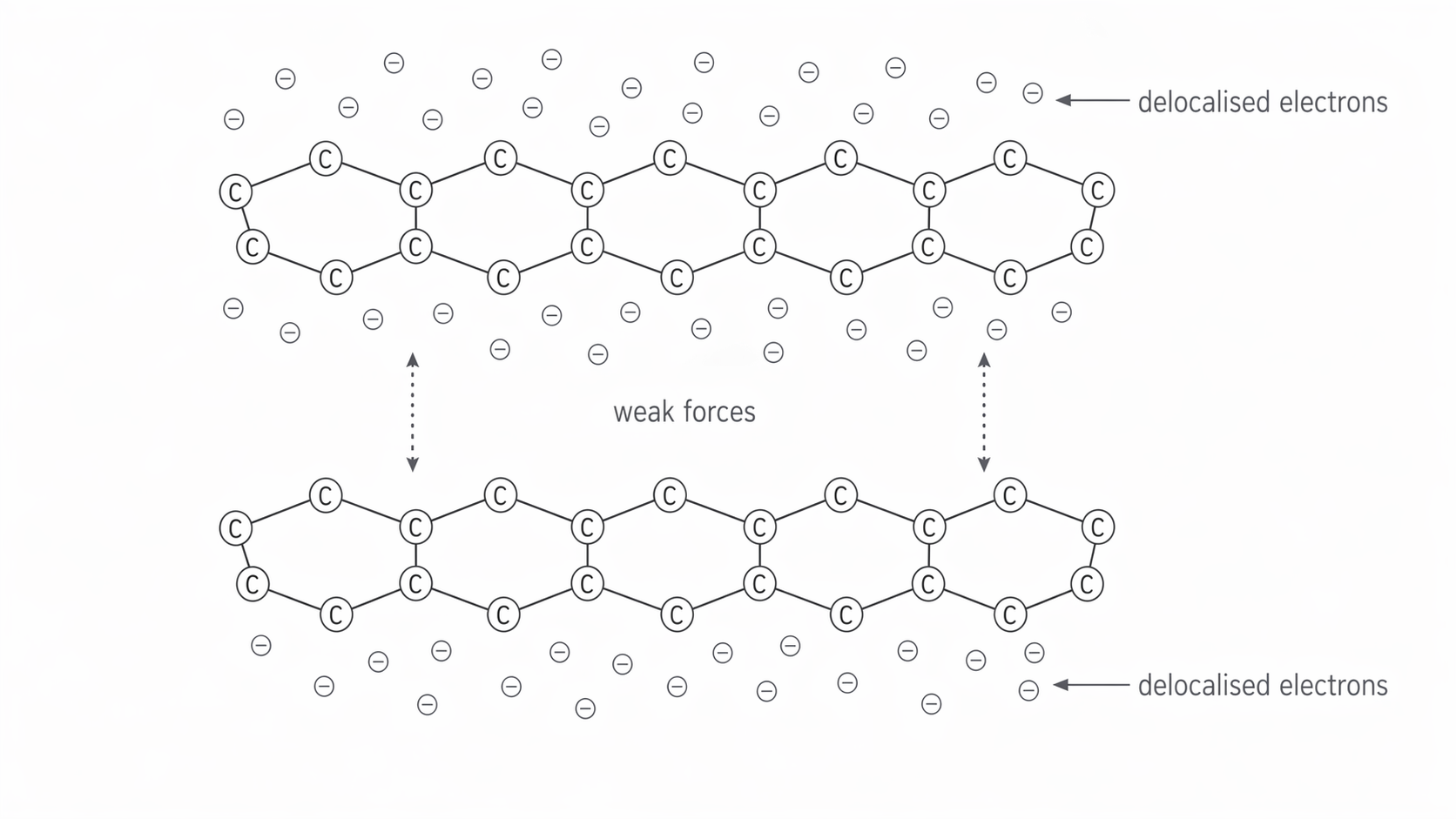
The comparison only becomes convincing when you explain both sides: why graphite conducts and why diamond does not.
Drawing and using the patterns
This topic often becomes much easier once you match the observable property to the particle model, whether you are sketching a structure or interpreting melting point and conductivity data.
Small drawing rules that keep the chemistry accurate:
NaCl: draw alternatingNa+andCl-ions in a repeating lattice; do not draw separate NaCl moleculesMg: draw a regular array of positive ions with a shared sea of electrons, not pairedMg-MgbondsI2: draw pairs of iodine atoms as molecules, with weak forces between molecules- ice: draw
H2Omolecules with dashed hydrogen bonds between molecules in an open arrangement - diamond: show each carbon bonded to four others in a 3D network
- graphite: show hexagonal layers, three bonds per carbon, and delocalised electrons within the layers
The diagrams above already show the essential particle models, so the quickest way to revise from here is to compress them into a classification table.
A quick classification summary pulls the whole topic together:
| Structure type | Example | What is held together? | Melting point | Conductivity |
|---|---|---|---|---|
| Giant ionic | sodium chloride | oppositely charged ions in a lattice | high | only when molten or in solution |
| Metallic | magnesium | positive ions and delocalised electrons | high | solid and liquid |
| Molecular | iodine, ice | molecules held by intermolecular forces | low relative to giant structures | none for pure substances |
| Macromolecular | diamond, graphite | atoms joined by covalent bonds in a giant network | very high | graphite yes, diamond no |
The pattern behind the table matters more than memorising isolated facts. High melting point usually means strong attractions throughout a giant structure. Conductivity depends on whether ions or electrons can actually move.
To explain a physical property, always name the structure, identify the particles present, and then say whether those particles can move or how much energy is needed to separate them.
If you keep linking visible properties back to the particle arrangement, this topic becomes much easier to reason through and much harder to memorise incorrectly.