9.7B - 9.8B - Biomass and energy transfer
Follow energy and biomass through food chains, construct and interpret scaled pyramids of biomass, and calculate transfer efficiencies and biomass percentages.
Energy in a food chain
Most food chains begin with a producer. During photosynthesis, a plant transfers light energy into chemical energy stored in molecules that make up its biomass. Feeding transfers some of that chemical energy from one organism to another.
Trophic level
A trophic level is a feeding level in a food chain or food web. Producers occupy the first trophic level, primary consumers the second, and consumers that feed on them occupy later levels.
Consider this meadow food chain:
Each arrow points from the organism being eaten to the organism that eats it. It therefore shows the direction in which biomass and its stored chemical energy can be transferred. Across the first feeding boundary, grass biomass is the source and the grasshopper is the receiving consumer, or sink; across the next boundary, the grasshopper becomes the source and the frog is the sink. The arrow does not show which way an animal travels or where it looks for food.
Biomass
Biomass is the total mass of living material in an organism or trophic level. Ecologists often compare dry mass for a defined area at a particular time so that different water contents do not distort the comparison.
The energy stored in an organism's biomass is potentially available to the next trophic level only if that biomass is eaten, digested and absorbed. Energy incorporated into consumer tissue remains available for a later feeding transfer; growth and reproduction add new biomass to the consumer's trophic level.
Why transfer is incomplete
The biomass at one trophic level does not simply become the same mass of organisms at the next level. Following the fate of the source biomass makes each boundary clear.
| Fate of source biomass | What happens to its stored energy | Effect on transfer to the next trophic level |
|---|---|---|
| It is not eaten | Chemical energy remains in uneaten or dead material and may later reach decomposers. | It does not enter this consumer. |
| It is eaten but not digested and absorbed | The material remains in the gut and is egested in faeces; its chemical energy may later reach decomposers. | It does not become consumer tissue. |
| It is absorbed and used in respiration | Respiration releases energy from food molecules for movement and other metabolic processes. Much of this energy is eventually transferred as thermal energy to the surroundings. | Thermal energy is a less useful form for building biomass at the next trophic level. |
| It is incorporated into growth or reproduction | Chemical energy remains stored in new consumer tissue or offspring. | This new biomass can be transferred onwards if the consumer is eaten. |
Egestion and excretion are not synonyms: egestion removes undigested food from the gut, whereas excretion removes metabolic waste made by cells. Both can reduce the material retained as consumer biomass, but undigested food is specifically egested.
Energy is not destroyed during respiration, and respiration does not produce energy. Respiration releases energy from food molecules; after metabolic transfers, much of it is dispersed to the surroundings as thermal energy and is therefore less available to build biomass at the next trophic level.
Consequences for an ecosystem
Only the fraction of chemical energy that remains stored in biomass can be transferred directly when that organism is eaten. This gives a causal chain:
A higher trophic level therefore usually supports a smaller population than the level below it. Biomass and organism number are not identical, however: ten large organisms can have more biomass than hundreds of tiny organisms. A biomass value alone cannot reveal an exact organism count unless the mass per organism is also known.
The effect compounds along a food chain. If only a fraction is retained after one transfer, only a fraction of that smaller quantity remains after the next. Eventually too little energy is available for enough organisms to grow, survive and reproduce as a stable additional population. This limits the length of the food chain.
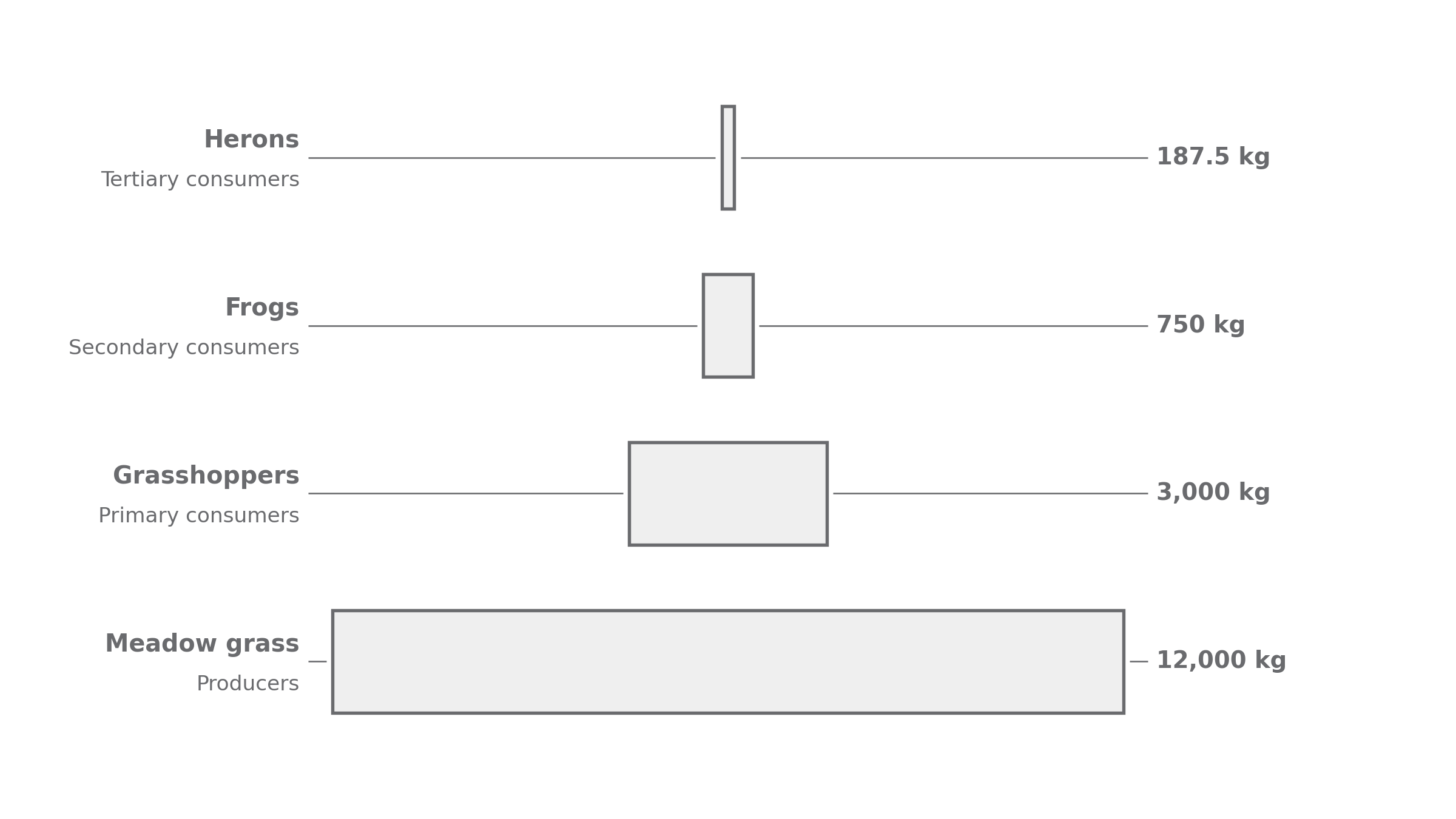
A pyramid of biomass displays these trophic levels as separate, centred horizontal bars. Each bar's width is proportional to the biomass at that level, with the producer at the bottom and later consumers above it. It is not one unscaled triangle, and its shape is determined by the supplied biomass values rather than by organism counts.
This original meadow dataset illustrates the typical pattern:
| Trophic level | Organism group | Biomass in the same defined area (kg) |
|---|---|---|
| Producer | meadow grass | 12,000 |
| Primary consumer | grasshoppers | 3,000 |
| Secondary consumer | frogs | 750 |
| Tertiary consumer | herons | 187.5 |
[DIAGRAM: asset_name: 9.7B-9.8B - Biomass and energy transfer - diagram 01; asset_slug: edexcel-gcse-biology-9-7b-9-8b-biomass-pyramid; recommended_method: matplotlib; description: Create an exact centred horizontal-bar pyramid of biomass from the original meadow dataset in the adjacent table: bottom meadow grass/producers 12,000 kg, above grasshoppers/primary consumers 3,000 kg, above frogs/secondary consumers 750 kg, top herons/tertiary consumers 187.5 kg. Bar widths must be exactly proportional to biomass, all four bars must share a vertical centre line, and labels and values must be readable outside or inside bars without changing their geometry. Use a white background, #6A6B6E outlines/text and minimal neutral fills. Show separate rectangular bars, not a triangle; do not add organisms, energy values, transfer percentages, arrows, decorative scenery or a claim that every real biomass pyramid must have this shape.]
Continue this lesson.
You’re previewing NovaLearn without an account. Create a free account to read the rest.
Create free account