8.3 - 8.5B - Alveoli and diffusion
Explain how alveoli exchange gases rapidly, then use the same surface-area, concentration and distance ideas to calculate relative diffusion rates with Fick’s law.
8.3 — Alveoli as exchange surfaces
Alveoli are tiny air sacs in the lungs. Each alveolus places an air space beside a network of capillaries, so the exchange boundary lies between air in the alveolus and blood in a capillary.
Blood arriving at the alveolar capillaries has a lower oxygen concentration and a higher carbon dioxide concentration than the alveolar air. Oxygen therefore diffuses from alveolar air, across the alveolar wall and capillary wall, into the blood. Carbon dioxide diffuses in the opposite direction: from the blood, across the capillary wall and alveolar wall, into the alveolar air, from which it is exhaled.
[DIAGRAM: asset_name: 8.1-8.5B - Exchange surfaces and diffusion - diagram 01; asset_slug: edexcel-gcse-biology-8-1-8-5b-alveolar-gas-exchange; recommended_method: image_gen; description: Textbook-style monochrome cutaway of one alveolus beside a close capillary, with the air space, thin moist alveolar wall, thin capillary wall and blood labelled. Show oxygen arrows only from alveolar air across both walls into blood, and carbon dioxide arrows only from blood across both walls into alveolar air; include incoming blood labelled low oxygen/high carbon dioxide, outgoing blood labelled high oxygen/lower carbon dioxide, and small ventilation arrows showing fresh air in and carbon-dioxide-rich air out. Emphasise the short air-to-blood diffusion distance and include a simple many-alveoli inset to show large total surface area; no heart, full airway tree, cell-type detail, numerical data, photorealism or colour-dependent meaning.]
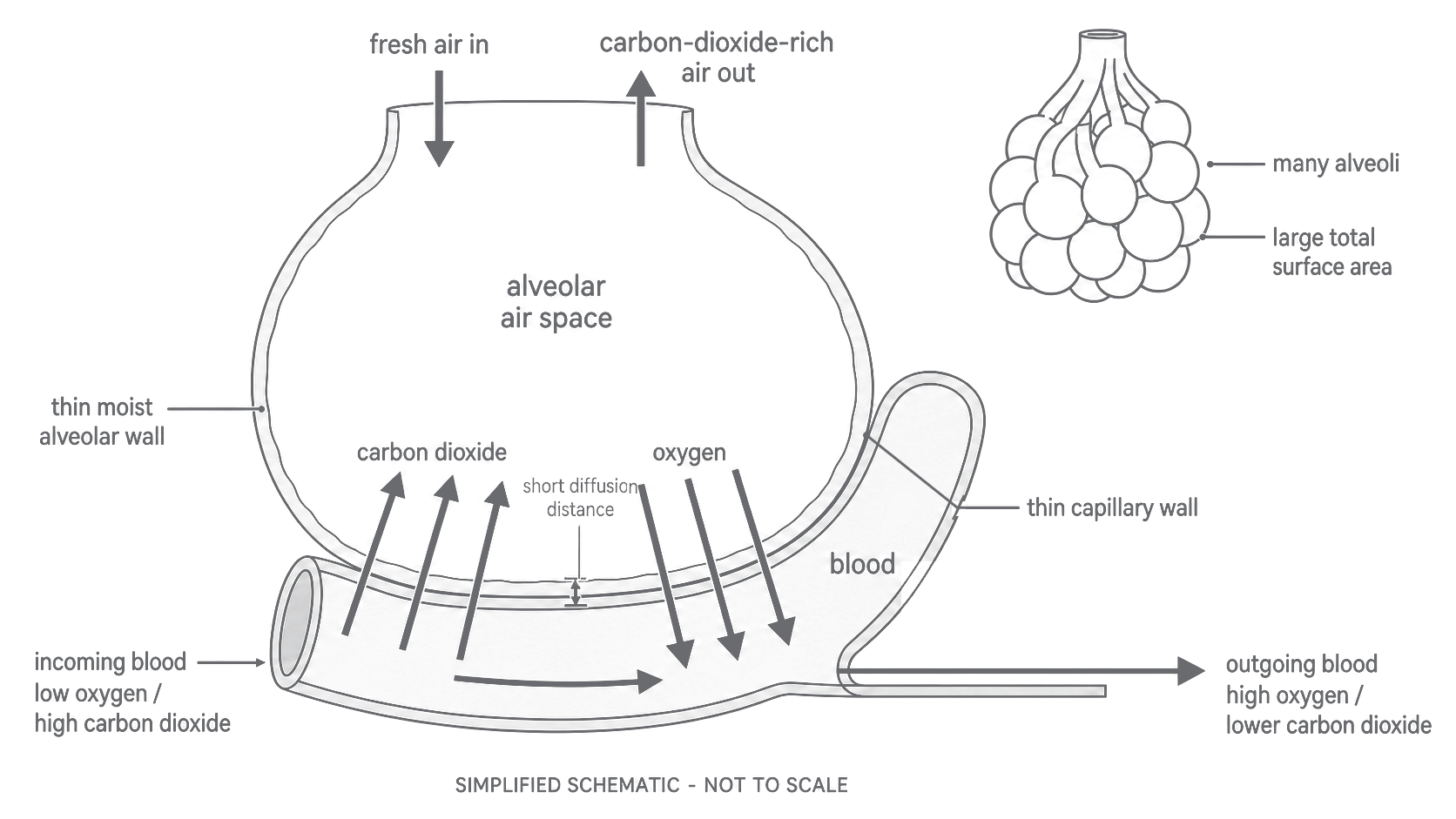
Several features make this diffusion rapid:
- Many alveoli provide a large total surface area. More of the air-blood boundary is available, so more gas particles can cross at the same time.
- The alveolar epithelium and capillary endothelium are each only one cell thick and lie close together. This creates a very short diffusion distance, so gases cross the boundary rapidly.
- The alveolar surface is moist. Oxygen and carbon dioxide dissolve before diffusing through the cells at the exchange boundary.
- Ventilation refreshes the alveolar air. It brings in air with a relatively high oxygen concentration and removes air containing more carbon dioxide.
- Continuous blood flow refreshes the other side of the boundary. It brings blood with relatively little oxygen and more carbon dioxide, then carries oxygen away and carbon dioxide towards the alveolus. Together, ventilation and blood flow maintain steep concentration gradients for both gases.
8.4B — The three diffusion-rate factors
The B suffix in 8.4B and 8.5B means Biology-only content. These points are required at both Foundation and Higher tiers.
The rate of diffusion means how much substance crosses a boundary per unit time. For the same diffusing substance and other conditions, three important factors are:
Continue this lesson.
You’re previewing NovaLearn without an account. Create a free account to read the rest.
Create free account