8.11 - Measuring respiration
Investigate aerobic respiration with a respirometer: explain the movement of its liquid marker, plan a temperature comparison, calculate rates and evaluate the control evidence.
8.11 — How a respirometer works
Recall that aerobic respiration uses oxygen and releases carbon dioxide as glucose is broken down in living cells. The apparatus below uses that gas exchange to measure a rate.
A respirometer estimates the rate of aerobic respiration by measuring oxygen uptake. It is not a spirometer: it does not measure breathing or human lung volume. The simple Pearson apparatus encloses small living organisms with a known volume of air and connects that sealed chamber to a narrow capillary containing coloured liquid.
[DIAGRAM: asset_name: 8.9-8.11 - Respiration and respirometry - diagram 01; asset_slug: edexcel-gcse-biology-8-9-8-11-respirometer-apparatus; recommended_method: image_gen; description: Two equal respirometers in one water bath, with living mealworms in the test and inert glass beads matching organism displacement volume in the control. Both chambers contain soda lime beneath porous cotton wool and have airtight bungs connected to capillaries dipping into coloured-liquid reservoirs. Show liquid moving towards the test tube, a ruler, thermometer, and bath water surrounding the trapped-air chambers. Label the physical separator, carbon dioxide absorption and oxygen uptake; keep organisms dry and separated from soda lime.]
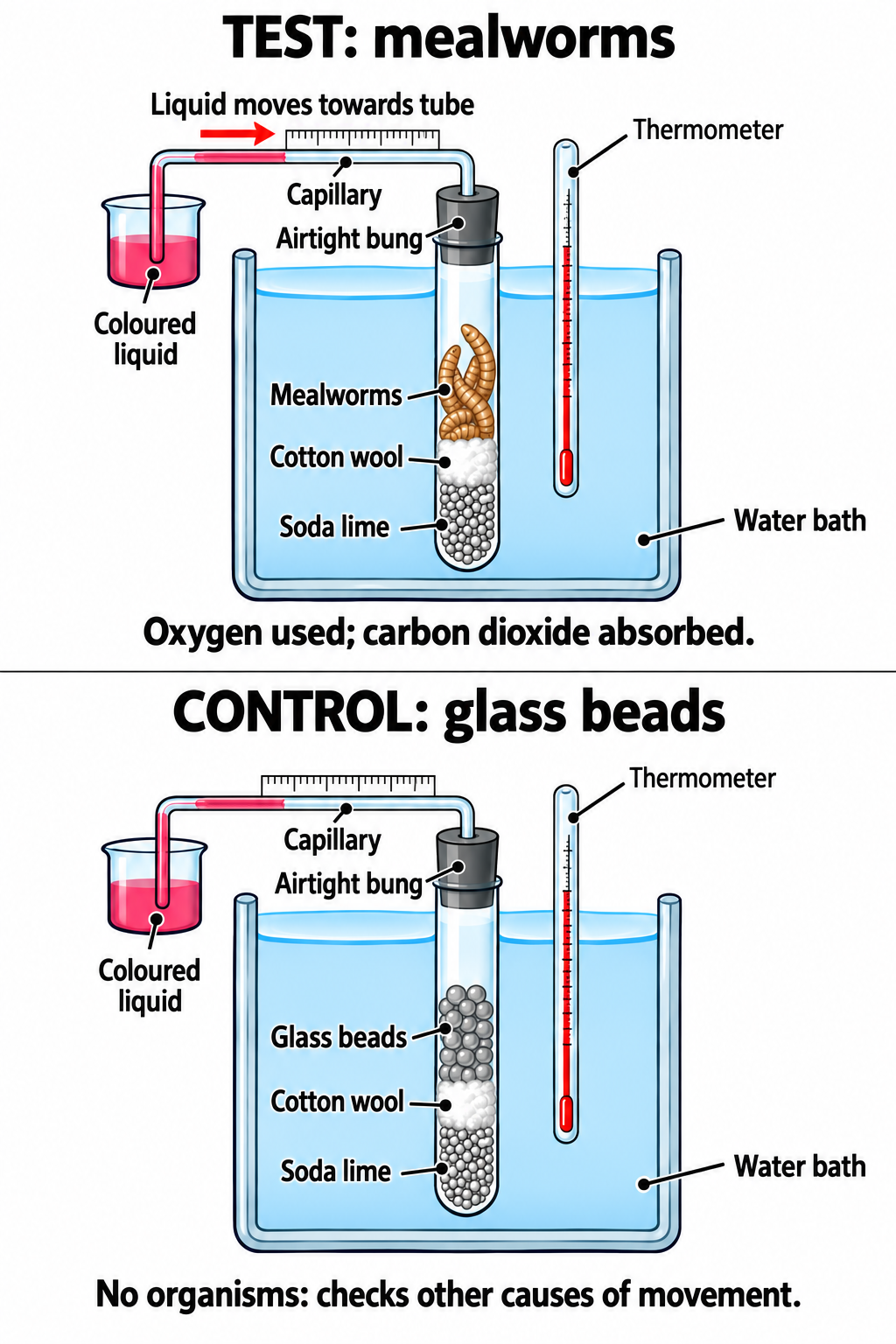
The panels separate the setups so their labels can be read clearly; in an experiment both matched tubes experience the same stable bath temperature. Cotton wool is a porous physical separator: it keeps the mealworms above the corrosive soda lime, while the control contains the same separator below its inert beads. Soda lime absorbs carbon dioxide. The control uses beads with the same displacement volume as the mealworms to match the trapped-air volume.
The movement has a precise causal explanation:
- The organisms take oxygen from the trapped air for aerobic respiration and release carbon dioxide into the chamber.
- Carbon dioxide diffuses through the porous cotton wool and is absorbed by the soda lime. The cotton wool keeps organisms physically separated from corrosive soda lime while allowing gases through. The soda lime does not absorb the oxygen.
- Oxygen has left the chamber air and entered the organisms, while the carbon dioxide returned by the organisms is removed from the air. At a stable temperature, the gas pressure inside the sealed chamber falls.
- Atmospheric pressure outside the apparatus is now greater than the pressure inside. It pushes the coloured liquid along the capillary towards the sealed tube and the organisms.
- Over a fixed time, a greater movement along the same capillary indicates a greater oxygen-uptake rate and therefore a greater rate of aerobic respiration.
The instrument does not measure energy release directly. Its valid chain of inference is marker movement -> fall in chamber gas pressure -> oxygen uptake -> aerobic respiration. That inference depends on an airtight apparatus, stable temperature, carbon dioxide absorption and an appropriate control.
8.11 — Core practical: changing temperature
The question for core practical 8.11 is: how does temperature affect the rate of oxygen uptake by living organisms? Use suitable small organisms, such as mealworms or germinating peas, selected by the teacher for the apparatus and safe temperature range.
| Role | Operational variable |
|---|---|
| Independent variable | temperature of the water bath, in degrees C, changed across several teacher-approved values that are safe for the chosen species |
| Dependent variable | distance the coloured liquid moves, in mm, during a fixed time, converted to a marker-movement rate such as mm s |
| Controlled variables | species and developmental stage of organism; mass of organisms; measurement time; starting gas volume; mass of soda lime; cotton-wool arrangement; capillary bore and chamber dimensions |
Use this workable sequence:
- Wearing eye protection, collect two tubes pre-prepared by the teacher or technician with the same measured mass of soda lime at the bottom and a cotton-wool plug above it. Students must not handle the soda lime. The cotton wool must prevent contact between the organisms and soda lime while still allowing gases to pass.
- Measure a small group of mealworms on a balance and place them above the cotton wool in the test tube. Put inert glass beads of the same total displacement volume as the organisms into the otherwise identical control tube. This matches the trapped-air volume without adding respiration.
- Fit each tube with its airtight cored bung and L-shaped capillary. Check the bungs and connections for leaks using the approved apparatus check before collecting results.
- Put both tubes into a water bath at the first safe temperature, with the trapped-air chambers surrounded by water and the bungs above the water surface. Check the bath with a thermometer. Keep the capillary ends open to air during equilibration. Wait long enough for the apparatus, trapped air and organisms to reach a stable bath temperature; five minutes is a possible starting period, not proof of equilibration. Then place the open capillary ends in coloured liquid, allow the liquid to settle, and record the starting positions.
- Record the starting position of the coloured liquid, start the timer, and measure the distance moved towards the tube over the fixed time interval.
- Reset using the teacher-approved method: briefly remove the bung to refresh the chamber air and equalise pressure. Have the liquid reset in the capillary without mouth suction, refit the bung, allow the temperature to stabilise again, and record a fresh starting position. Obtain at least three readings at that temperature so a mean can be calculated. Use fresh matched organism groups for independent biological repeats where practicable.
- Repeat at the other safe water-bath temperatures using fresh matched groups with the same species, developmental stage and mass. Unseal the tubes after each short measurement and return organisms promptly to suitable conditions.
Continue this lesson.
You’re previewing NovaLearn without an account. Create a free account to read the rest.
Create free account