6.7 - 6.10 - Plant transport systems
Follow water and mineral ions from the soil to the leaves, then trace sucrose from a source to a sink. Connect root hairs, xylem, phloem and stomata to their roles in transport.
6.7 - Absorption at root hairs
The transport story begins at the surface of a young root. A root hair cell is an epidermal cell with a long, narrow projection that grows between soil particles. The projection is part of one cell, not a separate multicellular hair.
Water and dissolved mineral ions reach the cell in the thin film of water around soil particles. Three structural features support absorption:
- The long projection gives a large surface area in contact with soil water. More cell surface is available for water and mineral-ion uptake, so absorption can occur more quickly.
- The cell wall is thin, giving water and ions a short path to the cell surface membrane where movement into the cell is controlled.
- The cell contains many mitochondria. Respiration releases energy that can be used for the active transport of mineral ions.
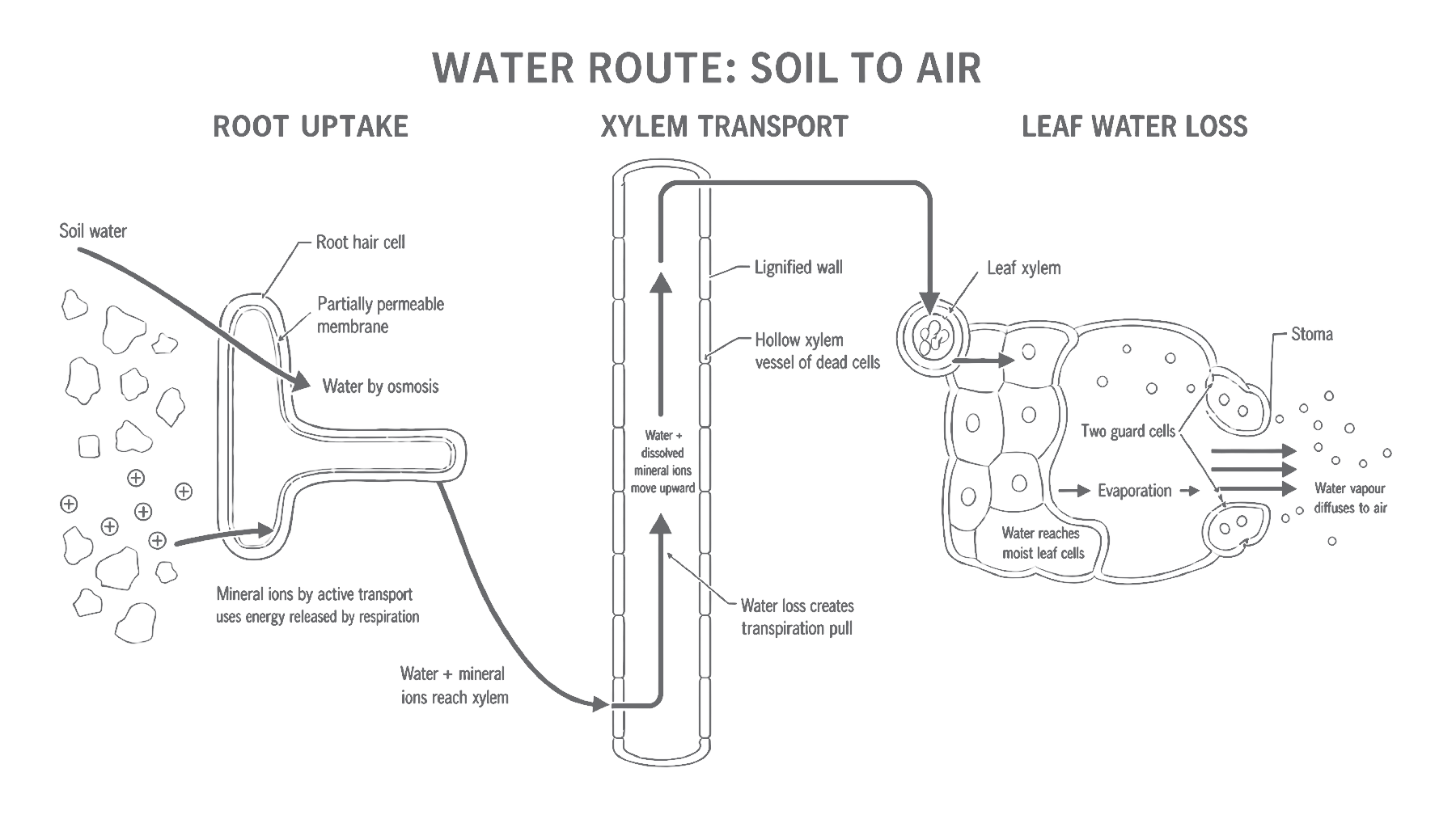
Water and mineral ions do not enter by the same process. Water moves across the partially permeable cell membrane by osmosis, from the soil solution with a higher water concentration to the root hair cell with a lower water concentration. A mineral ion may need to move from a lower concentration in the soil to a higher concentration in the cell; this is active transport, movement against the concentration gradient using energy released by respiration.
Osmosis moves water. Active transport can move mineral ions. Calling mineral-ion uptake "osmosis" confuses the substance that moves.
6.8 - Xylem: a strengthened water route
After entering the root, water and mineral ions reach the xylem, a transport tissue that runs through roots, stems and leaves. Mineral ions are dissolved in the water, so they are carried with it through the xylem.
A xylem vessel is built from cells joined end to end. When these cells mature, they die and lose their cell contents and end walls. This creates a long, hollow, continuous tube with little obstruction to water flow. Because the conducting cells are dead, they cannot use energy to pump water.
The vessel walls contain lignin. This material thickens and strengthens the walls, helping the tube remain open instead of collapsing while water is under tension. Lignified walls also help support the plant. The feature-function links are therefore:
- dead cells with no contents -> a hollow passage -> less resistance to water flow;
- no end walls -> a continuous vessel -> water can move along the plant;
- lignified walls -> a strong tube -> the vessel resists collapse as water is pulled upward.
Xylem transport has a fixed overall direction: from the roots, upward through the stem, towards the leaves and other aerial tissues.
6.9 - Transpiration and stomata
The pull that moves the xylem stream begins in a leaf. Water reaches leaf cells from the xylem, then evaporates from their moist surfaces into air spaces inside the leaf. Water vapour diffuses out through tiny pores in the leaf surface called stomata.
One pore is a stoma; more than one are stomata. Each stoma lies between two guard cells. The guard cells change shape to open or close the pore. An open pore permits carbon dioxide to diffuse into the leaf, but it also allows water vapour to diffuse out; closing the pore reduces this water loss.
Transpiration
Transpiration is the loss of water vapour from a plant's leaves, mainly through the stomata.
The complete causal sequence is:
- Water evaporates from moist leaf cell surfaces and water vapour diffuses through open stomata into the air.
- This loss creates tension, or a pull, on water in the leaf xylem.
- Water molecules cohere, so the pull is transmitted down a continuous column of water in the xylem.
- Replacement water is pulled upward from the roots to the leaves. Dissolved mineral ions travel in this transpiration stream.
The water loss drives the stream; roots do not pump the whole column upward. Mineral ions are delivered in solution to plant tissues, but they do not evaporate or diffuse out through the stomata with the water vapour.
[DIAGRAM: asset_name: 6.7-6.10 - Plant transport systems - diagram 01; asset_slug: edexcel-gcse-biology-6-7-6-10-water-transpiration-route; recommended_method: image_gen; description: A clean whole-plant textbook schematic tracing the water route from moist soil to air. Show a magnified root hair cell with water crossing its partially permeable membrane by osmosis and mineral ions entering by active transport using energy, then both reaching xylem. Show a long hollow lignified dead-cell xylem vessel with unambiguous upward arrows labelled water plus dissolved mineral ions. In a leaf inset, show evaporation from moist leaf cell surfaces, water vapour diffusion through one stoma between two guard cells, and the resulting pull on the xylem column. Every arrow must connect soil -> root hair -> xylem -> leaf -> air. Exclude phloem, environmental-rate factors, graphs, potometers, root pressure and detailed leaf-adaptation labels.]
Continue this lesson.
You’re previewing NovaLearn without an account. Create a free account to read the rest.
Create free account