9.15 - Nitrogen cycle and farming
Trace the bacterial processes that make nitrate available to plants, and explain how fertilisers, crop rotation and waterlogging change the nitrogen supply.
9.15 — Nitrates and bacteria
Plants need nitrogen to make amino acids and then proteins for growth. Although the atmosphere contains abundant nitrogen gas, most plants cannot use directly. They absorb nitrogen compounds, especially nitrate ions (), from soil water through their roots. Animals obtain nitrogen by feeding on plants or other animals.
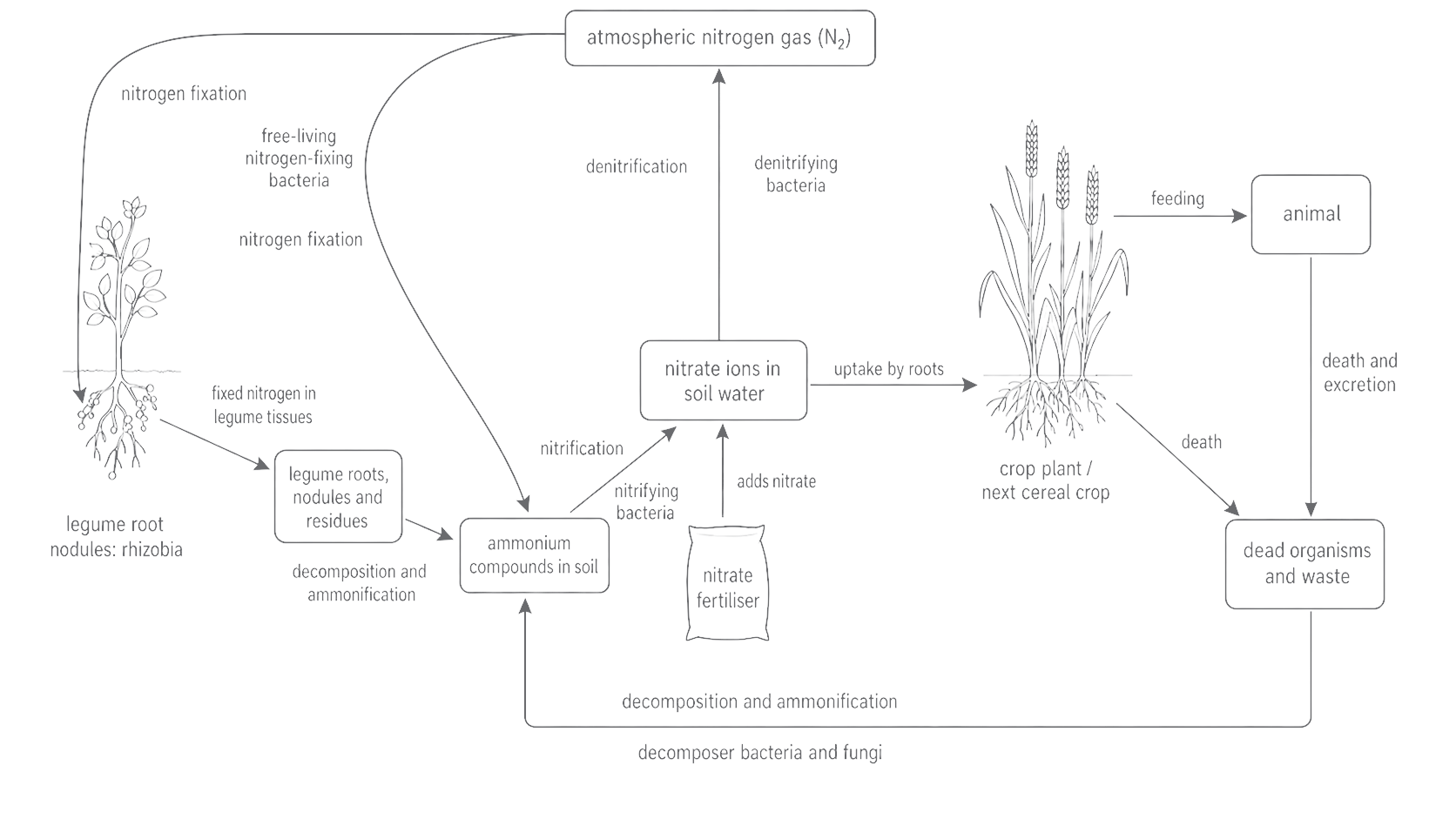
Different bacteria carry out different transfers in the nitrogen cycle:
- Nitrogen fixation: nitrogen-fixing bacteria convert atmospheric nitrogen gas into ammonia or ammonium compounds. Some live freely in soil; others, called rhizobia, live in root nodules of legumes such as peas, beans and clover. The legume supplies sugars to the bacteria, and uses the fixed nitrogen to make amino acids and proteins.
- Decomposition and ammonification: decomposer bacteria and fungi digest nitrogen-containing compounds in dead organisms and waste. They release ammonium ions () into the soil.
- Nitrification: nitrifying bacteria in aerated soil convert ammonium ions into nitrate ions, through nitrite as an intermediate. This makes nitrate available in the soil solution for root uptake.
- Plant uptake and feeding: plants absorb nitrate ions and build nitrogen into amino acids and proteins. Feeding transfers these organic nitrogen compounds to animals.
- Denitrification: in low-oxygen conditions, especially waterlogged soil, denitrifying bacteria convert nitrate ions back into nitrogen gas. This returns nitrogen to the atmosphere and reduces the nitrate available to plants.
[DIAGRAM: asset_name: 9.12-9.15 - Carbon, water and nitrogen cycles - diagram 03; asset_slug: edexcel-gcse-biology-9-12-9-15-nitrogen-cycle-farming-route; recommended_method: image_gen; description: A monochrome GCSE textbook nitrogen-cycle route with a main natural cycle and two clearly attached farming inputs. Required stores: atmospheric nitrogen gas, ammonium compounds in soil, nitrate ions in soil water, ordinary crop plant, animal, dead organisms and waste, decomposer bacteria/fungi, free-living nitrogen-fixing bacteria, legume root nodules with rhizobia, nitrifying bacteria and denitrifying bacteria. Required directed arrows: atmospheric nitrogen to ammonium/usable nitrogen compounds labelled nitrogen fixation; dead organisms/waste to ammonium compounds labelled decomposition and ammonification; ammonium to nitrate labelled nitrification; nitrate into plant roots labelled uptake; plant to animal labelled feeding; plant and animal to dead material/waste labelled death and excretion; nitrate to atmospheric nitrogen labelled denitrification. Farming attachments: nitrate fertiliser directly into the soil nitrate store; a crop-rotation sequence showing legume roots/nodules and residues decomposing to ammonium, then nitrification to nitrate available to the next cereal crop. Arrowheads and source/sink boundaries must be unmistakable. Do not show plants absorbing atmospheric nitrogen directly, legumes releasing nitrate directly, energy cycling, lightning, industrial fertiliser manufacture, eutrophication or quantitative data.]
9.15 — Fertilisers and crop rotation
Farmers can increase the nitrate available to crop roots in two ways:
Continue this lesson.
You’re previewing NovaLearn without an account. Create a free account to read the rest.
Create free account