9.14 - Water cycle and water supply
Follow water through the atmosphere, land and organisms, then explain why drought reduces freshwater supplies and how desalination can provide drinking water.
9.14 — Water cycling
Water is a reactant in photosynthesis, a solvent for cell reactions and a transport medium in organisms. The water cycle is important because it continually moves water between atmosphere, land, bodies of water and organisms, replenishing freshwater stores on which ecosystems depend.
The main transfers have fixed directions:
- Energy transferred from the Sun warms liquid water in oceans, lakes, rivers and wet soil. Evaporation changes liquid water into water vapour, which enters the atmosphere.
- Plants absorb water from soil through their roots. Some reaches the leaves, evaporates from cell surfaces and diffuses out as water vapour. This loss from leaves is transpiration.
- As moist air cools, water vapour condenses into tiny liquid droplets that form clouds.
- Droplets grow and water falls to the surface as precipitation, such as rain.
- Water collects in rivers, lakes and oceans. Surface runoff moves water downhill, while infiltration moves it into soil and groundwater. Plants take up soil water, animals obtain water by drinking and feeding, and excretion returns water to the abiotic environment.
[DIAGRAM: asset_name: 9.12-9.15 - Carbon, water and nitrogen cycles - diagram 02; asset_slug: edexcel-gcse-biology-9-12-9-15-water-cycle-desalination-route; recommended_method: image_gen; description: A clean monochrome textbook water-cycle route with one small desalination inset. Required stores: ocean, lake/river, soil and groundwater, plant, animal, atmospheric water vapour and cloud droplets. Required directed arrows: surface water to atmospheric vapour labelled evaporation; soil water into plant roots labelled uptake; leaves to atmospheric vapour labelled transpiration; vapour to cloud droplets labelled condensation; clouds to land and water labelled precipitation; land surface to river/ocean labelled runoff; surface into soil/groundwater labelled infiltration; plant/water to animal labelled feeding/drinking; animal to soil/water labelled excretion. Inset route: seawater to high-pressure reverse-osmosis membrane, with water passing to a treated-water/post-treatment outlet and dissolved salts retained in a brine outlet. All arrowheads must be unambiguous. Exclude exact data, weather systems, sewage treatment, decorative scenery and any suggestion that desalination is a natural water-cycle process.]
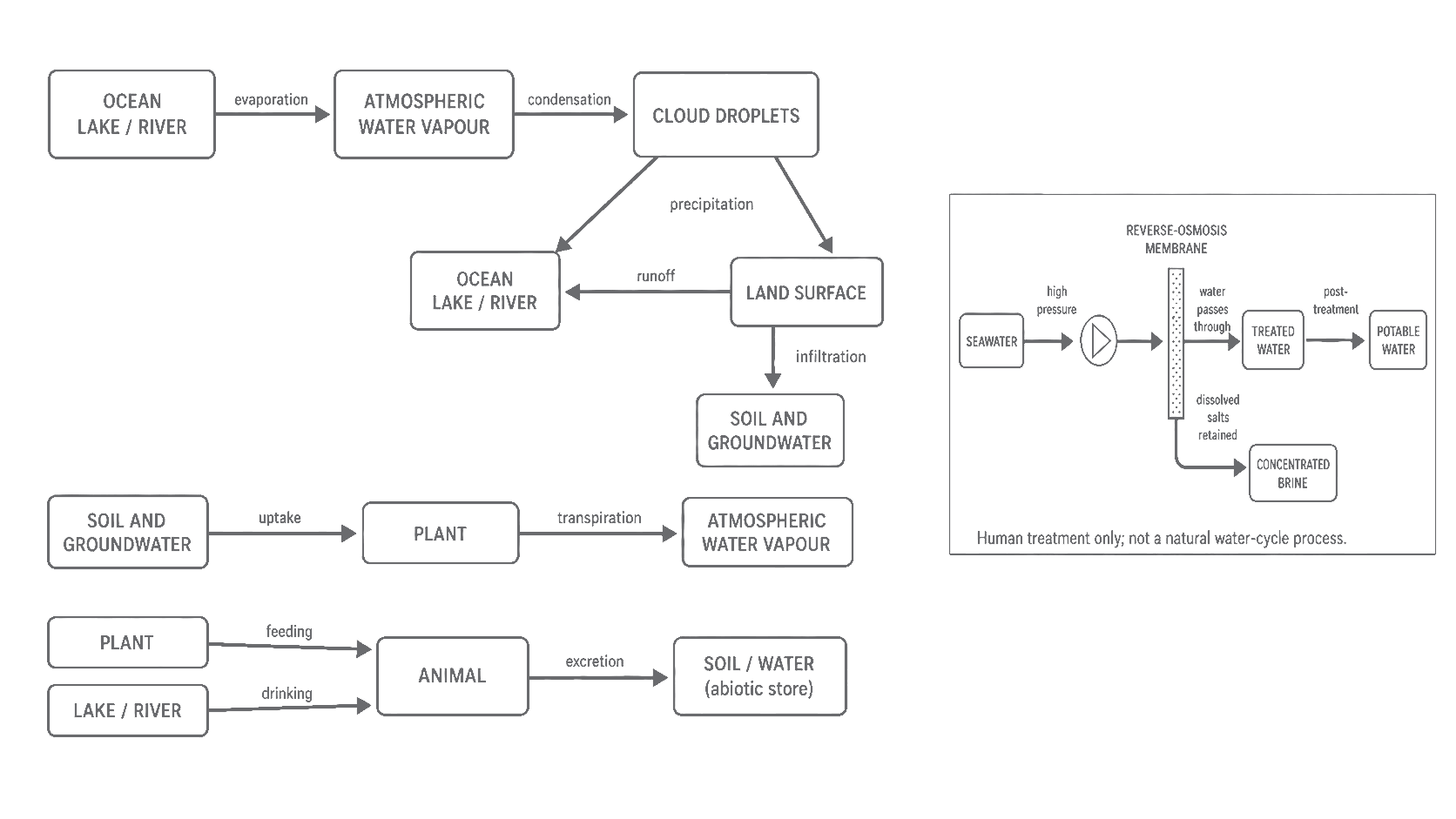
The water diagram repeats some store names to keep arrows readable: boxes with the same name represent the same store. Follow water back from precipitation to surface water and then evaporation; follow the plant branch through uptake and transpiration.
Continue this lesson.
You’re previewing NovaLearn without an account. Create a free account to read the rest.
Create free account