7.18B - 7.19B - Kidneys and urine formation
Keep the blood route through the kidneys separate from the urine route to the bladder. Connect nephron structure to filtration and to the reabsorption of useful substances and water.
7.18B - The urinary system route
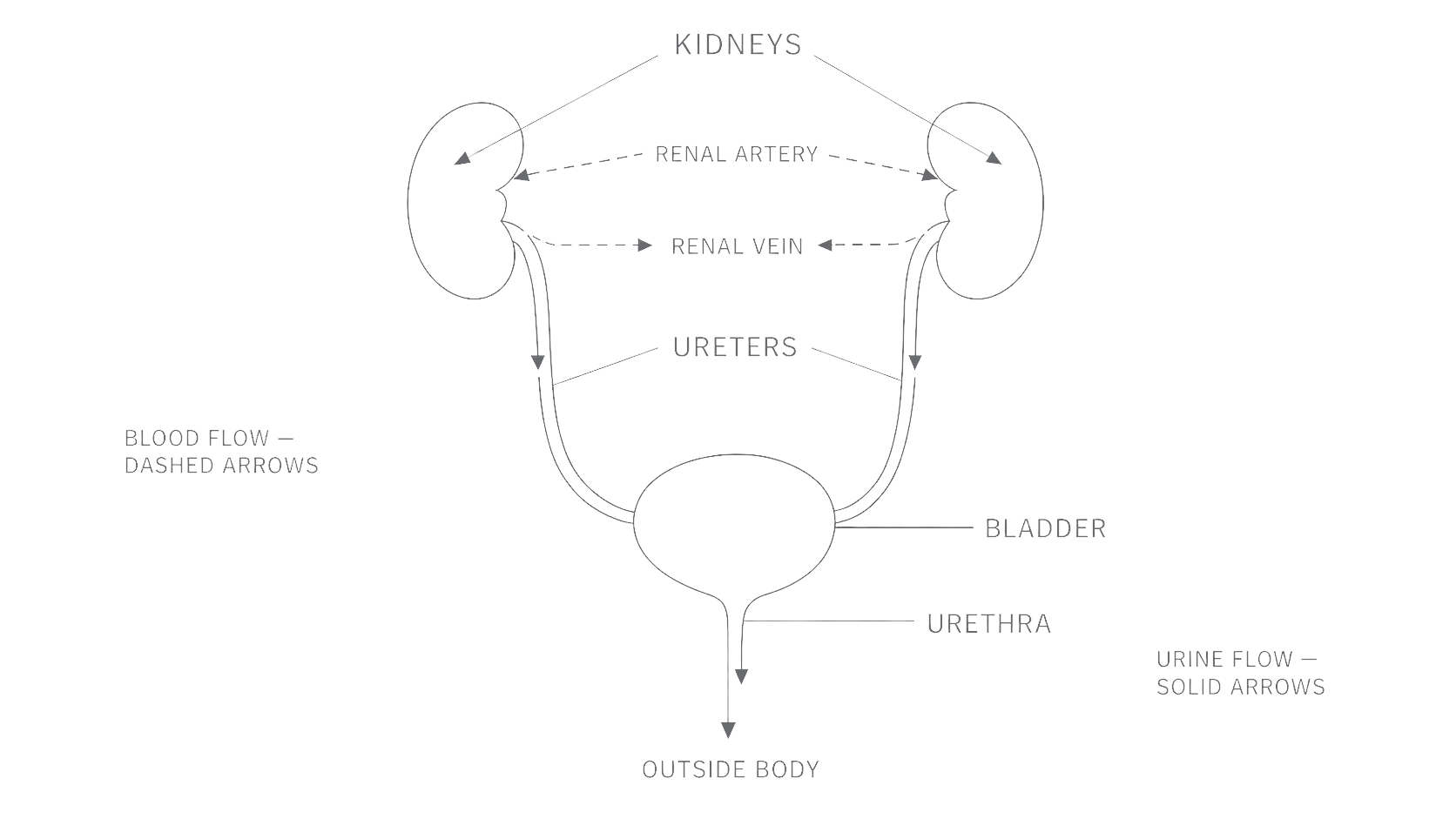
The urinary system has two routes that must be kept separate. Blood circulates through
the kidneys, but urine flows away from the kidneys.
- Two kidneys, one on each side of the spine, filter the blood and form urine. Blood
containing dissolved substances enters each kidney through a renal artery. Filtered
blood leaves through a renal vein. - A ureter carries urine from each kidney to the bladder. The bladder stores urine;
it does not produce it. - The urethra carries urine from the bladder to outside the body.
The directions are therefore:
| Route | Direction |
|---|---|
| Blood | renal artery -> kidney -> renal vein |
| Urine | kidney -> ureter -> bladder -> urethra -> outside the body |
Inside each kidney are many microscopic filtering units called nephrons. Each nephron
begins with a blood-filtering region and continues as a tubule. Fluid from the nephrons
enters collecting ducts, which drain towards the ureter.
[DIAGRAM: asset_name: 7.18B-7.22B - Kidneys, ADH and urea - diagram 01; asset_slug: edexcel-gcse-biology-7-18b-7-22b-urinary-system-route; recommended_method: image_gen; description: Simple monochrome textbook schematic of the human urinary system showing two kidneys, one ureter descending from each kidney into one bladder, and one urethra leaving the bladder to outside the body. Label renal artery with arrow into each kidney and renal vein with arrow away from each kidney. Show urine arrows only from kidney to ureter to bladder to urethra and outside; keep the blood route visually separate using distinct line styles and explicit text labels rather than colour. Exclude adrenal glands, reproductive organs, digestive organs, kidney cross-sections and any arrow from bladder back to kidney.]
7.19B - Filtering blood and forming urine
A nephron forms urine in an ordered sequence. The fluid first produced by filtration is
called filtrate; it is not yet urine because useful substances and much of its water
will be returned to the blood.
1. Filtration into Bowman's capsule
The glomerulus is a knot of tiny capillaries held inside the cup-shaped Bowman's
capsule. Its many capillaries provide a large filtering surface, and the blood in them is
under pressure. Water and small dissolved substances, including glucose and urea, cross the
filtration barrier from the blood into Bowman's capsule. Blood cells and large plasma
proteins are too large to cross and remain in the blood.
Bowman's capsule surrounds the glomerulus, so it collects the filtrate and directs it into
the nephron tubule. Whole blood does not enter the capsule.
2. Selective reabsorption of glucose
The tubule has a large surface area, providing more membrane for reabsorption, and lies close
to a network of capillaries, giving substances a short route back into the blood. In its first
part, glucose is moved from the filtrate, across the tubule wall and back into the blood by
active transport. Normally, all the filtered glucose is reabsorbed.
The cells lining this early tubule have microvilli, folds that increase the area for transport, and many mitochondria to supply energy for active transport. Together with the nearby capillaries, these adaptations allow useful glucose to return efficiently to the blood.
This is selective reabsorption: a useful substance is selected from the filtrate and
returned to the blood. It is the reverse direction from filtration.
3. Reabsorption of water
Water moves from the filtrate across parts of the nephron wall and back into nearby blood
capillaries by osmosis. The body can vary how much water is returned. The fluid then passes through a collecting duct, where further water reabsorption helps
adjust its final concentration. After useful substances and much of the water have been
reabsorbed, the remaining fluid forms urine, containing urea, excess salts and water. It
drains towards the ureter.
Continue this lesson.
You’re previewing NovaLearn without an account. Create a free account to read the rest.
Create free account