4.9B - Tissue culture
Follow how cells and tissues are grown outside an organism under controlled conditions. Explain how plant tissue culture multiplies a selected genotype and why cell cultures are useful, but limited, models in medical research.
4.9B — From explant to plantlets
Selective breeding produces varied offspring and takes several generations. Once a plant
breeding programme has found one plant with a valuable combination of characteristics,
plant tissue culture can make many copies of it much more quickly.
Tissue culture
Tissue culture is the growth of cells or small pieces of tissue outside an organism in a
suitable artificial growth medium under controlled conditions.
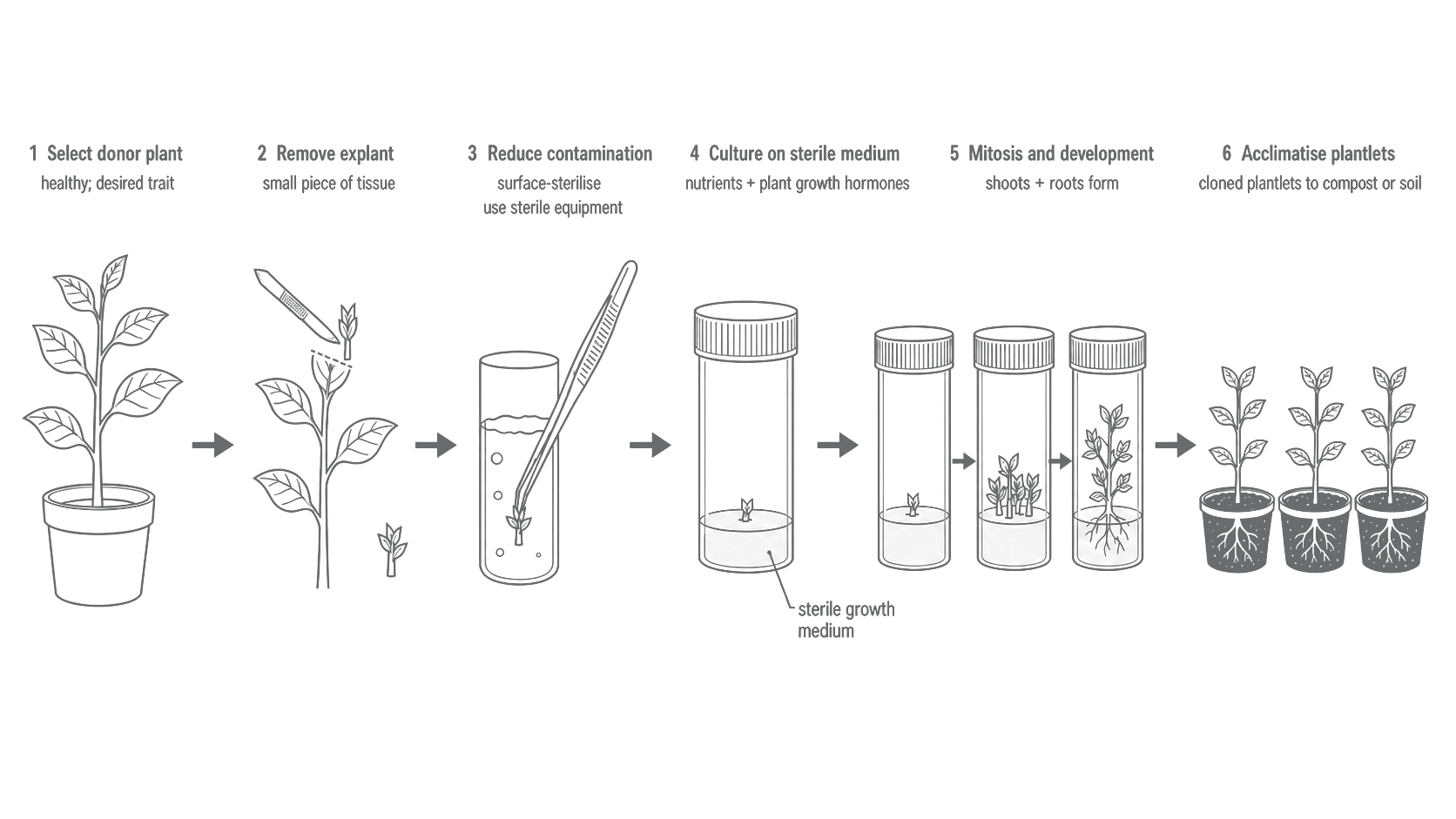
For plant tissue culture, the sequence is:
- Select a healthy donor plant with the desired characteristics and remove a very small
piece of tissue called an explant, often from an actively growing region. - Surface-sterilise the explant and use sterile equipment and vessels. This reduces
contamination by bacteria and fungi, which would otherwise use the nutrients and may
destroy the culture. - Place the explant on a sterile growth medium. The medium supplies water, mineral ions,
sugars and other nutrients; suitable plant growth hormones control cell division and
the development of shoots and roots. - Cells divide by mitosis. Under the right conditions they form shoots and roots, so
small plantlets develop. - Separate plantlets to make further cultures if more copies are needed. When large
enough, move them gradually to non-sterile growing conditions and then to compost or
soil. This acclimatisation prevents a sudden change in humidity and other conditions.
Because the plantlets arose by mitosis from one donor, they are clones and normally
carry the same alleles as that donor. Tissue culture therefore copies a selected genotype;
it does not by itself combine alleles from two parents or create a new crop variety.
[DIAGRAM: asset_name: 4.8-4.9B - Selective breeding and tissue culture - diagram 01; asset_slug: edexcel-gcse-biology-4-8-4-9b-plant-tissue-culture-sequence; recommended_method: image_gen; description: A simple left-to-right textbook process schematic of plant tissue culture with clear arrowheads and six labelled stages: selected healthy donor plant with a desired trait; removal of a small explant; surface-sterilisation and transfer with sterile equipment; explant on sterile nutrient medium containing plant growth hormones; mitosis followed by shoot and root formation; acclimatised cloned plantlets transferred to compost or soil. Show the explant and plantlets at sensible relative scales without implying an exact scale. Exclude seeds, sexual reproduction, genetic engineering, exact medium recipes or concentrations, photorealism, micrograph styling, and any claim that all cultured plants are automatically disease-free.]
4.9B — Tissue culture in research and breeding
The common idea in every tissue culture is that living cells are maintained outside the
organism in a controlled environment. The starting material and the purpose differ between
plant breeding and medical research.
Continue this lesson.
You’re previewing NovaLearn without an account. Create a free account to read the rest.
Create free account