9.1 - 9.4 - Ecosystem organisation and interdependence
Explore how organisms form populations, communities and ecosystems, and how changes in living and non-living factors affect their survival and reproduction.
9.1 — From one organism to an ecosystem
Picture an oak woodland. You could focus on one oak tree, count all the oak trees, record every species living there, or include the light, water, temperature and soil as well. Each change of focus moves to a more inclusive level of ecological organisation.
| Level | What belongs at this level? | Oak woodland example |
|---|---|---|
| Individual organism | One living individual | One oak tree |
| Population | All the organisms of one species living in the same area at the same time | All the oak trees in the woodland |
| Community | All the populations of different species living and interacting in the same area | Oaks, bluebells, fungi, insects, birds and every other living population in the woodland |
| Ecosystem | The community, the non-living environment and the interactions between them | The woodland community together with light, temperature, water, air and soil conditions |
The levels are nested. Adding more individuals of the same species to one organism forms a population. Adding the populations of other species forms a community. Adding the abiotic environment and its interactions with the community forms the whole ecosystem.
[DIAGRAM: asset_name: 9.1-9.4 - Ecosystem organisation and interdependence - diagram 01; asset_slug: edexcel-gcse-biology-9-1-9-4-ecological-organisation; recommended_method: image_gen; description: Four clean left-to-right panels that become progressively more inclusive: one oak tree labelled "individual organism"; several oak trees of the same species in one woodland labelled "population"; the oak population plus populations of bluebells, fungi, insects and birds labelled "community"; the same community together with non-living light, temperature, water, air and soil labelled "ecosystem". Between panels use expansion/containment arrows labelled "adds more individuals of the same species", "adds other species' populations" and "adds the abiotic environment and interactions"; these are scale/containment arrows, not food-chain, material-cycle or energy-transfer arrows. Use a white background, #6A6B6E linework and text, and minimal neutral fills. Exclude food-web arrows, trophic levels, cycles, quadrats, transects, biomass, percentages and all off-scope labels.]
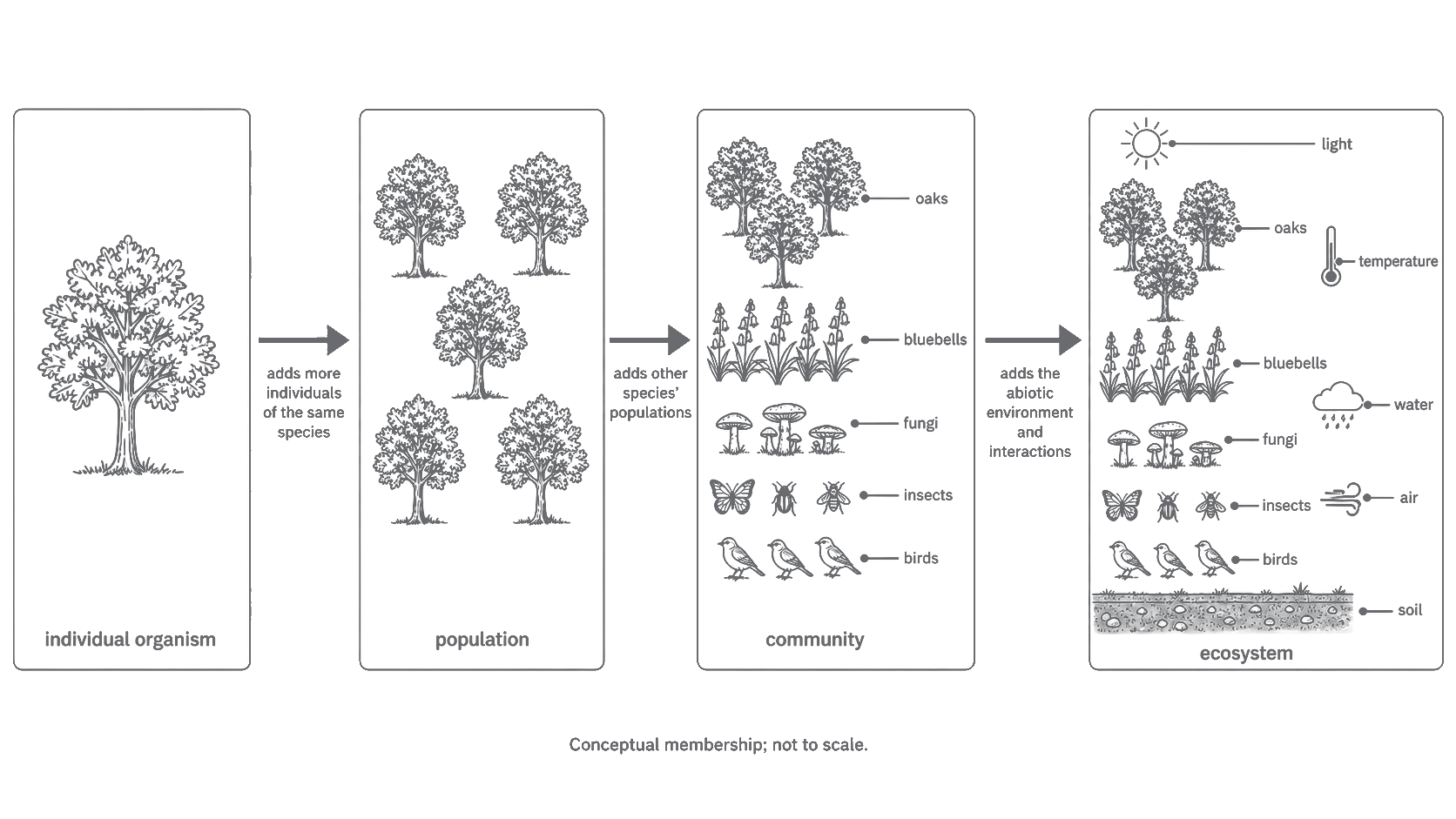
Two distinctions matter. A single oak and a fox are both organisms, but together they are not a population because they are different species. A community contains only the living populations; calling it an ecosystem is incomplete until the non-living surroundings and interactions are included.
9.2(a) — How abiotic factors change communities
An abiotic factor is a non-living physical or chemical part of the environment. It can act directly on organisms, changing their growth, survival or reproduction. Because species depend on one another, its effects can then spread indirectly through the community.
| Abiotic factor | Direct biological effect | Possible community consequence |
|---|---|---|
| Temperature | Temperature affects enzyme-controlled reactions and rates of growth. Each species has a range it can tolerate; temperatures outside that range reduce survival or reproduction. | Populations of sensitive species may decrease or move away, while better-tolerated species form a larger share of the community. |
| Light | Light is required for photosynthesis. Less light can reduce the growth of plants or algae. | There may be less plant material for herbivores and less shelter for other organisms, so animal populations may also change. |
| Water | Plants need water for photosynthesis and to keep cells turgid; aquatic organisms also require water as their habitat. Too little available water can reduce plant growth or survival. | Plant abundance can fall, reducing food or shelter for dependent animals and increasing competition for what remains. |
| Pollutants | Some chemical pollutants are toxic or interfere with growth, survival or reproduction. Different species have different sensitivities. | Sensitive populations can fall while tolerant populations make up more of the community, changing both the numbers and types of organisms present. |
Abiotic describes the factor itself, not its origin. A chemical pollutant is non-living and therefore abiotic even when human activity released it.
A community is affected when the abundance of populations, their distribution, or the species present changes. The effect need not be the same for every species. For example, reduced light may directly lower the growth of pond plants, but it affects a snail population indirectly if the snails then have less plant food.
Worked example: tracing a drought
Suppose rainfall decreases in a grassland.
- Less water is available to grass plants, so photosynthesis and growth can decrease and fewer grass plants may survive.
- Less grass is then available as food.
- Rabbits compete for a more limited food supply; fewer may survive or reproduce, and some may move away.
- The local abundance of both grass and rabbits changes, so the community has been affected by one initial abiotic factor.
Continue this lesson.
You’re previewing NovaLearn without an account. Create a free account to read the rest.
Create free account