9.5 - 9.6 - Fieldwork with quadrats and transects
Learn to sample organisms with random quadrats and belt transects, calculate population estimates, and judge what field evidence can show about an environmental gradient.
From a habitat to a sample
A population is all the organisms of one species in a defined area. Counting every
individual in a large habitat may take too long or damage the habitat, so ecologists study
smaller areas and use them as a sample. The sample is useful only if it represents the
larger area well.
Quadrat
A quadrat is a frame that encloses a known area in which organisms are identified and their
abundance is measured.
Quadrats suit organisms that remain in place while they are counted, especially plants and
other stationary or very slow-moving organisms. The frame must be an appropriate size: a
very small quadrat may repeatedly miss a large, scattered plant, while a very large quadrat
may be too slow to survey enough times.
The abundance measure must also suit the organism:
| Organism pattern | Useful measure inside each quadrat | What it tells you |
|---|---|---|
| Separate individuals can be recognised, such as daisies | Count the individuals | Number per quadrat or number per square metre |
| Individuals overlap or cannot be separated easily, such as a mat-forming plant | Estimate percentage cover using the quadrat grid | Proportion of ground covered, not the number of individuals |
To estimate a population across an area, quadrat positions should be random. Lay two
measuring tapes at right angles to make x- and y-axes, generate pairs of random coordinates,
and place the same corner of the quadrat at each coordinate. This gives every possible
position an equal chance of selection. Looking for a "typical" patch, choosing convenient
places, or throwing the quadrat can favour unusually dense or sparse vegetation and bias the
estimate.
Before counting, agree a boundary rule and use it every time. For example, count plants
touching the top and right edges but not those touching the bottom and left edges. The exact
pair of included edges is not important; consistency prevents edge plants being included or
excluded differently between samples.
Random quadrats across an area
Suppose the question is: What is the estimated number of daisies in this rectangular
lawn? There is no environmental gradient to follow. The task is to obtain a representative
estimate for the whole defined area.
A workable method is:
- Measure the lawn's length and width in metres and calculate its total area in square
metres. - Use an identification key to define the target species. Select one quadrat size and one
boundary rule before collecting results. - Set out perpendicular x- and y-axes. Generate valid random coordinate pairs without
looking at the vegetation, then place the same corner of the quadrat at each coordinate. - Identify and count the target species inside the quadrat. Record every count, including
zero; a zero is a valid result, not a missing value. - Repeat at many different random coordinates using the same quadrat and method. More
independent samples reduce the influence of one unusually dense or bare patch and make
the mean more stable. - Calculate the total sampled area, the mean or density, and then the population estimate.
Keep the raw counts so an apparent anomaly or recording error can be checked rather than
deleted automatically.
The quadrat area is a controlled variable. The target-species definition,
identification key, edge rule and counting method are standardised procedures. Neither
is a control setup: a separate untreated lawn would not help estimate how many daisies
are in this lawn.
Field conditions also matter. Complete a site-specific risk assessment, wear sturdy footwear
on uneven or wet ground, and use suitable clothing around nettles, brambles or ticks. Work
within the agreed area and with others. Place and lift the quadrat carefully, identify in place
where possible, and avoid uprooting plants or trampling unsampled patches; these choices
protect both the surveyors and the organisms being studied.
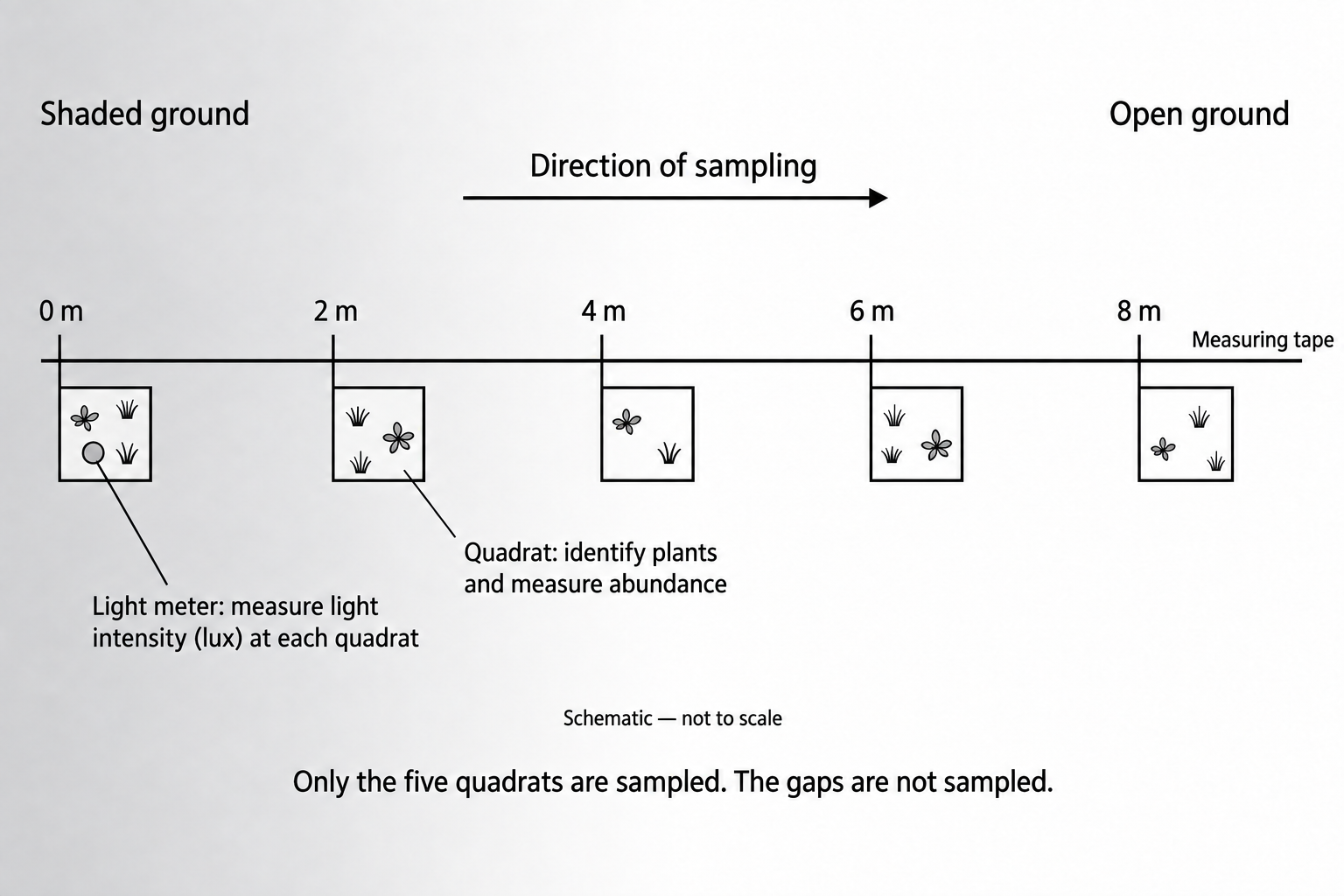
Belt transects across a gradient
Random quadrats estimate abundance across an area, but they lose the order of locations.
To find out how abundance changes from shade to open ground, the positions must retain
their distance along that environmental gradient. A belt transect does this by sampling a
strip of habitat with quadrats placed along a line.
The quadrats can touch one another to form a continuous belt, or they can be placed at fixed
intervals to form an interrupted belt. Either way, the spacing is decided before looking at
the organisms. This is systematic sampling: position changes in a regular way along the
gradient instead of being selected randomly within the whole area.
For the Pearson core practical, a suitable question is: How is the abundance of a chosen
low-growing plant related to light intensity from a shaded tree edge to open ground? The
environmental or independent variable is the light intensity measured in lux at each
position; distance along the transect is the spatial coordinate. The dependent variable is
plant abundance, measured by a count or, where individuals cannot be separated, by
percentage cover. Light is measured as it changes naturally rather than set by the
researcher. If low light limits photosynthesis for the chosen species, its growth and
reproduction may be reduced in deep shade, but the direction must be tested rather than
assumed for every plant species.
A complete method is:
- Identify a safe route that crosses the gradient. Lay a measuring tape in a straight line
from shaded ground to open ground, preferably at right angles to the shade boundary. - Choose a fixed interval, such as every 1 m. At each marked distance, place the same
quadrat immediately beside the tape in the same orientation. Adjacent quadrats may be
used instead for a continuous belt. - At every quadrat, measure light intensity with the same light meter in the same position
and orientation. Record the reading in lux and the distance in metres. - Use the same identification key and abundance measure to count the target plant or
estimate its percentage cover. Apply the same edge rule at every position. - Continue to the other end of the gradient and record the paired distance, light and
abundance results in a table. - Repeat the whole transect along parallel routes whose starting points on the habitat edge
were selected without looking for the target plant. Calculate a mean abundance and, if
repeated, a mean light reading for each distance.
Keep the quadrat dimensions, sampling interval, plant definition, edge rule, observer method,
light meter, meter orientation and short survey period consistent. Soil moisture, soil pH,
temperature, trampling and competition may still change along the route. These are possible
confounding variables: they cannot all be controlled in a natural habitat, so measure or
record the important ones and limit the conclusion accordingly.
[DIAGRAM: asset_name: 9.5-9.6 - Fieldwork with quadrats and transects - diagram 01; asset_slug: edexcel-gcse-biology-9-5-9-6-belt-transect-apparatus; recommended_method: image_gen; description: Simple top-down monochrome textbook apparatus schematic of a belt transect running at right angles from shaded ground beneath the edge of a tree canopy to open ground. Show and label one straight measuring tape, equal fixed distance intervals, identical quadrats placed immediately beside the tape at each interval, and a light meter sensor positioned consistently within or beside each quadrat. Include a clearly labelled sampling-direction arrow from shade to open ground, labels for distance in metres, light intensity in lux and target-plant abundance counted in each quadrat, and a clear statement that only the quadrats are sampled and the gaps in the interrupted belt are not sampled. Exclude numerical results, plotted data, extra traps or collecting apparatus, organisms outside the quadrats, colour-dependent coding and any implication that light is the only changing environmental factor.]
Continue this lesson.
You’re previewing NovaLearn without an account. Create a free account to read the rest.
Create free account