6.11B - Leaf structure
Explore how the tissues of a leaf bring light, carbon dioxide and water to photosynthesising cells. Link each structural feature to photosynthesis or gas exchange.
6.11B - A leaf built for exchange
A typical terrestrial leaf is a thin, broad organ. Its broad, flat surface exposes a large area to light, while its small thickness gives carbon dioxide a short diffusion distance from the air to photosynthesising cells. These whole-leaf features help only because the tissues inside are arranged to use them.
[DIAGRAM: asset_name: 6.11B - Leaf structure - diagram 01; asset_slug: edexcel-gcse-biology-6-11b-leaf-structure-gas-exchange; recommended_method: image_gen; description: High-contrast portrait cross-section of a typical terrestrial leaf with eight large numbered callouts. 1 waxy cuticle; 2 upper epidermis; 3 palisade mesophyll with many chloroplasts; 4 spongy mesophyll with connected air spaces; 5 xylem in the upper vein; 6 phloem in the lower vein; 7 lower epidermis; 8 stoma and paired guard cells. A single-headed blue arrow carries water from xylem into mesophyll; an orange arrow carries sucrose away in phloem. Large gas arrows show CO2 in and oxygen and water vapour out through the lower-surface stomatal pore. The structure/function key is normal text immediately below. White background, dark outlines, green tissue fills; no small text, scale, numerical data or photorealism.]
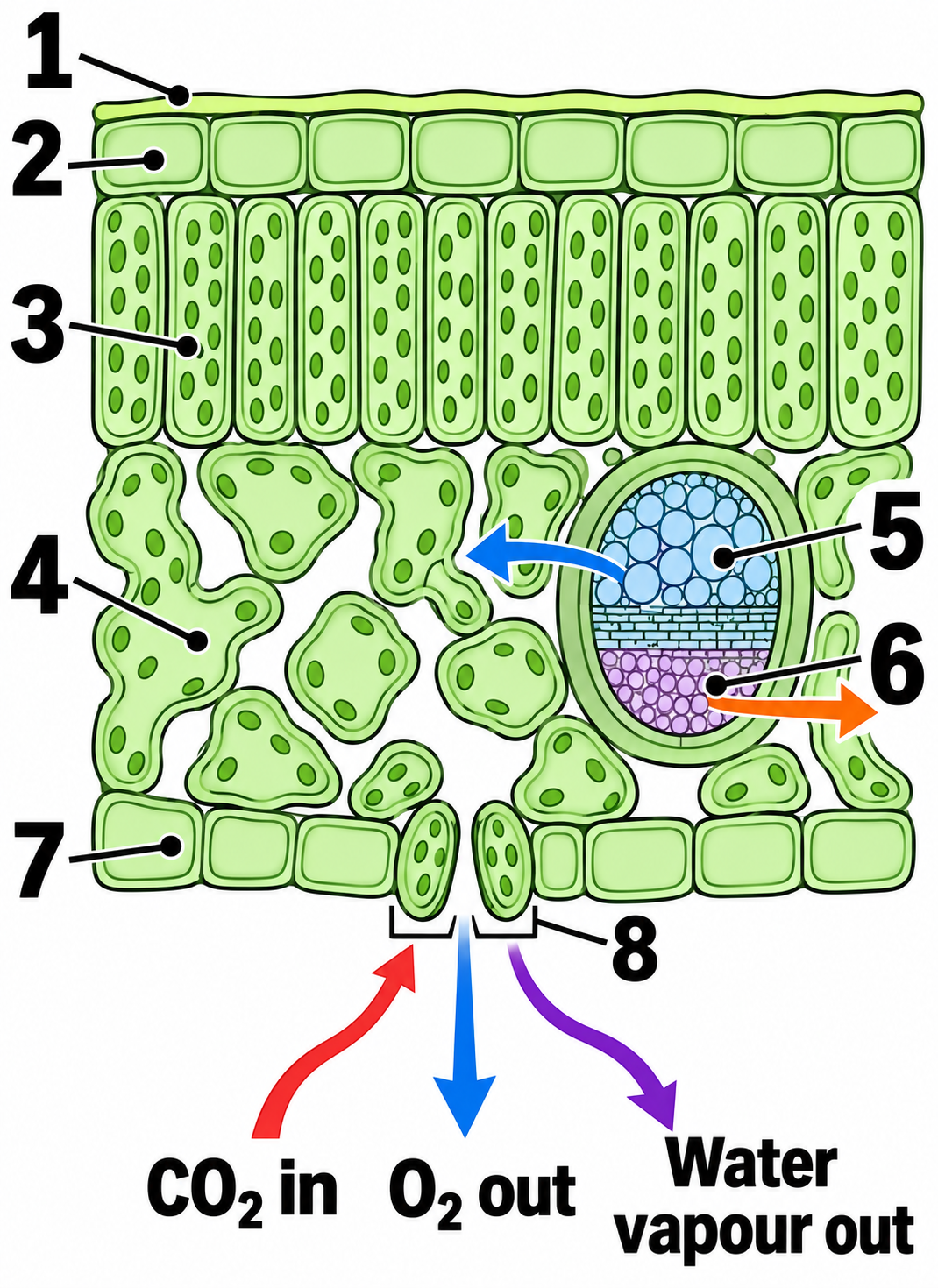
Read the numbered leaf diagram
Continue this lesson.
You’re previewing NovaLearn without an account. Create a free account to read the rest.
Create free account