6.5 - Photosynthesis practical
Use algal balls to investigate the effect of light intensity on photosynthesis. Plan a fair comparison, turn indicator readings into a rate and judge the quality of the evidence.
6.5 - Turning photosynthesis into a rate
An algal ball contains many living algal cells held in a small bead of alginate. In the light, the cells photosynthesise and take in carbon dioxide, but they also respire and release carbon dioxide. The experiment therefore detects the net change in carbon dioxide around the algae during a measured time interval.
Hydrogencarbonate indicator changes in response to carbon dioxide concentration because dissolved carbon dioxide affects pH. If photosynthesis removes carbon dioxide faster than respiration replaces it, the indicator moves towards the low-carbon-dioxide end of its colour scale. This is indirect evidence: the indicator does not count glucose molecules and it does not measure oxygen directly.
Air-equilibrated indicator is orange-red. A change towards purple shows a fall in carbon dioxide because photosynthesis exceeds respiration; a change towards yellow shows a rise in carbon dioxide because respiration exceeds photosynthesis. Little colour change can mean the two processes balance: it does not show that both have stopped. Compare against the supplied colour standard. SAPS practical guidance.
Rate proxy
A rate proxy is a measurable change used to estimate the rate of a process. Here, the change in a hydrogencarbonate-indicator reading per unit time is a proxy for the rate of photosynthesis.
The indicator can be compared with a standard colour scale, but matching colours by eye is subjective. A colorimeter gives a numerical reading, so a useful rate measure is:
The direction of the reading must be interpreted using the indicator standard. Blank the colorimeter and use the same wavelength, clean cuvettes and orientation for each reading. Colour or absorbance change is not automatically proportional to carbon dioxide uptake over the entire colour range, so avoid saturated endpoints and compare like-for-like readings over a suitable short interval. If every bottle begins with the same indicator and is exposed for exactly the same time, the final readings can also be compared fairly. A final colour with no controlled time interval is not a rate.
6.5 - Core practical 6.5
This section is common to Foundation and Higher. The biological question is: how does changing light intensity affect the rate of photosynthesis? Pearson's practical anchor is a set of algal balls, or a suitable equivalent, placed at varying distances from a light source. The rate must be measured and compared with distance.
Use enough identical capped transparent bottles for at least five distances and repeats. You also need pre-prepared algal balls, air-equilibrated hydrogencarbonate indicator, a lamp, a metre rule, a timer and a standard indicator scale or colorimeter. A thermometer and a water-filled heat filter help check and control heating; a light meter can measure illuminance directly.
[DIAGRAM: asset_name: 6.5-6.6 - Photosynthesis practical and inverse square law - diagram 01; asset_slug: edexcel-gcse-biology-6-5-algal-ball-apparatus; recommended_method: image_gen; description: Simple monochrome textbook apparatus schematic with one lamp at the left, a transparent water-filled heat filter, and five capped identical sample bottles containing equal volumes of hydrogencarbonate indicator and equal numbers of similar-sized algal balls at labelled increasing distances. Show a metre rule measuring from the light-emitting part of the lamp to the centre of each bottle, samples arranged in direct light without shadowing one another, a timer, the note “Check the temperature of the samples at every distance”, and a separate standard colour scale or colorimeter. Label light intensity changed by distance as the independent variable and indicator change per fixed time as the dependent rate proxy. Include one optional indicator-only control bottle. Exclude pondweed, bubble counting, wavelength filters, exact result data, photorealism and decorative colour coding.]
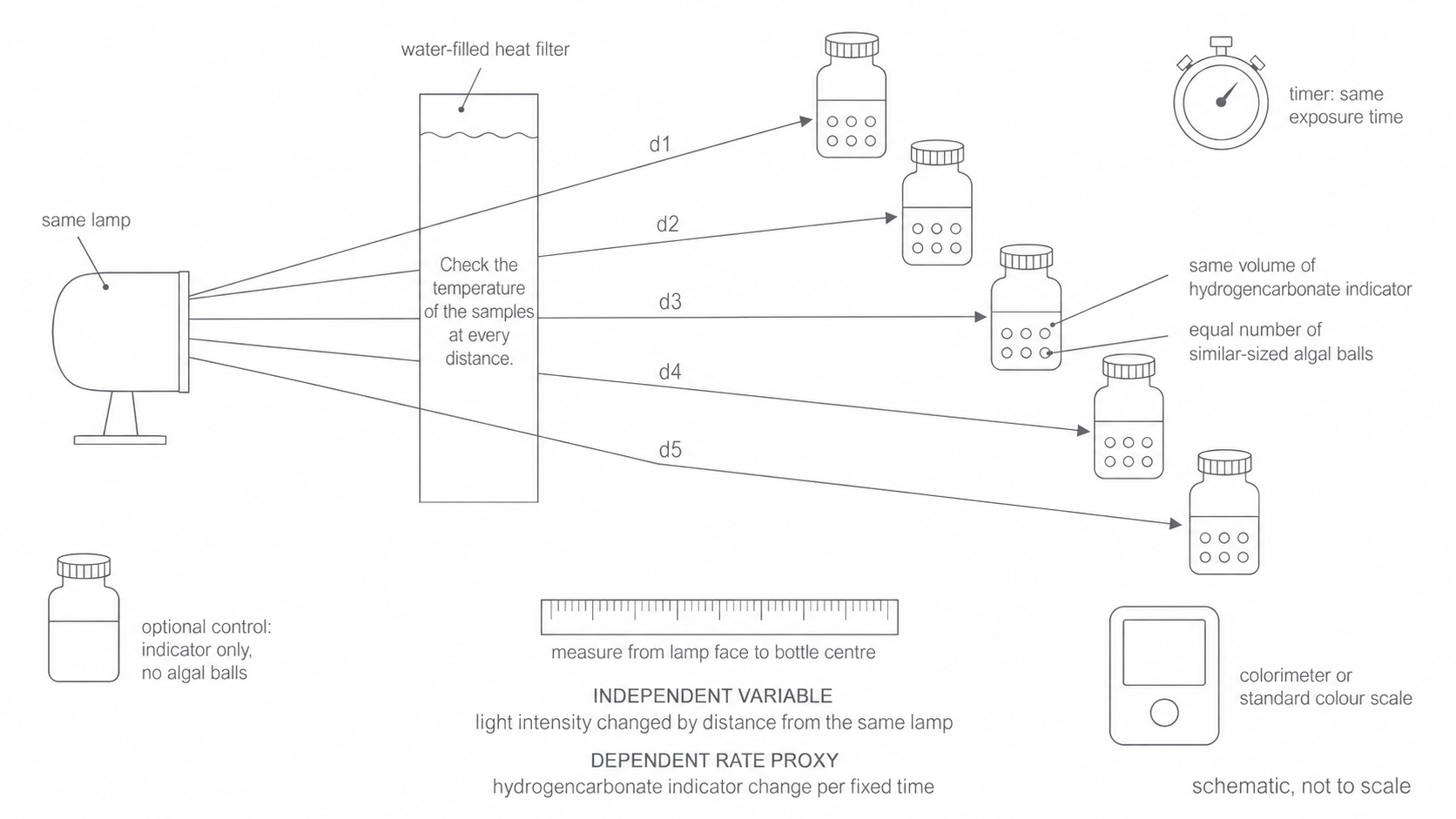
The diagram separates bottles to prevent shading and is not to scale. Check the temperature of the samples at every distance: the temperature of the heat filter alone cannot establish that every sample stayed at the same temperature.
Variables
| Role | Operational variable |
|---|---|
| Independent variable | Light intensity, changed by placing bottles at a measured range of distances from the same lamp. A light meter may measure the intensity at each position directly. |
| Dependent variable | Rate of photosynthesis, estimated from the change in indicator colour or colorimeter reading per unit time. |
| Controlled variables | Number and approximate size of algal balls; algal-ball and indicator batch; indicator volume and starting reading; exposure time; temperature; lamp; bottle type and orientation; ambient-light conditions. |
A workable method
- Label the sample bottles with a suitable range of lamp distances. Rinse them as directed so residues do not alter the indicator.
- Add the same measured volume of indicator from one well-mixed batch to every bottle. Add the same number of similar-sized algal balls from one batch, then cap each bottle promptly. Record each starting colour or colorimeter reading.
- Measure every distance from the same reference point on the light-emitting part of the lamp to the same point on each bottle. Face the bottles towards the same lamp without allowing a nearer bottle to shade another.
- Place a transparent water-filled heat filter between the lamp and samples if the lamp warms them. Monitor temperature and keep it constant; otherwise temperature would change alongside light intensity.
- Switch on the lamp and start the timer. Expose every sample for the same fixed interval, keeping the lamp, ambient light and bottle orientation unchanged.
- Compare each final colour with the same standard scale, or record a colorimeter reading using the same settings. Calculate the indicator change per unit time.
- Repeat each distance with fresh, identically prepared samples. Record all repeat readings before deciding whether any result is anomalous.
- An extra bottle containing indicator but no algal balls can act as a control setup: it tests whether the indicator changes under the lamp when no algae are present. This control is different from the controlled variables kept constant in every sample.
Continue this lesson.
You’re previewing NovaLearn without an account. Create a free account to read the rest.
Create free account