4.6B - 4.7 - Evolutionary relationships and classification
Use shared limb anatomy and DNA comparisons to infer evolutionary relationships. Explain why genetic evidence led scientists to separate Bacteria and Archaea in the three-domain classification.
4.6B — Pentadactyl limbs and common ancestry
Biology-only 4.6B, for both Foundation and Higher: pentadactyl means five digits. The forelimbs of many tetrapod vertebrates have the same underlying arrangement: one upper limb bone, two forearm bones, a group of wrist bones and a five-digit pattern.
[DIAGRAM: asset_name: 4.4-4.7 - Evolution evidence and classification - diagram 01; asset_slug: edexcel-gcse-biology-4-6b-pentadactyl-limb-homology; recommended_method: image_gen; description: monochrome textbook-style side-by-side schematic of a human arm, bat forelimb and whale forelimb with corresponding bones aligned and lightly matched by position; label only one upper limb bone, two forearm bones, wrist bones and the five-digit pattern, plus the functions grasping, flight and swimming; include clear leader lines, no photorealism, no specimen claim, no scale claim, no bone-name recall requirement, no extra taxa and no evolutionary-tree labels]
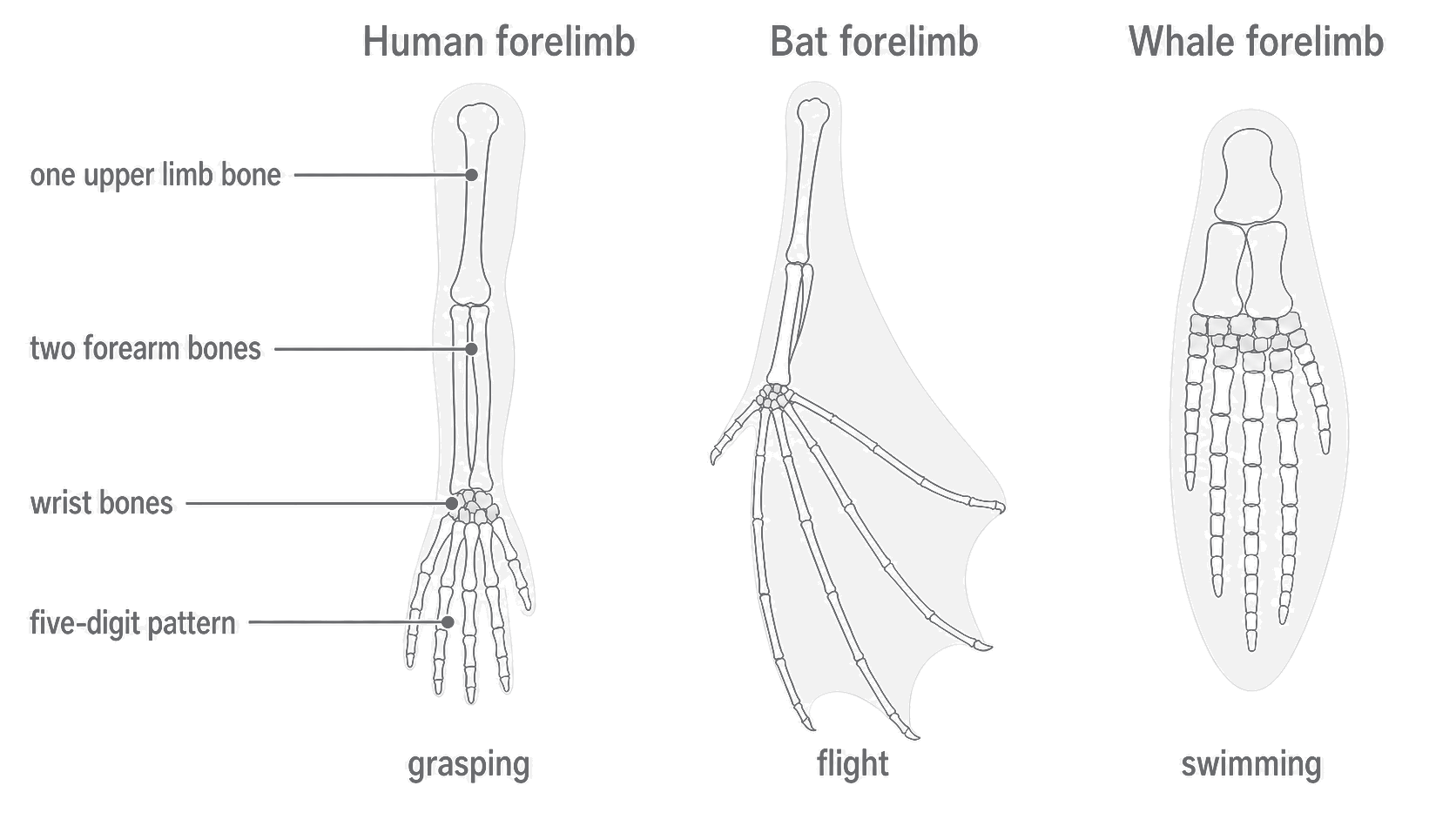
The drawing is schematic and not to scale; it compares corresponding bone arrangements, not exact bone lengths or every small wrist bone.
The limbs look different externally and perform different functions. A human hand can grasp, elongated bat digits support a wing for flight, and a whale's shortened, broadened forelimb forms a flipper for swimming. Yet the corresponding bones remain in the same basic relative order.
Homologous structures
Homologous structures share an underlying anatomical pattern because that pattern was inherited from a common ancestor, even when the structures now have different shapes or functions.
The pentadactyl limbs are therefore evidence for evolution: the most economical explanation for the shared, detailed arrangement is that the species inherited it from a common ancestor that also had the pattern. After populations separated, inherited variation and natural selection modified the proportions for different functions. The evidence lies in the corresponding bone arrangement, not merely in all animals having something called a limb.
Continue this lesson.
You’re previewing NovaLearn without an account. Create a free account to read the rest.
Create free account