5.25 - Cardiovascular treatments
Compare how medicines, stents, bypass surgery and lifestyle changes address cardiovascular disease. Use a patient’s stated circumstances to weigh present blood-flow benefits, future risk, side effects and practical limitations.
5.25 · Cardiovascular treatment options
Coronary arteries supply the heart muscle with blood and oxygen. A fatty deposit called atheroma can narrow their lumen. Reduced oxygen delivery during activity can cause chest pain called angina; a blockage that kills heart muscle can cause a heart attack.
There is no single treatment for every cardiovascular disease. Coronary heart disease provides a clear example because treatment can target an immediate narrowing, reduce future risk, or do both.
Life-long medication
Statins reduce cholesterol synthesis in the liver, lowering LDL cholesterol in the blood. Lower LDL cholesterol reduces the chance of further atheroma building up and lowers the risk of future heart attack or stroke. Taking a tablet is less invasive than surgery, but treatment is usually long term and often life-long while clinically indicated. It depends on regular adherence, may cause side effects or interact with other medicines, and reduces risk rather than removing it. A statin also does not rapidly reopen a severely narrowed artery.
Procedures and surgery
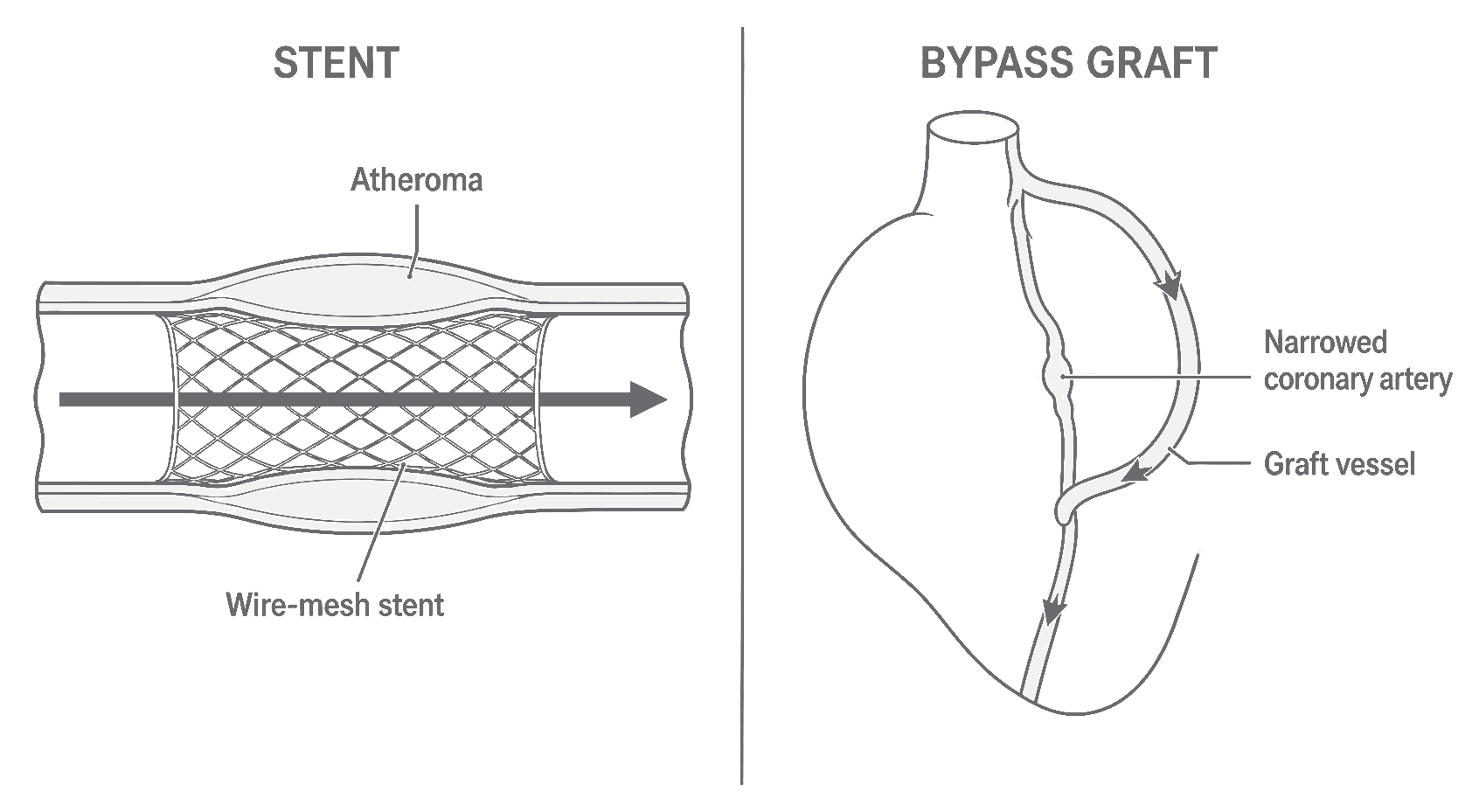
In coronary angioplasty, a small balloon widens a narrowed coronary artery and a wire-mesh stent is usually left in place to hold the lumen open. This can quickly improve blood flow and relieve symptoms. Risks include bleeding or infection where the catheter enters, a clot forming in the stent, and the artery narrowing again. Prescribed antiplatelet medicine and lifestyle changes may still be needed.
In coronary artery bypass grafting (CABG), a grafted blood vessel provides a new route around a narrowed or blocked coronary artery. It can restore blood flow when disease is severe or affects several sites, but it is major surgery with a longer recovery and risks such as bleeding, infection, clots or graft failure.
[DIAGRAM: asset_name: 5.23-5.25 - Lifestyle disease and cardiovascular treatment - diagram 01; asset_slug: edexcel-gcse-biology-5-23-5-25-stent-and-bypass; recommended_method: image_gen; description: A clean monochrome textbook comparison of two treatments for narrowed coronary arteries. Left panel: a coronary artery segment with labelled atheroma narrowing the lumen, a labelled wire-mesh stent holding the narrowed region open, and one clear arrow showing restored blood flow through the lumen. Right panel: a simplified external heart view with one labelled narrowed coronary artery and a labelled graft vessel connecting an upstream blood supply to the coronary artery beyond the narrowing, with arrows showing blood travelling around the blockage. Show correct relative connections without claiming exact scale; exclude clinical-scan appearance, blood cells, numerical data, unrelated heart anatomy and decorative colour.]
Lifestyle changes
Stopping smoking removes continuing smoke exposure, reducing artery damage, clot risk and carbon-monoxide exposure. A balanced diet can support healthy energy intake and reduce exposure to dietary factors that contribute to high cholesterol or blood pressure. Regular physical activity increases energy expenditure, helps weight management and supports cardiovascular health.
Lifestyle change is non-surgical, can act on several risk factors and brings benefits beyond one artery. Its limitations are that change can be difficult to maintain, benefits accumulate over time, and it cannot rapidly reopen a critically narrowed coronary artery. Access to affordable food, safe places for activity and stop-smoking support can affect how achievable a change is.
Continue this lesson.
You’re previewing NovaLearn without an account. Create a free account to read the rest.
Create free account