5.13 - 5.15B - Immune response and vaccination
Learn how antibodies recognise a pathogen and how memory lymphocytes improve a later response. Use these mechanisms to explain vaccination, herd immunity and the benefits and limitations of immunisation.
5.13 · Antigens and specific antibodies
If a pathogen passes the body's barriers and enters the tissues, the specific immune system can respond. It is called specific because the response is directed against particular molecules on that pathogen, rather than working in exactly the same way against every pathogen.
Keep these three terms separate:
| Term | Meaning in this response |
|---|---|
| Pathogen | A microorganism that causes disease, such as a bacterium or virus. |
| Antigen | A molecule, often on the surface of a pathogen, that is recognised as foreign and triggers a specific immune response. |
| Antibody | A protein made by lymphocytes. Its binding site has a shape complementary to a particular antigen. |
After exposure to a pathogen, its antigens trigger the response. Lymphocytes that can respond to those antigens produce many copies of the matching antibody. The antibodies bind to the antigens because their binding sites are complementary in shape. Binding can neutralise the pathogen or help other immune cells recognise and destroy it.
The specificity matters. An antibody made in response to antigen A will bind to antigen A, but it will not usually bind to a differently shaped antigen B. An antigen is the trigger on the pathogen; an antibody is the protein produced in response. They are not interchangeable terms.
5.13 · Memory and the secondary response
The first encounter with an antigen produces the primary response. Antibodies are produced and help destroy the pathogen, but making enough of the correct antibody takes time. The person may develop symptoms while this response is building.
The antigen also triggers the production of memory lymphocytes. These cells remain in the body after the pathogen has been removed. They are specific to the antigen that caused their production.
If the same antigen enters the body again, the memory lymphocytes recognise it and cause the matching antibodies to be produced faster and in greater quantities. This is the secondary response. The pathogen is destroyed more quickly, reducing the chance that it causes disease or serious illness.
[DIAGRAM: asset_name: 5.13-5.15B - Immune response and vaccination - diagram 01; asset_slug: edexcel-gcse-biology-5-13-primary-secondary-immune-response; recommended_method: image_gen; description: simple monochrome textbook process comparison on a white background with #6A6B6E linework; top route labelled First exposure showing pathogen with labelled antigen -> antigen triggers specific lymphocyte -> specific antibodies plus memory lymphocytes -> pathogen removed; bottom route labelled Second exposure to the same antigen showing memory lymphocytes -> antibodies made faster and in greater quantity -> pathogen removed more quickly, reducing the chance of disease or serious illness; clearly distinguish antigen on a pathogen from free Y-shaped antibody, use unambiguous arrowheads, and include no time-scale graph, numerical values, T cells, phagocytosis, vaccine, or off-scope immune structures]
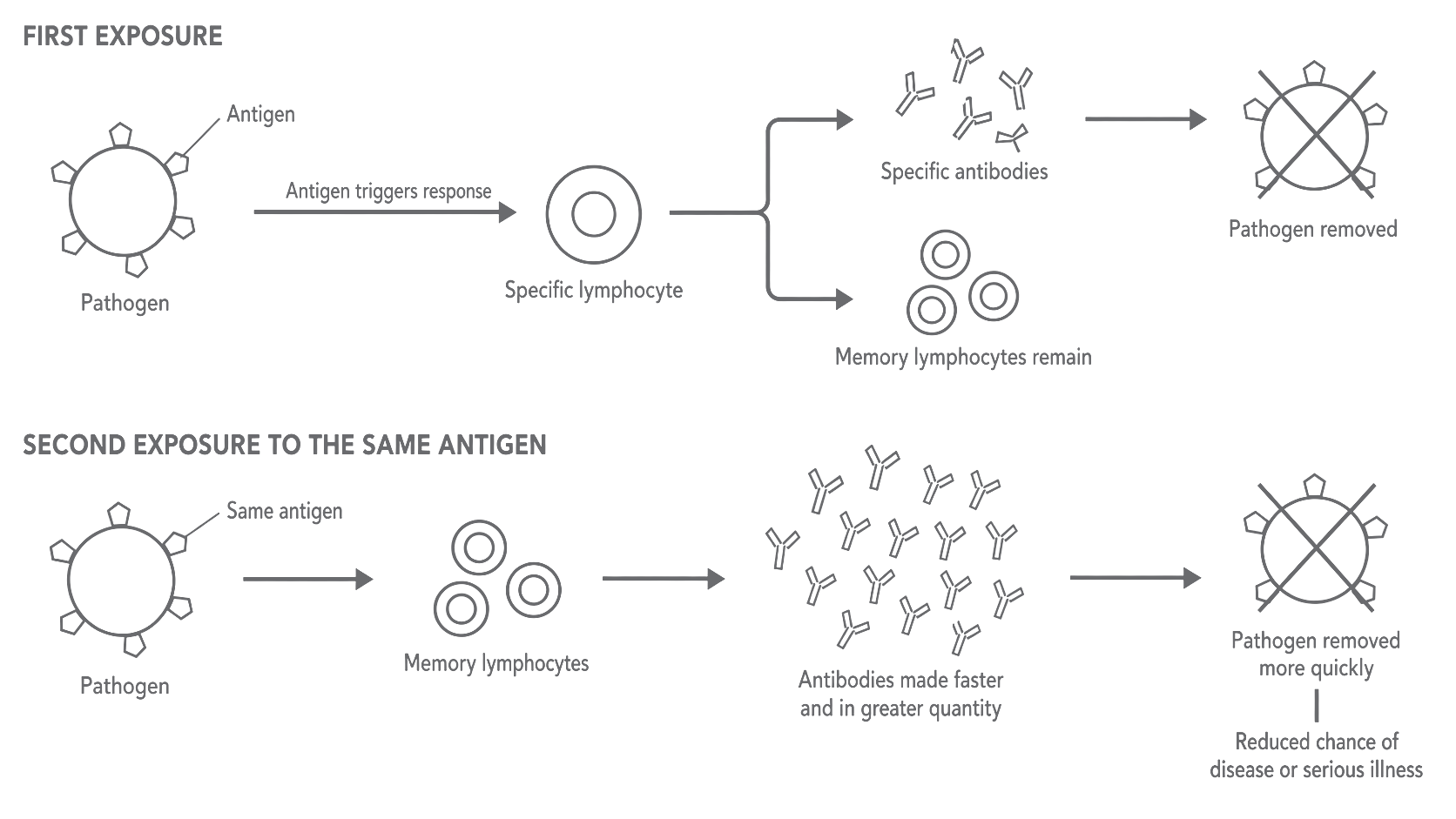
The phrase same antigen is essential. Exposure to an unrelated antigen would require a different matching response; memory lymphocytes for the first antigen would not provide the same rapid response.
Primary response: first exposure produces antibodies and memory lymphocytes. Secondary response: memory lymphocytes respond to the same antigen, so the specific antibody response is faster and greater.
5.14 · Immunisation with an inactive pathogen
Immunisation uses the body's own specific response before the disease-causing form of a pathogen is encountered. In the model required by 5.14, a vaccine introduces an inactive form of the pathogen. The inactive pathogen cannot reproduce or cause the disease it normally causes, but it retains the antigens needed to trigger an immune response.
The sequence is:
- The inactive pathogen enters the body through vaccination.
- Its antigens trigger lymphocytes to produce specific antibodies.
- The same antigens also trigger the production of memory lymphocytes.
- The inactive pathogen is removed, while memory lymphocytes remain.
- If the active pathogen later enters, its matching antigens trigger a faster, greater secondary response.
- Specific antibodies are produced quickly, so the pathogen is destroyed sooner and is less likely to cause disease or serious illness.
The vaccine does not work by supplying a permanent store of ready-made antibodies. It supplies the antigen stimulus so the person's own immune system produces antibodies and memory lymphocytes. "Inactive" also does not mean "unable to trigger a response": the antigens are still present even though the pathogen cannot reproduce.
Continue this lesson.
You’re previewing NovaLearn without an account. Create a free account to read the rest.
Create free account