7.11B - 7.12B - Thermoregulation
Trace temperature changes through receptors, the hypothalamus and effectors. Explain how sweating and shivering help restore temperature; vasodilation and vasoconstriction are Higher-only mechanisms.
7.11B - The skin and hypothalamus
Thermoregulation keeps core body temperature within a narrow range so enzymes can work effectively. In a negative-feedback response, a change is detected and opposed; the response becomes smaller as normal conditions return.
Thermoregulation links a coordination centre in the brain to effectors in the skin and skeletal muscles. Temperature receptors in the skin detect changes at the body surface. Receptors in and around the hypothalamus, a region of the brain, monitor core temperature, including the temperature of the blood flowing through the brain. The hypothalamus also receives information from skin receptors and coordinates responses when temperature is too high or too low.
The two main layers of the skin make different contributions:
- The epidermis is the outer, avascular layer, so it contains no blood vessels. It forms a protective water barrier that reduces uncontrolled water loss. Sweat reaches the epidermal surface through ducts and pores, and it is at this surface that sweat can evaporate.
- The dermis lies beneath the epidermis. It contains sweat glands, blood vessels, temperature-sensitive nerve endings, hair follicles and hair erector muscles. These structures can act as receptors or effectors in temperature control.
[DIAGRAM: asset_name: 7.9-7.12B - Homeostasis and thermoregulation - diagram 01; asset_slug: edexcel-gcse-biology-7-9-7-12b-skin-map; recommended_method: image_gen; description: Simple monochrome textbook cross-section of human skin showing a thin outer epidermis above a deeper dermis. Label the epidermis as an avascular outer barrier and evaporation surface. Within the dermis, accurately place and label a coiled sweat gland, its duct passing through the epidermis to a surface pore, a temperature-sensitive nerve ending, a hair follicle with attached erector muscle, a superficial capillary bed and its supplying arteriole. Use clear leader lines and no directional response arrows. Exclude sebaceous glands, detailed epidermal strata, hypodermal anatomy, clinical realism, exact numerical data and all off-spec structures.]
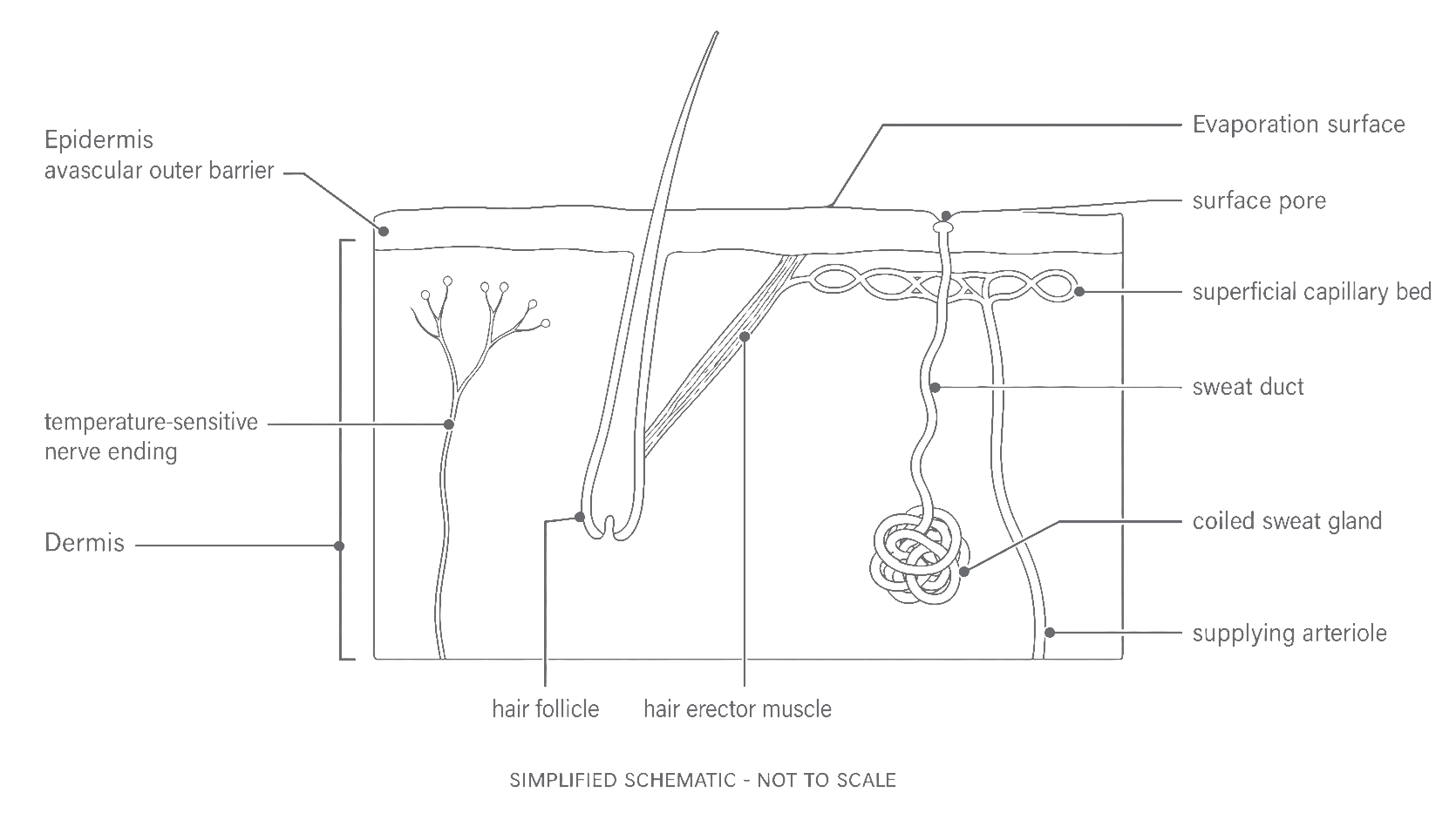
The hypothalamus is the coordination centre, not the structure that sweats, shivers or changes skin blood flow. It sends nerve impulses to the relevant effectors. Each effector then changes heat loss or heat production, and the resulting change in core temperature feeds back to the receptors.
Keep the roles separate: receptors detect temperature; the hypothalamus coordinates; sweat glands, muscles and skin arterioles carry out the response.
7.11B, 7.12B - Responses when the body is too hot
When core body temperature rises above its normal range, thermoreceptors provide information to the hypothalamus. The hypothalamus coordinates responses that increase heat loss.
Sweat glands in the dermis secrete more sweat. The sweat travels through ducts to the surface of the epidermis. The most energetic water molecules escape as the sweat evaporates, and the energy needed is transferred from the skin and the blood beneath it. This increases heat loss and cools the body. Sweat that remains as liquid on the skin is much less effective than sweat that evaporates.
Hair erector muscles relax, so hairs lie flatter and trap less insulating air. In humans this has a relatively small effect compared with sweating.
Higher only: vasodilation
Vasodilation is the widening of arterioles that supply capillary beds near the skin surface. Smooth muscle in the arteriole walls relaxes, increasing the lumen diameter. More blood flows through superficial capillaries, so more warm blood is brought close to the surface and more thermal energy is transferred to the surroundings.
Capillaries do not move closer to the surface. The blood-flow change occurs because the supplying arterioles change diameter. As heat loss lowers core temperature towards its normal range, the stimulus for these cooling responses decreases.
Continue this lesson.
You’re previewing NovaLearn without an account. Create a free account to read the rest.
Create free account