3.11B - 3.13 - Mendel and inheritance terms
Use Mendel’s pea-plant evidence to explain how inherited information can remain hidden and reappear. Connect chromosomes, genes and alleles to genotypes, phenotypes, gametes and zygotes.
3.11B — Mendel's evidence
In the nineteenth century, people knew that offspring often resembled their parents, but they did not know how inherited information was carried. One common idea was blending inheritance: that the parents' characteristics simply mixed in their offspring. Gregor Mendel tested inheritance more systematically using pea plants.
Mendel chose characteristics with clear contrasting forms, such as tall or short plants and round or wrinkled seeds. He first used true-breeding plants, which continued to produce the same form of a characteristic when self-pollinated. He then controlled which plants supplied pollen, grew the resulting seeds and followed the characteristic through later generations.
This design gave Mendel more than a collection of interesting peas. He counted many offspring and found repeatable numerical patterns. When plants with contrasting forms were crossed, one form could be visible in the offspring while the other disappeared; the hidden form could then reappear in a later generation, often in an approximate 3:1 pattern.
From this evidence, Mendel inferred that inheritance depended on separate units passed from parents to offspring. The units did not blend or vanish: an inherited unit could remain present even when its effect was masked by another. These unseen units provided the basis of genetics and were later understood in terms of genes and alleles.
Mendel could observe plants and count outcomes, but he could not observe the mechanism behind the pattern. Genes, DNA and the role of chromosomes in inheritance were not yet understood. His abstract explanation was therefore difficult to connect to a physical process, and the importance of his work was not widely recognised until later, when knowledge of cells and chromosomes gave it a mechanism.
3.12, 3.13 — Chromosomes, genes and alleles
Modern genetics locates Mendel's inherited units inside cells. In plant and animal cells, the nucleus contains chromosomes: long DNA-containing structures that carry many genes. A gene is a section of DNA on a chromosome that codes for a specific protein. The protein’s function can affect a characteristic.
An allele is a different version of the same gene. For a simple gene in a pea plant, the two copies occupy corresponding positions on a pair of chromosomes, with one copy inherited from each parent. Their matching position identifies them as copies of the same gene; R and r are allele versions whose different DNA information can affect the characteristic differently.
[DIAGRAM: asset_name: 3.11B-3.13 - Mendel and inheritance terms - diagram 01; asset_slug: edexcel-gcse-biology-chromosome-gene-allele-pair; recommended_method: image_gen; description: Simple monochrome textbook schematic of one matched chromosome pair in a pea-plant cell, with one chromosome labelled as inherited from each parent. Mark the same gene position on both chromosomes and show two possible allele versions, R and r, with a small zoom that makes the hierarchy chromosome contains DNA and a gene is a section of that DNA. Required labels: nucleus, chromosome pair, gene, same position, allele R, allele r, one from each parent. Exclude Punnett squares, crosses, probabilities, meiosis stages, human chromosome numbers, nucleotide sequences, photorealism and decorative elements.]
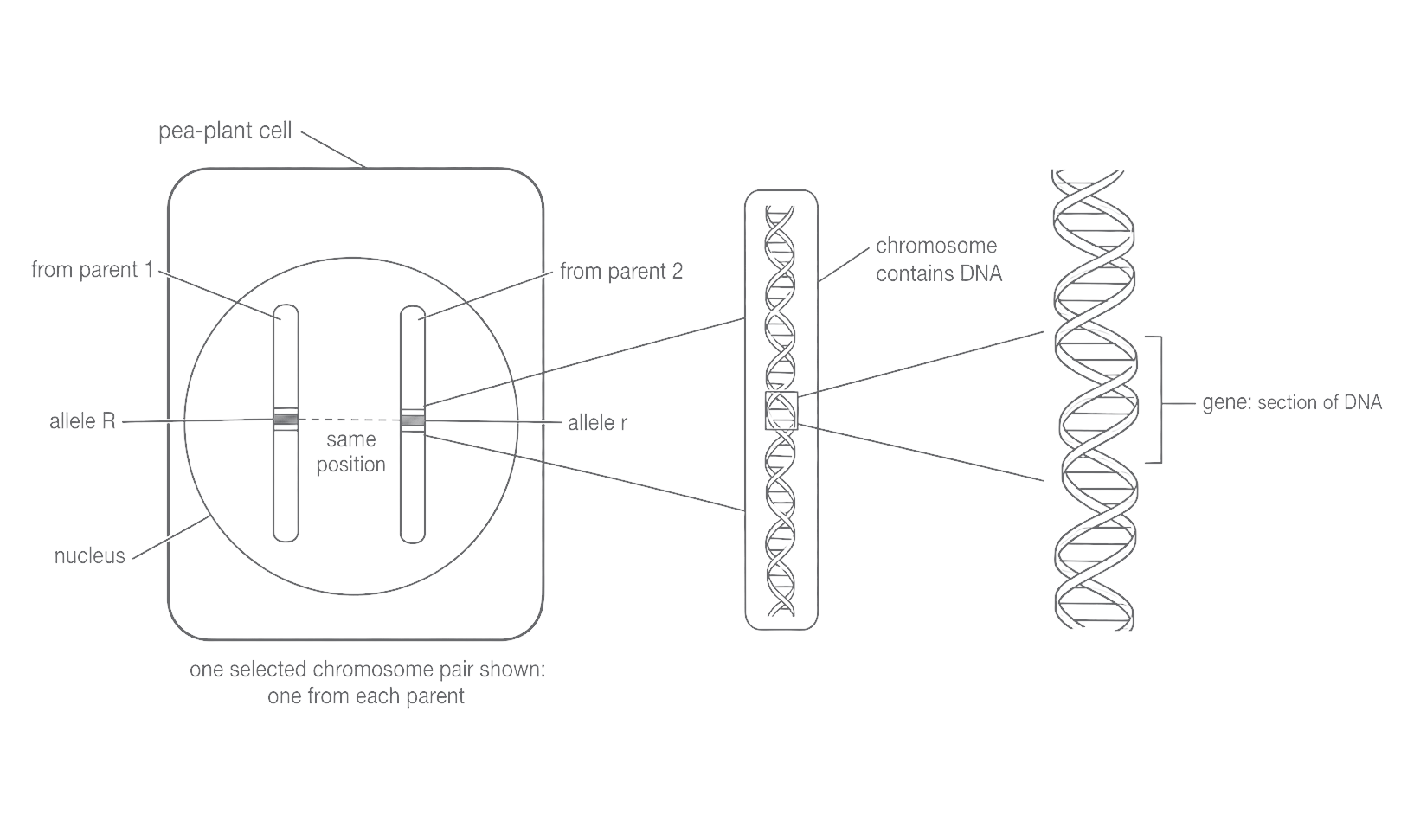
Different alleles can carry different instructions. They may result in different versions or amounts of a biological product, so they can produce different forms of an inherited characteristic. For example, different alleles of one pea gene can contribute to round or wrinkled seed shape. An allele is therefore a version of a gene, not the characteristic itself.
Continue this lesson.
You’re previewing NovaLearn without an account. Create a free account to read the rest.
Create free account