4.14 - Biotechnology choices
Compare selective breeding and genetic engineering as choices in agriculture and medicine. Build a reasoned judgement from biological benefits and risks, practical constraints and ethical implications.
4.14 — Selective breeding choices
Selective breeding uses inherited variation already present in a breeding population. Humans choose parents with a desired characteristic, breed them, then select offspring showing the characteristic most strongly. Repeating this over generations can produce crops with higher yield or disease resistance and livestock with greater milk, meat or egg production.
The method can also select characteristics that improve resilience or welfare, such as disease resistance, fertility or ability to cope with local conditions. However, it requires suitable inherited variation and can take many generations, especially in animals. Other alleles may be inherited alongside the desired alleles, so unwanted characteristics can remain.
Repeatedly breeding from a small number of related individuals narrows the gene pool and increases inbreeding. Harmful recessive alleles are then more likely to be inherited in pairs and expressed. Low genetic diversity also leaves fewer variants that might help a population survive a new disease or environmental change. Selective breeding does not make every organism genetically identical, but concentrating on only a few parents reduces variation.
Selective breeding also has uses in medical research. Researchers can breed animals with an inherited characteristic relevant to a disease, producing a research strain in which possible treatments can be compared. Repeated breeding of related animals can make the genetic background more uniform, reducing one source of variation between groups. However, inherited disease or inbreeding can cause suffering, and results from a particular animal strain may not transfer to humans. The possible medical benefit must therefore be weighed against welfare, the need for the study and whether cell cultures or other methods could answer the question with fewer animals.
The breeding goal creates an ethical implication. Selecting only for extreme production can damage animal welfare: very rapid growth or a very large body, for example, may contribute to leg or birth problems. A balanced programme can instead include health, fertility and welfare alongside productivity. The ethical question is therefore not simply Is selective breeding right or wrong?, but Which characteristics are being selected, and what happens to the animals and the remaining genetic diversity?
4.14 — Genetic engineering in agriculture and medicine
Selective breeding combines alleles from parents that can reproduce with each other. Genetic engineering changes an organism's genome more directly and can introduce a known gene from an organism that could not breed with the recipient. It may therefore provide a useful characteristic that is absent from the available breeding population. Developing, testing and approving a new engineered organism can still be expensive and time-consuming, so more direct does not mean instant.
In agriculture, an insect-resistant crop could suffer less feeding damage, increasing yield and reducing the need for sprayed insecticide. The same trait creates risks that need to be managed: the insect population may evolve resistance if one control is used repeatedly; the gene could pass by cross-pollination to a closely related crop or wild relative; and changes in pest or weed populations could affect food webs and biodiversity. These effects depend on the particular gene, crop, relatives nearby and farming practice. A crop is not safe or dangerous merely because it is genetically engineered.
In medicine, genetically engineered bacteria can be cultured so that they make human insulin. The insulin is harvested from the production culture, purified and quality-tested before it becomes a medicine. This can provide a large, reliable supply with consistent purity and reduce dependence on insulin extracted from animal pancreases. Production still requires contained cultures, contamination control, purification, testing and investment; access and price can remain practical and ethical concerns.
[DIAGRAM: asset_name: 4.13B-4.14 - Agriculture, population and biotechnology choices - diagram 01; asset_slug: agriculture-biotechnology-insulin-production-route; recommended_method: image_gen; description: A clean monochrome textbook process route with four left-to-right stages: contained culture of genetically engineered bacteria, bacteria producing human insulin protein, insulin separated and purified with bacteria retained in the production system, and quality-tested insulin medicine in a vial. Use clear directional arrows and label engineered bacteria, human insulin, separation and purification, and quality-tested medicine. Emphasise that only purified insulin reaches the medicine vial. Exclude patients being injected with bacteria, photorealistic laboratory imagery, restriction enzymes, ligase, sticky ends, vectors, gene-insertion stages, numerical data and off-scope molecular detail.]
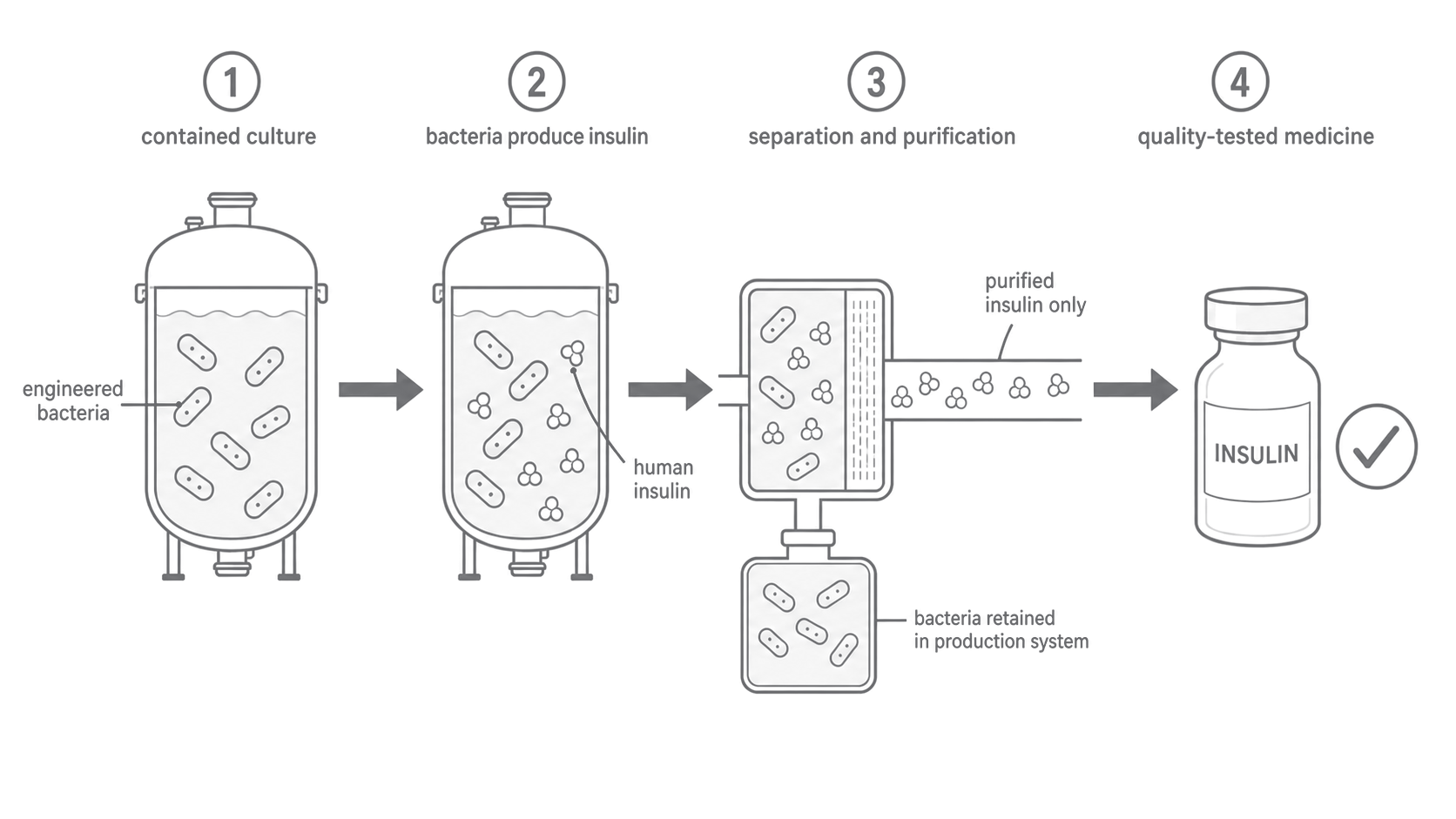
The diagram summarises a production route, not a complete manufacturing method. Depending on the system, recovery can include extracting the protein from bacterial cells; purification involves more than simply filtering out intact bacteria. The vial contains the prepared protein medicine, not the production organisms.
Using microorganisms can reduce the number of animals needed as a source of the product, which some people regard as an ethical benefit. Other people object in principle to modifying living organisms. That objection is an ethical position, not scientific evidence that the purified insulin is harmful; biological safety is judged from product testing, containment and manufacturing evidence.
Continue this lesson.
You’re previewing NovaLearn without an account. Create a free account to read the rest.
Create free account