9.2 - Uneven development and welfare in India
National development averages can conceal large differences between places and groups. This spatial subdivision of 9.2 explains the causes of uneven development and examines poverty, employment, housing and infrastructure in India. It uses dated evidence to distinguish a national improvement from equal improvement for everyone.
Development varies between and within countries
Global development is uneven. UNDP's 2025 report, using 2023 data, records very high HDI in the UK and medium HDI in India, while Niger is in the low group. Many European countries, North America and some East Asian and other economies have high health, education and income outcomes, but neighbouring countries and regions can differ substantially. A single “rich North–poor South” line misses exceptions and change.
Within countries, major cities, accessible corridors and long-established economic regions may attract more investment than remote or poorly connected areas. Yet a prosperous city can contain low-income neighbourhoods. Differences also occur within households and between social groups. Map scale matters: a country-coloured choropleth displays a national average, not uniform conditions across its entire territory.
Uneven development
Differences in development outcomes and opportunities between places or groups, at scales from global to local.
Describe a pattern with evidence before explaining it. “There are differences” is insufficient. Identify concentrations, contrasts and exceptions, then examine plausible mechanisms rather than using the pattern itself as a cause.
History and investment create cumulative advantages
Historical processes influence present opportunities. Colonial trade systems often concentrated infrastructure around ports, extraction and export routes rather than evenly serving local needs. Independence did not instantly erase differences in assets, education or connections. History creates starting conditions, not an unchangeable destiny.
Economic processes can reinforce an advantage. Firms locate near transport, skilled workers, suppliers and customers. Their investment creates jobs and public revenue, which can improve services and attract more firms. Areas without reliable electricity, roads or finance may struggle to join this cycle. A remote location raises costs, but public investment or new technology can alter its effect.
Social differences in education, health, discrimination and access to property or credit influence who can participate. Governance and conflict affect investment and whether revenue becomes useful services. These factors interact: an educated person may still lack a suitable job, and a road without affordable transport may not improve access for poorer households.
Avoid “the climate makes this country poor” or “people do not work hard.” Natural conditions can constrain activity, but institutions, historical relationships, technology and unequal opportunities shape responses. Good explanations identify a mechanism and acknowledge more than one influence.
A numerical profile of India reveals regional contrasts
India is the named country for this lesson. It occupies much of South Asia, with Himalayan regions to the north, large plains, a peninsular interior and long coastlines. Its population was about 1.4 billion in 2023. UNDP's 2025 report assigns HDI 0.685 for 2023, in medium human development and therefore “emerging” under Pearson's terminology. A large total economy does not imply equally high income or services for all residents.
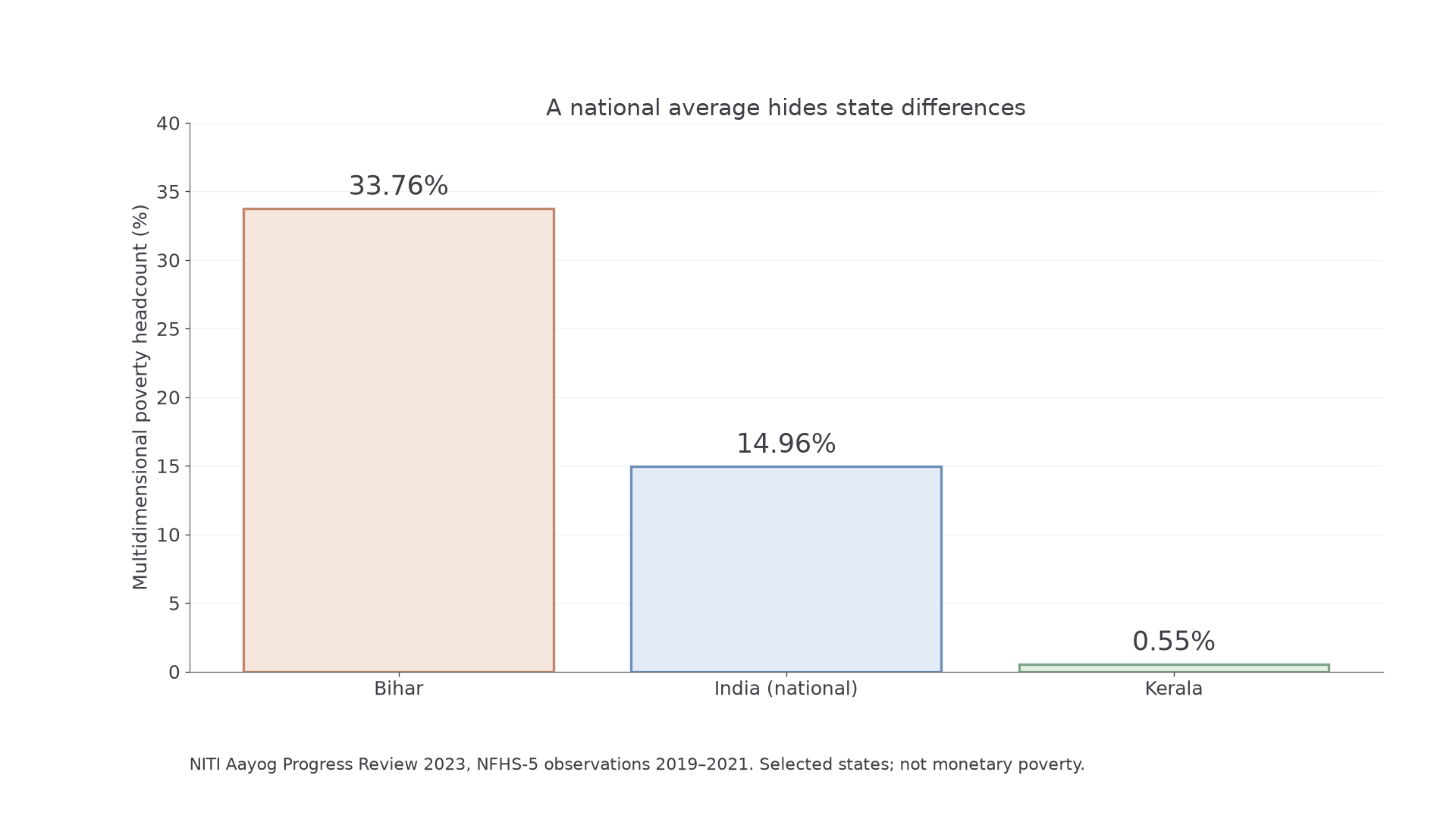
NITI Aayog's National Multidimensional Poverty Index Progress Review 2023 uses twelve indicators across health, education and living standards. It compares household surveys from 2015–2016 and 2019–2021. Its national multidimensional poverty headcount fell from 24.85% to 14.96%; these are survey periods, not observations newly collected in the publication year.
Continue this lesson.
You’re previewing NovaLearn without an account. Create a free account to read the rest.
Create free account