5.1 - Farming systems and ecosystem change
Farming provides food by managing plants, animals, soils and water. This part of 5.1 explains how farming systems differ and follows the causal links through which agricultural changes affect ecosystems and rural communities.
A farm as a system
A farming system connects inputs, processes and outputs. Physical inputs include sunlight, rainfall, soil and temperature. Human inputs include labour, machinery, seed, feed, fertiliser, capital and knowledge. Processes include planting, irrigation, crop growth, animal rearing and harvesting.
Outputs include useful food, fibre and income, but also wastes and environmental effects. Some outputs become inputs again: manure can return nutrients to soils, while crop residues can feed livestock. A farm is therefore connected both internally and to markets, ecosystems and settlements beyond its boundary.
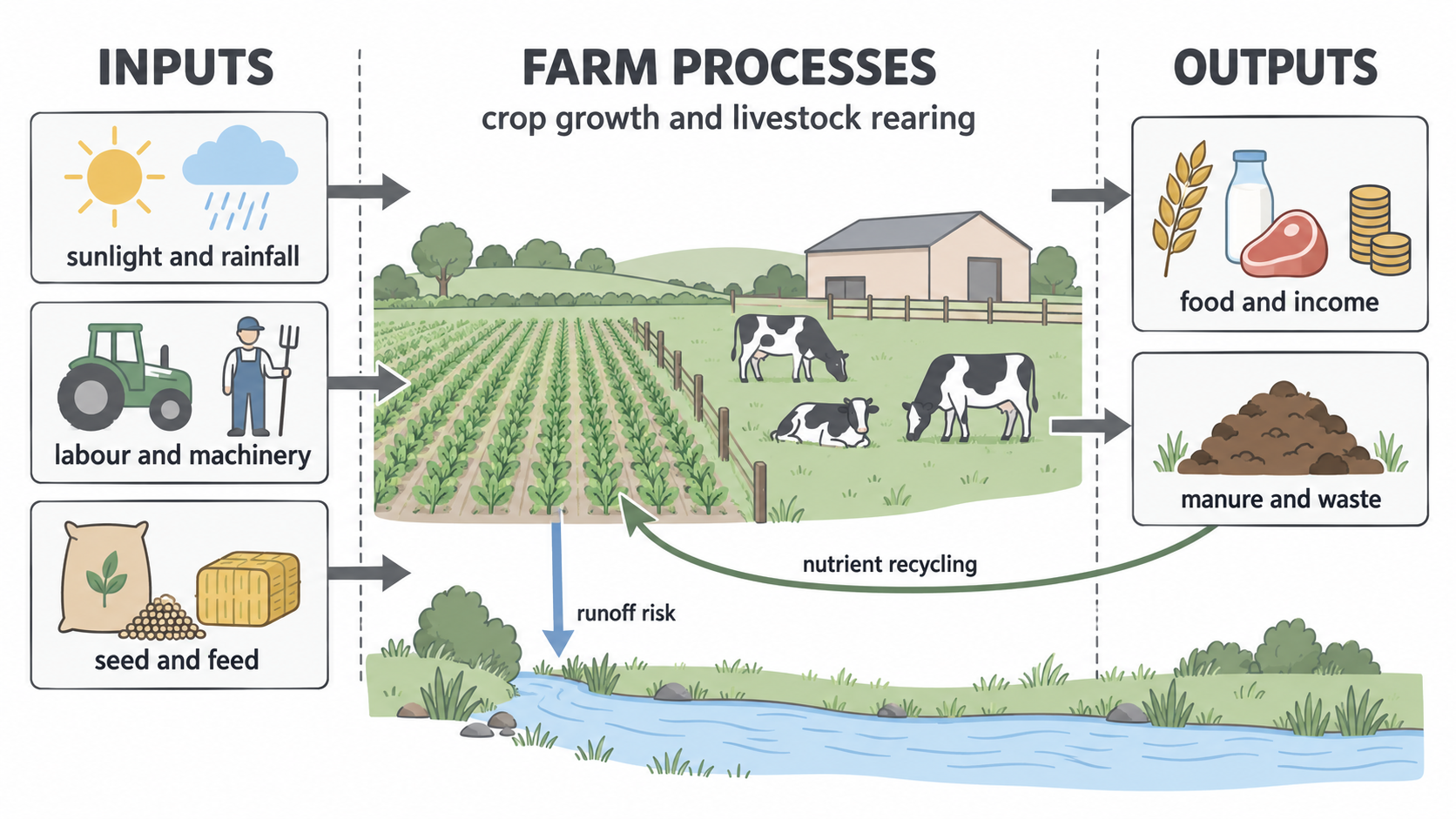
A conceptual mixed-farm system. Manure can recycle nutrients, while runoff can carry losses into water. The arrows show possible connections, not measured flows or a claim that every farm pollutes.
For example, adding irrigation may allow a second crop and increase income. It also increases water demand and may require pumps and energy. Whether the change is successful depends on water availability, costs, crop prices and effects on other users. A system explanation follows both the intended benefit and the additional demands.
Three different farming classifications
Farms can be classified along three independent dimensions. Do not use one pair of terms as if it automatically determines the others.
| Classification | Meaning | Examples and cautions |
|---|---|---|
| Arable / pastoral | Growing crops / rearing animals | A mixed farm does both |
| Commercial / subsistence | Producing mainly for sale / mainly for the household's own use | A household may consume some output and sell a surplus |
| Intensive / extensive | Relatively high / low inputs per unit area | Inputs can include labour, capital, feed or chemicals; extensive farms can cover large areas |
A small irrigated vegetable farm supplying a city can be arable, commercial and intensive. An extensive sheep farm may also be commercial because its animals are sold. A labour-intensive subsistence farm is possible: small size or limited machinery does not automatically make a farm extensive.
Intensity concerns inputs relative to land area, not simply total output. Compare two hypothetical farms: Farm A uses 20 worker-days on 2 hectares, or 10 worker-days per hectare; Farm B uses 100 worker-days on 100 hectares, or 1 per hectare. B uses more labour overall, but A is more labour-intensive per unit area. Other forms of input would also matter in a complete comparison.
Why farming systems vary
Farmers select systems within physical and human constraints. Steep land may be difficult to plough safely or economically, favouring grazing or forestry. Flat fertile land with enough water can support crops, while a short growing season restricts which crops mature. Irrigation can reduce rainfall dependence, but requires a reliable source and investment.
Continue this lesson.
You’re previewing NovaLearn without an account. Create a free account to read the rest.
Create free account