7.1, 7.2, 7.3 - Drylands, desertification and water security
Why can a landscape support people for centuries yet lose productive soil within a few dry years? These dryland parts of 7.1–7.3 connect fragile environments, the causes and consequences of desertification, and technologies that improve water security. The key is to follow changes in vegetation, soil, water and livelihoods together.
Where environments are fragile
An environment is fragile when disturbance can produce substantial damage or recovery is difficult. Fragility does not mean that an ecosystem is empty or naturally failing. A desert community may be well adapted to little rainfall, but recover slowly after repeated vehicle damage; a rainforest can support abundant life yet depend on rapidly recycled nutrients.
Fragile environment
An environment that is especially vulnerable to damage or has limited capacity to recover from disturbance.
Fragile environments occur at different latitudes and altitudes. Drylands include the Sahel south of the Sahara, central Australia and parts of western Asia. Rainforests cluster around the equator, notably the Amazon, Congo Basin and Southeast Asia. Arctic tundra and polar environments have short growing seasons; high mountains have cold conditions, steep slopes and thin soils. Sensitive coastal and marine ecosystems include mangroves and coral reefs: physical damage, pollution or altered temperature can disrupt close ecological relationships. These are examples, not an exhaustive list.
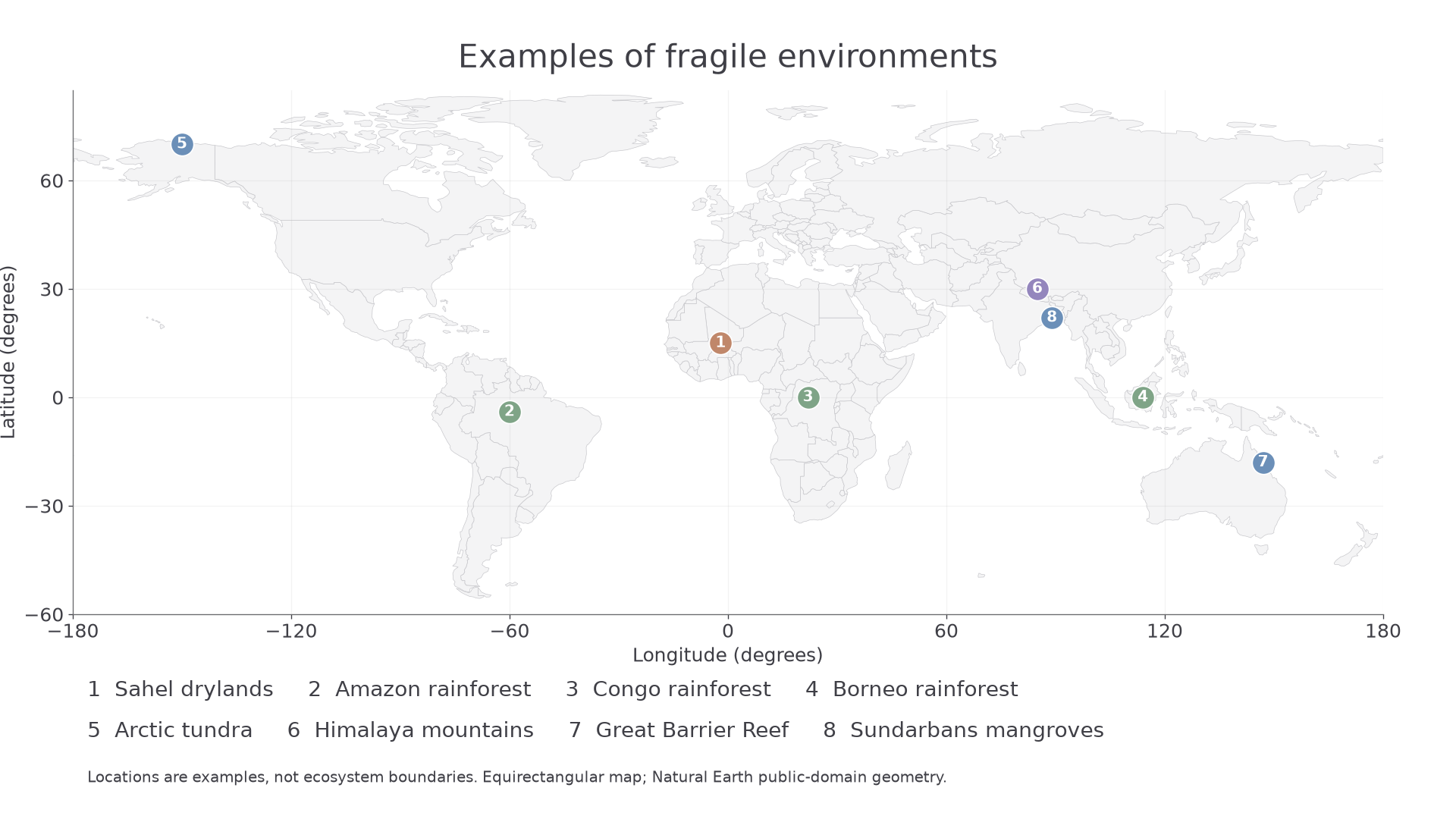
The points locate examples; they do not map the full boundaries of each ecosystem. Read latitude and neighbouring regions before explaining a distribution.
For a world distribution, begin with a pattern and then name evidence: “Major tropical rainforests lie near the equator, including the Amazon in South America and Congo Basin in Africa.” “They are scattered everywhere” loses both the pattern and its geographical explanation.
How productive dryland becomes degraded
Drylands have limited and often variable moisture. Drought is an unusually prolonged shortage of precipitation relative to normal conditions; desertification is land degradation in arid, semi-arid and dry sub-humid areas. Desertification can occur far from a desert's edge. One drought need not permanently degrade well-managed land.
Drought reduces plant growth. Bare soil receives less protection from wind and raindrop impact, so topsoil can be removed. Repeated trampling compacts soil; water then runs off instead of infiltrating. Less stored soil moisture restricts the next season's growth. This is a reinforcing feedback: vegetation loss makes recovery harder.
Human pressure can strengthen that feedback. More demand for food may shorten fallow periods, leaving less time for soil recovery. Collecting fuelwood faster than trees regrow removes cover and organic inputs. Overgrazing removes vegetation faster than it regenerates, while concentrated livestock trampling damages the surface. Migration into a locality can increase demand on limited land and water; migration away may also remove labour needed to maintain terraces or water systems. Its effects depend on who moves, where and under what conditions.
Population growth therefore changes pressures, not a predetermined outcome. Secure land rights, local knowledge, access to other fuels and better farming can support more people without the same degradation. UNCCD's 2021 Sahel evidence describes regreening as well as degradation: a whole region should not be represented as a uniformly advancing desert.
Reading population and resource pressure
A rising population line is evidence of more people, not proof that resources are exhausted. Demand also depends on consumption per person; available supply depends on technology, distribution and the condition of the environment.
The UN's World Population Prospects 2024 estimated a global population of about 8.2 billion in 2024. Its future population pathways are projections built from assumptions about fertility, mortality and migration, not promises. The teaching graph below uses rounded historical landmarks and a stated projection. Global totals cannot directly establish water availability in one Sahel village.
Continue this lesson.
You’re previewing NovaLearn without an account. Create a free account to read the rest.
Create free account