5.1 - Biomes and ecosystem goods and services
Rural environments are parts of ecosystems that provide materials, livelihoods and protection. This part of 5.1 locates the world's major biome groups and explains why their goods and services matter to people, including effects that are easy to overlook in a market price.
Why biomes form global patterns
An ecosystem consists of organisms interacting with each other and with their physical environment. A biome is a large ecological region with broadly similar climate and characteristic vegetation. A forest ecosystem is local; the tropical forest biome stretches across parts of several continents.
Temperature and moisture control how long plants can grow and how much water they lose. Near the Equator, high temperatures and frequent rainfall support dense vegetation. Where rainfall is low, plants must survive water shortage. At high latitudes, low temperatures and a short growing season restrict growth even where water is present as snow or ice.
Latitude helps explain these broad patterns, but does not determine everything. Altitude lowers temperature, mountain rain shadows reduce moisture, and ocean influences alter seasonality. Soil, fire, grazing and human land use also affect vegetation. Biome boundaries are transitions rather than precise walls; different classifications may draw them differently.
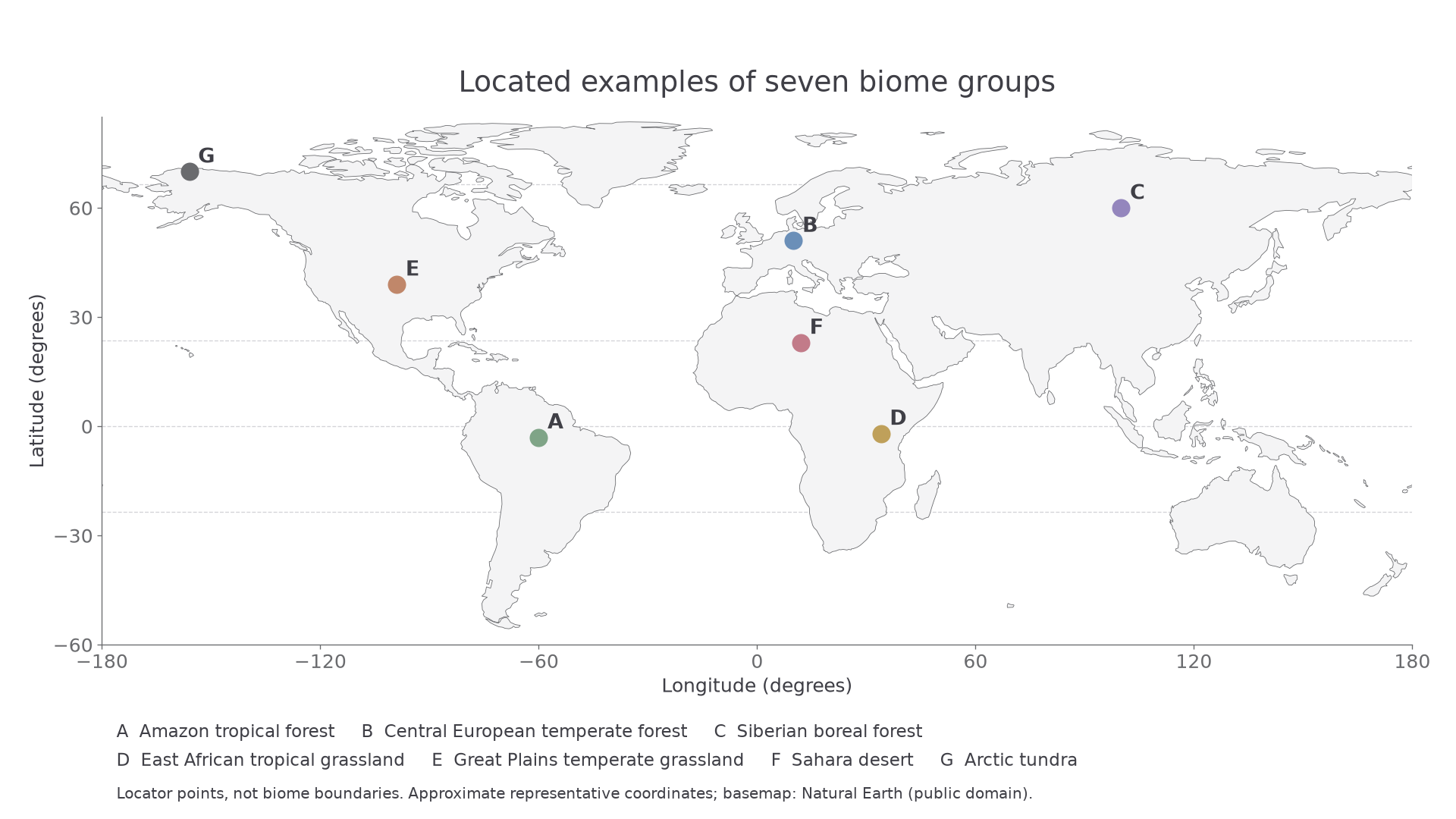
Representative locations, not the full extent or boundaries of each biome. Coordinates are approximate; the Natural Earth basemap is public domain. Present land use at a point may have modified the natural vegetation.
Read a world map using the Equator, tropics, polar latitudes, continents and hemisphere. For example, the Amazon is largely equatorial South America, whereas boreal forests form a high northern belt across North America and Eurasia. Saying “in the north” is less useful than locating a pattern relative to those reference lines.
Contrasting forest biomes
Forests differ because their trees must cope with different combinations of rainfall, temperature and seasonality.
| Forest biome | Broad distribution | Climate and characteristic vegetation |
|---|---|---|
| Tropical forest | Equatorial regions, including the Amazon, Congo basin and Southeast Asia | Warm throughout the year; wet tropical forests have abundant rainfall and dense, layered broadleaf vegetation; some tropical forests have marked dry seasons |
| Temperate forest | Mid-latitudes, including parts of Europe, eastern North America and East Asia | More seasonal temperatures; sufficient moisture for trees; deciduous trees shed leaves in an unfavourable season, while some temperate forests are evergreen |
| Boreal forest, or taiga | High northern latitudes, especially Canada, Scandinavia and Russia | Long cold winters, short growing seasons; many needle-leaved conifers, often evergreen, although exceptions such as larch occur |
In a wet tropical forest, year-round warmth and moisture allow rapid growth and decomposition, although nutrients may be quickly recycled rather than stored in a deep fertile soil. In a temperate deciduous forest, losing leaves reduces demands during winter. Boreal trees cope with cold and a short growing season; needle leaves and conical forms are common adaptations, not a claim that every species is identical.
The distribution table describes broad natural patterns. A country can contain several biomes, and farmland or cities may occupy land that once supported forest. A land-cover map showing today's crops is therefore answering a different question from a map of potential biome distribution.
Grasslands, deserts and tundra
Not every region with few trees is a desert. Water, temperature, fire and grazing produce different types of open vegetation.
Tropical grasslands, including savannas in East Africa and parts of Brazil and northern Australia, are warm with marked wet and dry seasons. Grasses grow during wetter periods; scattered drought-tolerant trees occur in many savannas. Seasonal drought, fire and grazing can limit continuous tree cover.
Temperate grasslands, such as the North American prairies and Eurasian steppes, occur mainly in continental interiors with seasonal temperatures and insufficient moisture for extensive forest. Grasses tolerate grazing and fire through growth close to or below ground. Many areas have been converted to crops or livestock farming.
Continue this lesson.
You’re previewing NovaLearn without an account. Create a free account to read the rest.
Create free account