7.1, 7.2, 7.3 - Rainforests, deforestation and sustainable management
Rainforest clearance can generate income while weakening the ecosystem on which future livelihoods depend. These rainforest parts of 7.1–7.3 explain the causes and consequences of deforestation, then compare management in the Brazilian Amazon. Maps and dated evidence help distinguish a real improvement from an unsupported claim of success.
A productive but interdependent ecosystem
Major tropical rainforests occur near the equator, including the Amazon Basin in South America, Congo Basin in Africa and parts of Southeast Asia. Warm conditions and abundant rainfall support year-round growth. Dense layers of vegetation contain many habitats, while organisms depend on each other through food webs, pollination and seed dispersal.
High productivity does not mean every rainforest soil is permanently rich. Warm, moist conditions allow rapid decomposition. Roots quickly take up released nutrients, so a large nutrient store is held in living vegetation. Heavy rainfall can leach soluble nutrients downward. Removing the vegetation interrupts litter inputs and exposes the soil; a temporary ash nutrient pulse after burning does not guarantee lasting fertility.
The Brazilian Amazon is the named management region in this lesson. It occupies much of northern Brazil and forms part of a forest system extending into neighbouring countries. Read a regional map carefully: the legally defined Legal Amazon, the Amazon biome and the river basin have different boundaries. A statistic for one is not automatically a statistic for all three.
Why clearing spreads along access routes
Deforestation is the conversion of forest to another land use or a long-term loss of forest cover. Selective logging may degrade a forest without immediately converting all of it; later clearance can follow.
Commercial timber extraction removes valuable trees and often requires access tracks. Agricultural conversion creates cattle pasture or crop fields, linking local clearance to demand and prices elsewhere. Mining clears working areas and requires roads, power and settlements. Transport routes reduce the cost of moving timber, minerals and farm products. Settlement creates demand for land, fuel and food. Hydroelectric power schemes can inundate forest beneath reservoirs and attract further access infrastructure.
These causes interact. A road may initially serve a mine, then allow logging, settlement and farming to expand. On satellite maps this can create narrow clearings branching from a transport corridor, often called a fishbone pattern. Describe what the source shows before inferring a driver: a linear clearing is consistent with road access, but the image alone may not reveal who cleared it or whether the activity was legal.
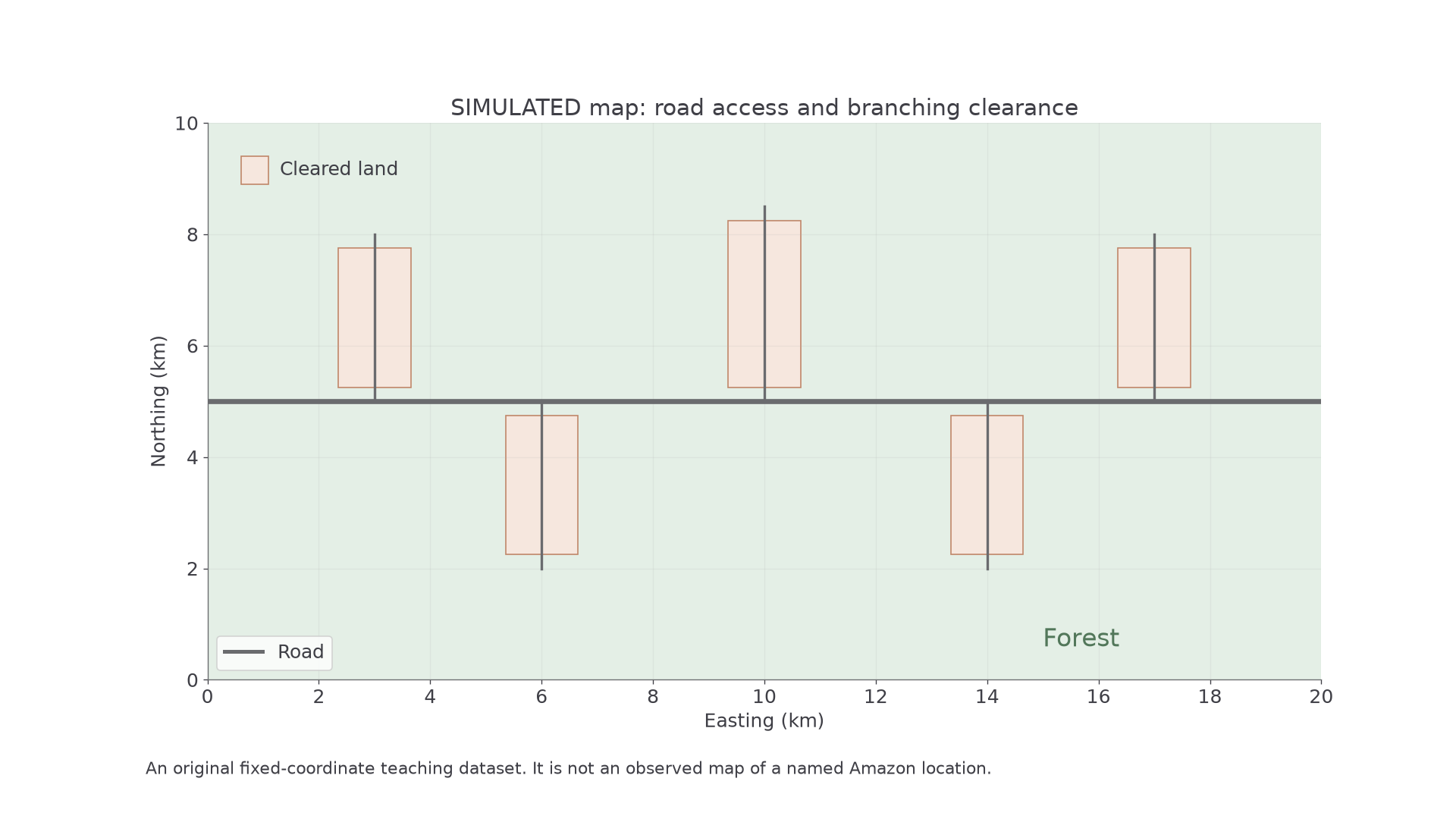
An explicitly simulated satellite-style teaching map, with fixed coordinates and a scale. It demonstrates a pattern rather than presenting invented observations as an actual Amazon survey.
At the wider scale, inspect actual INPE satellite maps through its TerraBrasilis monitoring service. Look for concentrations along the southern and eastern forest margins and transport corridors, while checking the map's date, boundary and legend. A source records a time and measurement method; it is not a timeless picture of the whole rainforest.
Gains and losses from deforestation
Clearance can supply timber, minerals, electricity, jobs, export earnings and farmland. Those gains explain why simply telling people to stop may fail. Yet benefits may go mainly to large landholders or outside firms while nearby communities bear costs or lose access to forest resources.
Habitat destruction removes feeding and breeding sites. Fragmentation isolates populations and creates hotter, drier edges; a narrow strip of trees does not necessarily preserve the ecological functions of a large connected forest. Loss of species can reduce ecosystem resilience and remove useful genetic resources.
Burning and decomposition release carbon stored in vegetation, while fewer trees remain to take carbon from the atmosphere. This contributes to climate change. Reduced evapotranspiration can also alter regional moisture recycling. It does not follow that every local drought can be attributed solely to one area of clearance.
Continue this lesson.
You’re previewing NovaLearn without an account. Create a free account to read the rest.
Create free account