3.1 - Tectonic hazard patterns, causes and measurement
Earthquakes and volcanoes are concentrated in recognisable belts, but they do not occur at every boundary in the same way. Learn the mechanisms behind those patterns and distinguish a hazard's physical size from its effects on people.
Earthquakes, faults and seismic waves
The Earth's rigid outer lithosphere is divided into moving plates. The mantle beneath is mostly solid but can deform and flow over long timescales; it is not a worldwide ocean of liquid magma. Plate movement deforms rock and builds stress. Where a fault is locked by friction, strain can accumulate until sudden slip releases stored energy as seismic waves.
The focus, or hypocentre, is where rupture begins below the surface; the epicentre is the surface point above it. Rupture can spread across a large fault area, so the epicentre is not the only place affected. Ground shaking can damage buildings, trigger landslides or cause liquefaction, where some saturated loose sediments lose strength. Vertical seabed displacement can generate a tsunami.
Aftershocks are further earthquakes following the main event. They can damage weakened structures and delay recovery. Earthquakes are therefore more than a single moment of shaking, and their secondary hazards depend on the local setting.
Boundary types and hazard mechanisms
At a divergent, or constructive, boundary plates move apart. Hot mantle material rises; falling pressure allows some to melt. Magma rises and cools to form new crust, often at ocean ridges. Faulting produces mainly shallow earthquakes, and eruptions occur where magma reaches the surface.
At a convergent subduction boundary, a denser oceanic plate descends beneath another plate. Locked interfaces and movement within the descending slab generate earthquakes, including very large events. Water released from the descending material promotes melting in the mantle above it. Buoyant magma can rise through the overriding plate to form volcanoes. The slab does not simply turn directly into a pipe of liquid lava.
At a continental collision, such as the Himalayas, converging continental crust shortens and thickens. Major earthquakes occur along faults, but there is generally no continuous subduction-related volcanic arc like the Andes. At a conservative, or transform, boundary plates slide past each other; friction and sudden slip cause earthquakes, while the boundary does not normally generate magma by creating or destroying crust.
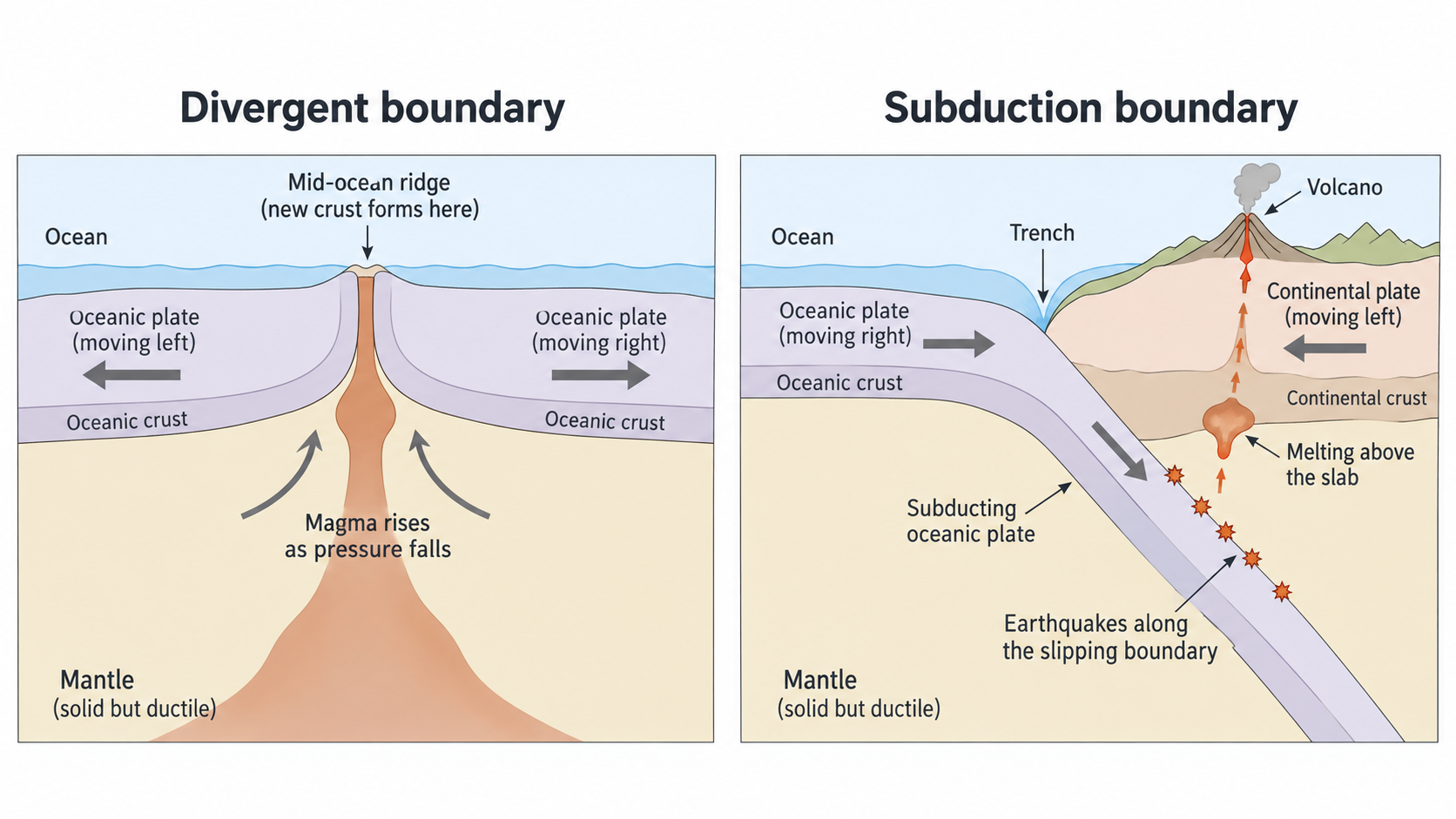
Schematic cross sections. Real boundaries have varied geometries, and earthquakes can occur beyond the illustrated contact.
Volcanic hazards differ from earthquake shaking. Lava is magma at the surface. Explosive eruptions eject ash and rock fragments; hot pyroclastic flows are dangerous mixtures of gas and material moving rapidly downslope. Lahars are flows of volcanic debris mixed with water. Gases, ash and water routes mean the most exposed areas are not determined by distance from the crater alone.
Hotspots and global distribution
Many earthquakes and volcanoes follow the Pacific Ring of Fire, where numerous subduction boundaries surround the ocean. Divergent volcanism follows ocean ridges, including the Mid-Atlantic Ridge. Large earthquakes also occur at collision and transform zones where active volcanoes may be absent. Most plate interiors have fewer tectonic events, but “fewer” does not mean impossible.
Continue this lesson.
You’re previewing NovaLearn without an account. Create a free account to read the rest.
Create free account