2.2 - Coastal ecosystems and their threats
Coastal ecosystems develop where living organisms can tolerate particular physical conditions. Compare reefs, mangroves, dunes and salt marshes, then use the Sundarbans to connect food webs, nutrient cycling and human pressures.
Distribution and physical conditions
An ecosystem consists of organisms interacting with one another and with their non-living environment. Biotic characteristics concern living things; abiotic characteristics include temperature, salinity, water depth, sediment and light. Similar conditions can support similar ecosystem types in distant places.
| Ecosystem | Conditions and features | World pattern and located examples |
|---|---|---|
| Tropical coral reefs | Reef-building corals commonly depend on warm, clear, shallow, sunlit marine water; their skeletons build complex habitats. Many contain symbiotic algae. | Mainly tropical/subtropical seas: Great Barrier Reef, Red Sea and Caribbean. Deep/cold-water corals also exist, so not every coral lives in this setting. |
| Mangroves | Salt-tolerant trees and shrubs in intertidal environments, often sheltered muddy coasts and deltas. Roots and other adaptations help with flooding, unstable sediment and low oxygen. | Mainly tropical/subtropical coasts: Sundarbans, Southeast Asia and northern Brazil. |
| Sand dunes | Wind-blown sand accumulates above the beach; pioneer plants can trap sand and stabilise it. Salt spray, drought and burial create demanding conditions. | Sandy coasts across many latitudes, including Britain, southern Africa and Australia; suitable sand supply and wind matter. |
| Salt marshes | Salt-tolerant plants colonise sheltered intertidal mud/silt, often with channels and zones reflecting flooding frequency. | Sheltered estuaries and bays, particularly temperate examples such as the Wash in England and Atlantic North America. |
Use the world map to compare latitude and coast type. Reefs and mangroves have a stronger warm-water pattern than dunes. Sheltered sediment and tidal inundation help explain salt-marsh sites. Latitude alone cannot explain every distribution.
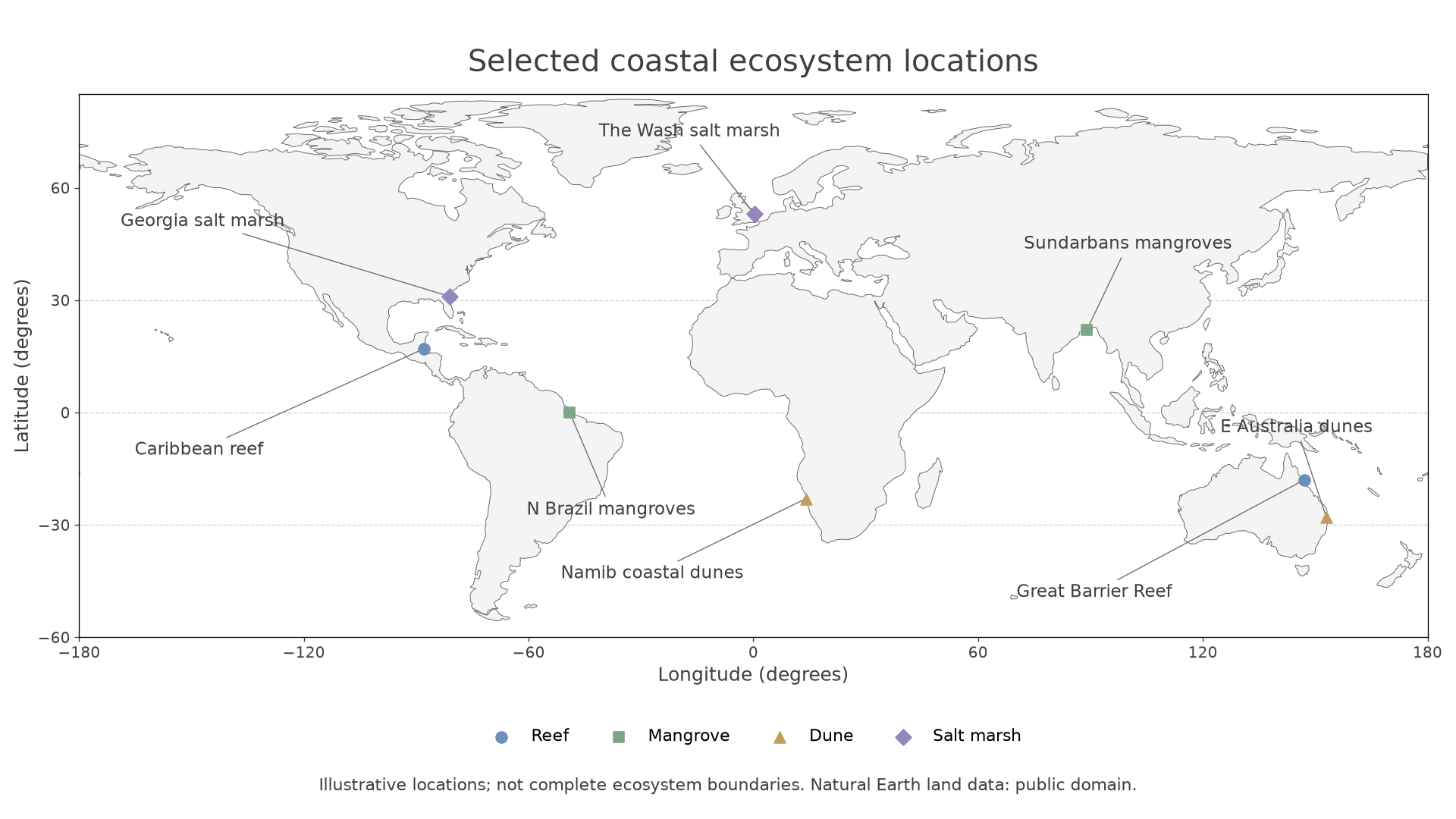
Selected located examples, not complete ecosystem boundaries. Land outline: Natural Earth public-domain data. Coordinates locate examples; they do not imply that the ecosystem fills the surrounding country.
The Sundarbans: conditions and organisms
The Sundarbans mangrove ecosystem lies on the Bay of Bengal across Bangladesh and India, in the Ganges–Brahmaputra–Meghna delta. Here the named focus is the Bangladesh Sundarbans; its World Heritage wildlife sanctuaries form part of a larger forest and are not the same area as the whole transboundary ecosystem.
Freshwater inflow mixes with seawater, producing brackish conditions. Tides repeatedly flood and expose low islands and mudflats. Fine sediment, changing salinity, waterlogged soils and low soil oxygen shape where different plants can grow. Mangrove adaptations include tolerance or management of salt and, in some species, roots that obtain oxygen above the mud. Not every species uses identical root structures.
Mangrove trees, algae, fish, crustaceans, birds and larger animals form connected communities. Trees trap sediment and create shelter; channels and roots provide feeding and nursery habitats. The forest also supports local fishing and other livelihoods. UNESCO's account identifies both high biodiversity and the importance of maintaining the hydrological processes outside the protected boundary.
Food webs and nutrient cycles
In a food web, arrows normally point from food to consumer, showing the transfer of energy and material. Mangrove leaves enter feeding routes directly or after becoming detritus, dead organic material. Crabs, shrimps and other consumers use parts of this resource; fish and fish-eating birds connect further feeding relationships. A web joins different feeding routes: the figure separates crabs and shrimps as two consumer groups that can both provide food for fish. A simplified web illustrates dependencies, not an exhaustive local diet for every species.
Continue this lesson.
You’re previewing NovaLearn without an account. Create a free account to read the rest.
Create free account