7.1 - Natural climate change and the enhanced greenhouse effect
Earth's climate has changed naturally, but that fact alone does not explain today's rapid warming. This climate-causes subdivision of 7.1 examines natural drivers, the greenhouse effect and human emissions. You will learn to judge a proposed explanation by its mechanism, timing and evidence.
Natural drivers operate on different timescales
Climate describes long-term weather patterns and variability. A cold winter does not disprove a warming long-term average, just as a warm day does not establish a new climate.
Milankovitch cycles are slow changes in Earth's orbit and axis. Eccentricity changes the shape of the orbit, obliquity changes the tilt of the axis and precession changes its orientation. Together they alter the seasonal and latitudinal distribution of incoming solar energy over tens to hundreds of thousands of years. Summer conditions at high northern latitudes can affect whether winter snow survives, allowing ice-sheet changes and feedbacks. These cycles are too slow to explain the rapid warming observed over recent decades.
Solar variation changes the energy supplied by the Sun. Solar activity includes an approximately eleven-year cycle, but the recent long-term warming pattern cannot be explained by an equivalent sustained increase in solar output. A driver needs the right direction and magnitude, not merely the ability to influence climate at some time.
Volcanism can inject sulfur compounds high into the atmosphere. Resulting aerosols reflect some incoming sunlight and can cool the surface for a few years after a major explosive eruption. Volcanoes also emit carbon dioxide, but volcanic emissions do not explain the scale of recent human-driven increases. “Volcanoes change climate” is true; “therefore recent warming is volcanic” does not follow.
How greenhouse gases alter the energy balance
Sunlight reaches Earth mainly as shortwave radiation. Some is reflected by clouds, particles and the surface; the rest is absorbed and warms the climate system. The warmed surface emits longwave infrared radiation. Greenhouse gases absorb some of this outgoing radiation and emit radiation in all directions, including back towards the surface.
Greenhouse effect
The warming influence of atmospheric gases that absorb and re-emit outgoing longwave radiation.
The natural greenhouse effect is essential to Earth's climate. Enhancement means that additional greenhouse gases change the energy balance: initially, less energy escapes to space for the same surface temperature. The climate system warms until outgoing energy increases towards a new balance. Energy still escapes; the atmosphere is not a sealed lid, and gases do not simply reflect all heat back like a mirror.
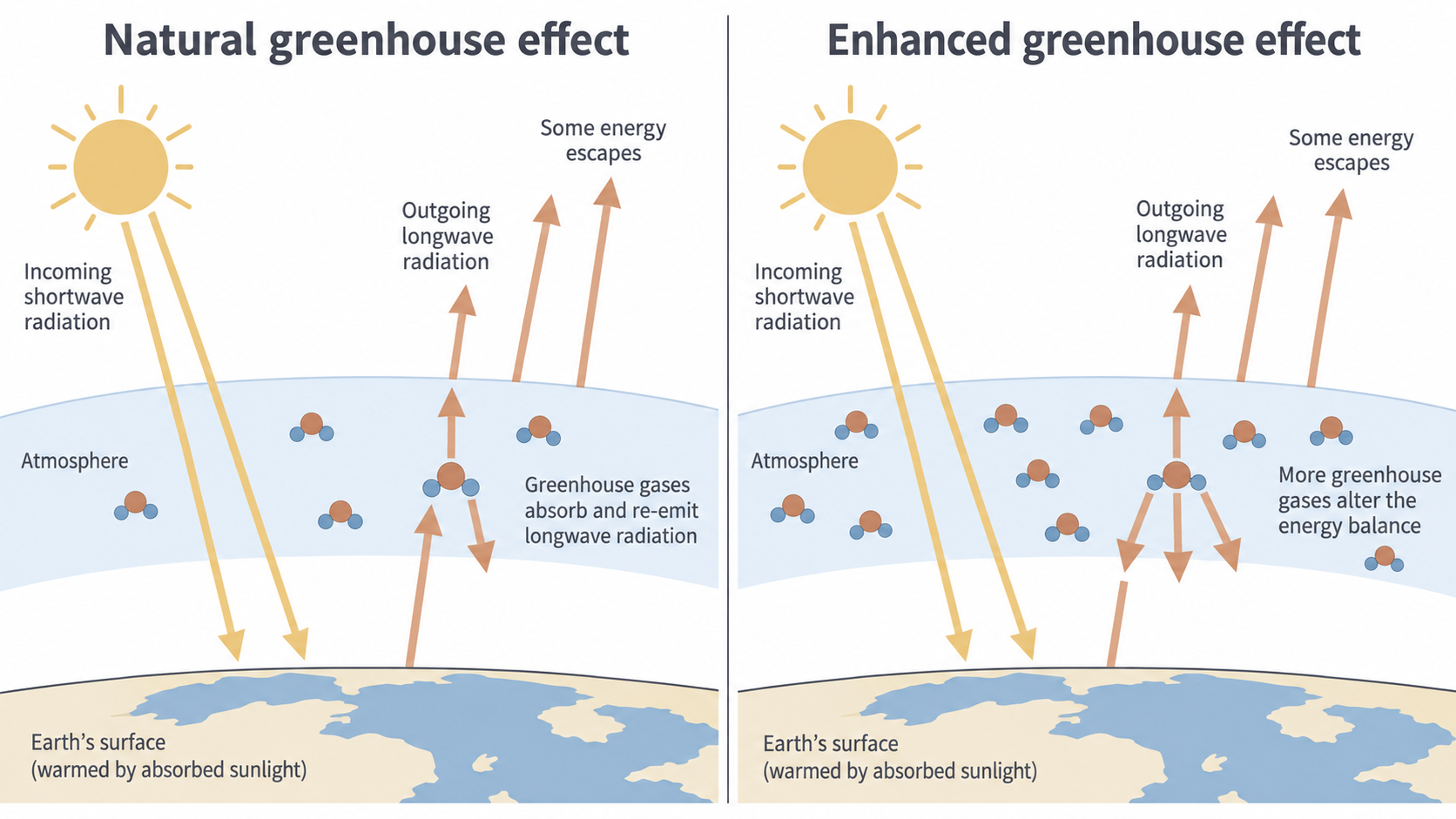
A conceptual comparison, not a scale diagram. Downward arrows represent longwave emission by greenhouse gases; they are not extra sunlight from the Sun.
Water vapour is an important greenhouse gas, but it responds rapidly to temperature and can amplify warming. Long-lived human additions of carbon dioxide help drive the initial sustained change. The ozone hole and the enhanced greenhouse effect are different issues: reduced ozone protection is not the main mechanism of current global warming.
Continue this lesson.
You’re previewing NovaLearn without an account. Create a free account to read the rest.
Create free account