7.2, 7.3 - Climate impacts and responses in the UK and Bangladesh
The same climatic change can have very different consequences depending on where people live and what they can afford to do. These climate parts of 7.2–7.3 trace impacts through ecosystems and livelihoods, then compare responses in the UK and Bangladesh. A useful judgement explains both how an action works and whom it leaves exposed.
From rising seas to changing settlements
Warming raises global mean sea level principally by expanding seawater and melting land-based ice. Melting floating sea ice has little direct effect on sea level, although it affects climate feedbacks. Local relative sea level also depends on land movement and regional ocean conditions.
IPCC AR6 assessed a global mean rise of about 0.20 metres between 1901 and 2018. Its estimated average rate increased from about 1.3 mm per year in 1901–1971 to 3.7 mm per year in 2006–2018. The graph compares period-average rates; it does not show an identical increase in every year or every location.
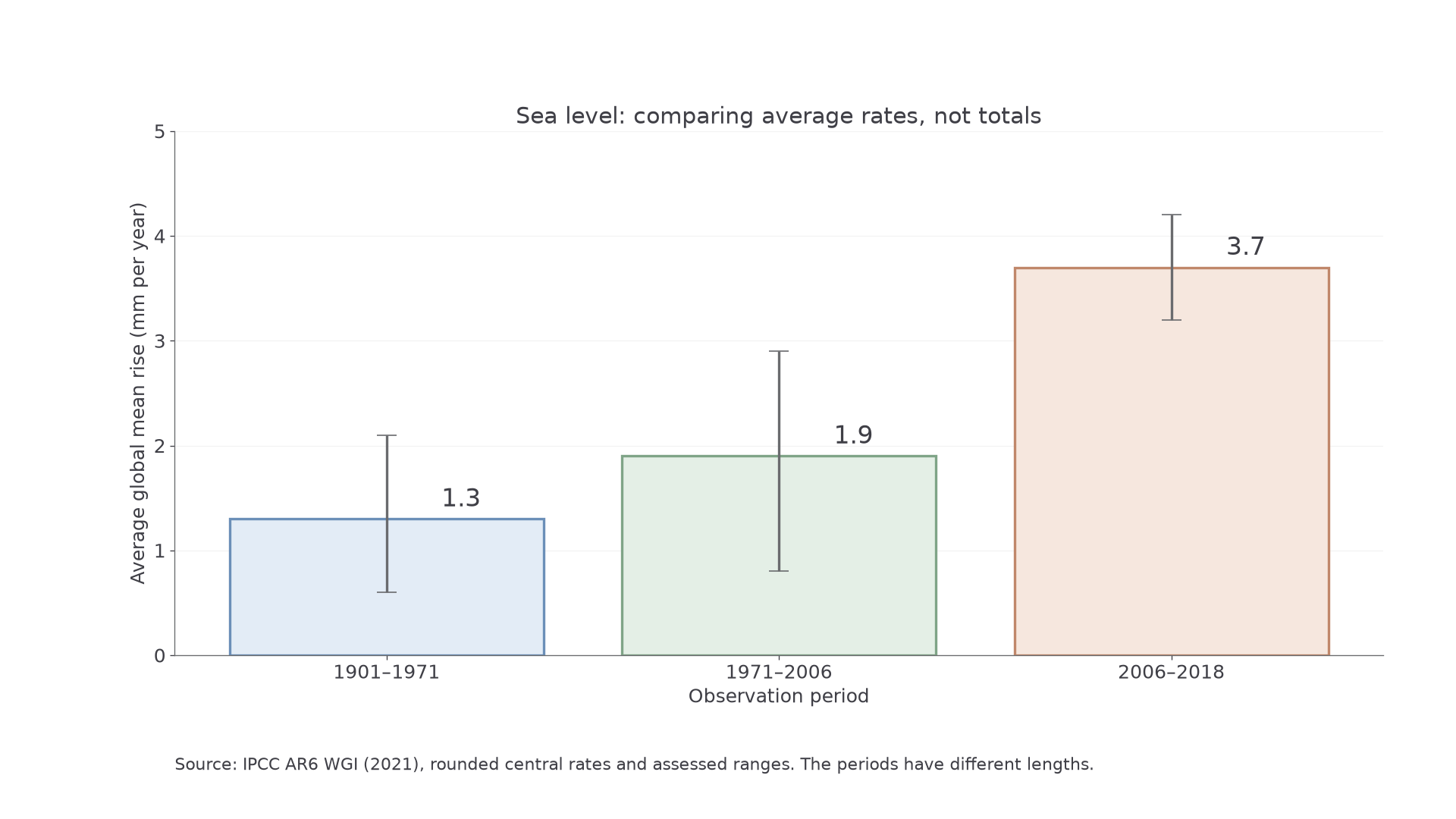
IPCC AR6 Working Group I. Periods differ in length; bars show rates, and whiskers show assessed ranges.
A higher starting sea level allows a storm surge to reach further inland. Flooding can damage homes, roads, power and workplaces. Saltwater intrusion can affect freshwater and agricultural soils, reducing crop options or increasing treatment costs. Repeated losses may lead households, businesses or governments to change settlement locations. Moving also carries costs: employment, social ties, land rights and cultural sites cannot always be replaced by paying for a new building.
Impacts spread through food, health and work
Climate change alters the conditions to which organisms are adapted. Some species shift their ranges; others cannot move fast enough or lack suitable connected habitat. Warming seas can contribute to coral bleaching, weakening habitats and the fisheries and tourism jobs associated with them. Hotter, drier conditions can increase stress on forests, although land management and ignition sources also affect fire risk.
People experience linked risks. Heat can make outdoor work unsafe and reduce productivity. Floods can interrupt employment and schooling, contaminate water and create stress long after the water recedes. Changing rainfall and heat affect harvests, livestock and food prices. Changing conditions can alter disease risks, but healthcare, sanitation and control measures influence the outcome.
Bangladesh's flat delta, dense settlement and dependence on climate-sensitive farming and fisheries increase exposure. Coastal salinity, river flooding and storm surges can interact. In the UK, the 2022 heatwave demonstrated risks to health and infrastructure; flooding and heat also affect businesses and food supply chains. A wealthier country is not immune, and poorer households in either country may have fewer resources to recover.
Do not write “climate change causes more of every hazard everywhere.” Risks differ by hazard and region. A particular flood depends on rainfall, drainage, land use and exposure as well as the changing climate. A reasoned answer identifies a plausible change and follows its consequences, with appropriate limits.
Two complementary kinds of response
Mitigation reduces the causes of climate change by cutting greenhouse emissions or increasing removals. Adaptation reduces harm from experienced or expected effects. Replacing fossil generation with low-carbon electricity is mitigation; raising a building above floodwater is adaptation. Some actions serve both purposes: restoring a wetland can store carbon and slow water.
Mitigation needs cooperation because gases mix globally. Adaptation is often place-specific because risk depends on local conditions. Neither substitutes fully for the other. Emissions reductions limit future risks, but some warming and sea-level rise require preparation. Adaptation also has limits: an area can become costly or impossible to protect under larger changes.
Evaluate a response through an explicit criterion. Does it reduce risk for the most exposed group? Is it affordable to maintain? Does it transfer damage downstream or lock people into a vulnerable location? A benefit that appears nationally may conceal a local loss.
Continue this lesson.
You’re previewing NovaLearn without an account. Create a free account to read the rest.
Create free account