H567/03 Section B Option 4 - Zajonc et al. (1969) and spectator sport
Zajonc, Heingartner and Herman studied social enhancement and impairment using cockroaches. A straight runway and a cross-shaped maze let them test whether social presence strengthens a response that may be appropriate in one task and inappropriate in another.
Drive theory, background and aims
The prescribed study is Zajonc et al. (1969), Social enhancement and impairment of performance in the cockroach. Earlier grouped-cockroach maze research found poorer performance and suggested distraction. Other studies found social enhancement, particularly for well-learned or instinctive responses. The researchers sought an explanation for both patterns.
The drive account proposes that the presence of others increases general arousal, strengthening the dominant response. If that response is appropriate for the task, performance improves; if it is inappropriate, performance worsens. The dominant response is the likely response, not automatically the correct one.
A cockroach's straight movement away from bright light can lead directly to a dark goal in a runway. A cross-shaped maze requires a turn, so simply continuing straight can be inappropriate. The prediction was that social conditions would improve runway performance and impair maze performance.
Experiment 1 compared solitary performance with co-action and passive-audience conditions. The audience comparison asked whether the effect required another animal to run alongside and supply route cues. Experiment 2 investigated reduced social presence through mirror images and conspecific odour. “Conspecific” means a member of the same species.
This is evidence within the social area and OCR's audience-effects topic. The proposal links a situation to behaviour through general drive. It does not require assuming that cockroaches worry about spectators awarding them a poor evaluation.
Experiment 1 design and apparatus
This was a laboratory experiment with independent groups across social conditions and tasks. Repeated trials measured each animal within its assigned condition; they did not make it a repeated-measures social-condition experiment.
The experimental subjects were 72 adult female Blatta orientalis cockroaches. For at least a week before testing they were housed individually in screened mason jars, kept in darkness at approximately 75°F and provided sliced apples freely. Of the 72, 32 were in the co-action treatment and its alone comparison, and 40 in the audience treatment and its alone comparison. Within each treatment, half performed the runway and half the maze; each task was further split between alone and social conditions. That gives eight subjects per co-action cell and ten per audience cell.
The apparatus was a clear 20-inch cube holding either a straight runway or a cross-shaped maze. A 150-watt floodlight supplied aversive light behind the starting box. The covered goal box was dark. Both tasks used enclosed tracks with comparable start-to-goal path length, while the maze introduced a choice and a turn.
[DIAGRAM: asset_slug: sp12_runway_maze_routes; file: sp12_runway_maze_routes.png; description: Conceptual top-down routes away from bright light: the straight runway reaches a dark goal directly; the cross-shaped maze requires a turn, with other arms ending without the goal.]
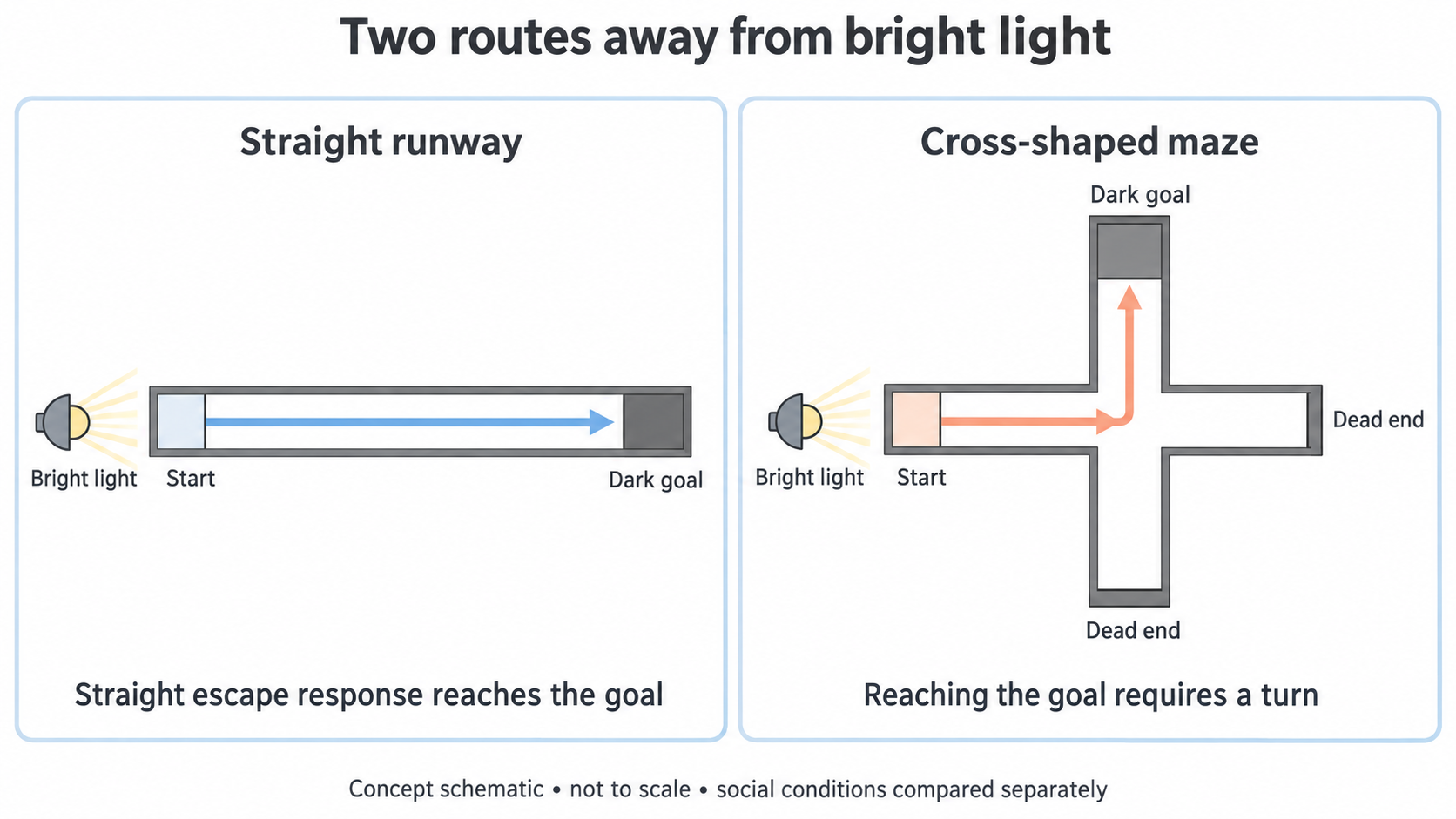
Diagram description: The image isolates the task difference. It is not to scale and does not show the cube, gates or social-condition boxes. A correct route in the maze turns at the intersection rather than continuing straight.
In co-action, paired subjects shared the track; white and blue markings allowed individual identification. In the audience condition, the subject ran alone beside four boxes, each holding ten adult female audience cockroaches. Clear walls and aligned air holes allowed sensory information. Audience controls had the same boxes present but empty and clean. The 72 experimental subjects exclude the additional audience animals.
The manipulated factors concerned task and social presence, with the kind of social treatment also compared. Main dependent measures were starting latency and total running time. An audience cockroach did not act as a co-running partner.
Experiment 1 procedure and measures
Before each trial, the track was swabbed with alcohol and allowed to dry thoroughly. The start and goal boxes were cleaned before each set of ten trials. This reduced residual chemical traces from earlier animals and made testing more standardised.
The animal began in a covered starting box. Testing began by removing its opaque cover, switching on the floodlight and raising the starting gate. The trial ended when the cockroach entered the goal and the gate was lowered after its last leg crossed the entrance, or after five minutes, whichever came first. In co-action, each subject was timed individually even though the gate was not lowered until both reached the goal.
Each subject received ten consecutive trials, with one-minute intervals. Starting latency was the interval from opening the start gate until the animal's whole body left the start box, recorded to the nearest second. Total running time was recorded to the nearest tenth of a second. Leaving the box and completing the task are different outcomes; one cannot be substituted for the other.
The original excerpts explain that individual times were skewed, so a median across each subject's ten trials was calculated. The published table reports averages of those subject medians, not one median from all pooled trials. Ten trials improve measurement of one animal's performance; they do not multiply the number of independent subjects by ten.
Cleaning, fixed lighting, consistent timing endpoints and inter-trial intervals support repeatability and control. Timing is quantitative, but measuring time precisely does not directly measure physiological arousal. The proposed drive mechanism remains an interpretation of the performance pattern.
Experiment 1 results and interpretation
The table gives average subject-median running times in seconds. A lower time indicates quicker task completion.
| Treatment | Runway alone | Runway social | Maze alone | Maze social |
|---|---|---|---|---|
| Co-action comparison | 40.58 | 32.96 | 110.45 | 129.46 |
| Audience comparison | 62.65 | 39.30 | 221.35 | 296.64 |
Both treatments showed the predicted direction: quicker runway completion but slower maze completion under social conditions. In the audience comparison, runway time was 23.35 seconds lower with spectators, while maze time was 75.29 seconds higher.
The original results excerpt reports a significant overall social-condition × task interaction for running times, and its discussion reports a significant interaction in the audience treatment (p < .01). The co-action interaction alone was only borderline, p < .10, so it should not be described as significant at a conventional .05 level. A predicted numerical direction and a statistically significant specific comparison are different claims.
Starting-latency effects did not reach statistical significance. For example, audience starting latencies were numerically lower under social conditions in both tasks, but those numbers do not establish a reliable effect on leaving the box. The running-time conclusion should not be extended to every measured outcome.
The passive audience pattern supports an effect that need not depend on imitating a companion running the route. It is consistent with drive strengthening dominant responses. However, no direct physiological measure demonstrated arousal, and other sensory or attentional processes still require consideration. Co-action and audience subjects also came from different sources according to the original methods excerpt, so their overall speed difference should not automatically be attributed entirely to treatment type.
Continue this lesson.
You’re previewing NovaLearn without an account. Create a free account to read the rest.
Create free account