H567/03 Section B Option 2 - Neighbourhoods and crime prevention
Learn how neighbourhood design, informal social control and responses to disorder may influence crime, and evaluate the reasoning behind zero tolerance.
Design, visibility and shared responsibility
Neighbourhood features can alter the opportunities for offending and residents' willingness to look after shared spaces.
Defensible space means arranging residential space so that residents can recognise it as theirs, observe it and take responsibility for it. Territorial markers such as a clearly defined shared entrance distinguish public access from a small group's shared area. Natural surveillance comes from usable sightlines: windows overlooking an entrance or a well-lit path make activity visible to ordinary residents. Visibility can raise a potential offender's expectation of being noticed and can help residents recognise problems.
The image of a place also matters. Maintained entrances and repaired damage communicate care; neglected communal areas may communicate weak supervision. The surrounding environment, or milieu, affects whether routes and adjacent activities support safe everyday use. These features work together: an entrance visible from homes may still feel unowned if hundreds of people use it and nobody knows who maintains it.
Newman's work stresses residents' perceived ownership and control rather than simply putting a fence around an estate. A boundary that excludes legitimate users, blocks sightlines or makes access difficult can undermine the aim. Physical design is an opportunity structure, not a judgement about the character of residents in high-rise or low-income housing.
The cognitive contribution is the interpretation of visible cues about detection and care. The social contribution is territorial responsibility and informal social control: neighbours' ordinary presence, cooperation and willingness to respond appropriately. Design cannot substitute for trust, resources or support where residents face intimidation.
Disorder, fear and informal control
Visible disorder can influence perceptions of a neighbourhood even when it does not directly measure serious crime.
Wilson and Kelling's broken-windows argument proposes that unrepaired damage signals that nobody is taking responsibility. People may become more fearful, avoid shared spaces and interact less. With fewer people watching and weaker cooperation, further disorder or offending may become easier. The pathway links a cognitive interpretation of neglect to a social change in informal control.
[DIAGRAM: asset_slug: disorder_pathway; file: disorder_pathway.png; description: A proposed pathway links unrepaired damage to perceived lack of care, fear and withdrawal, weakened informal control and possible increased offending opportunities.]
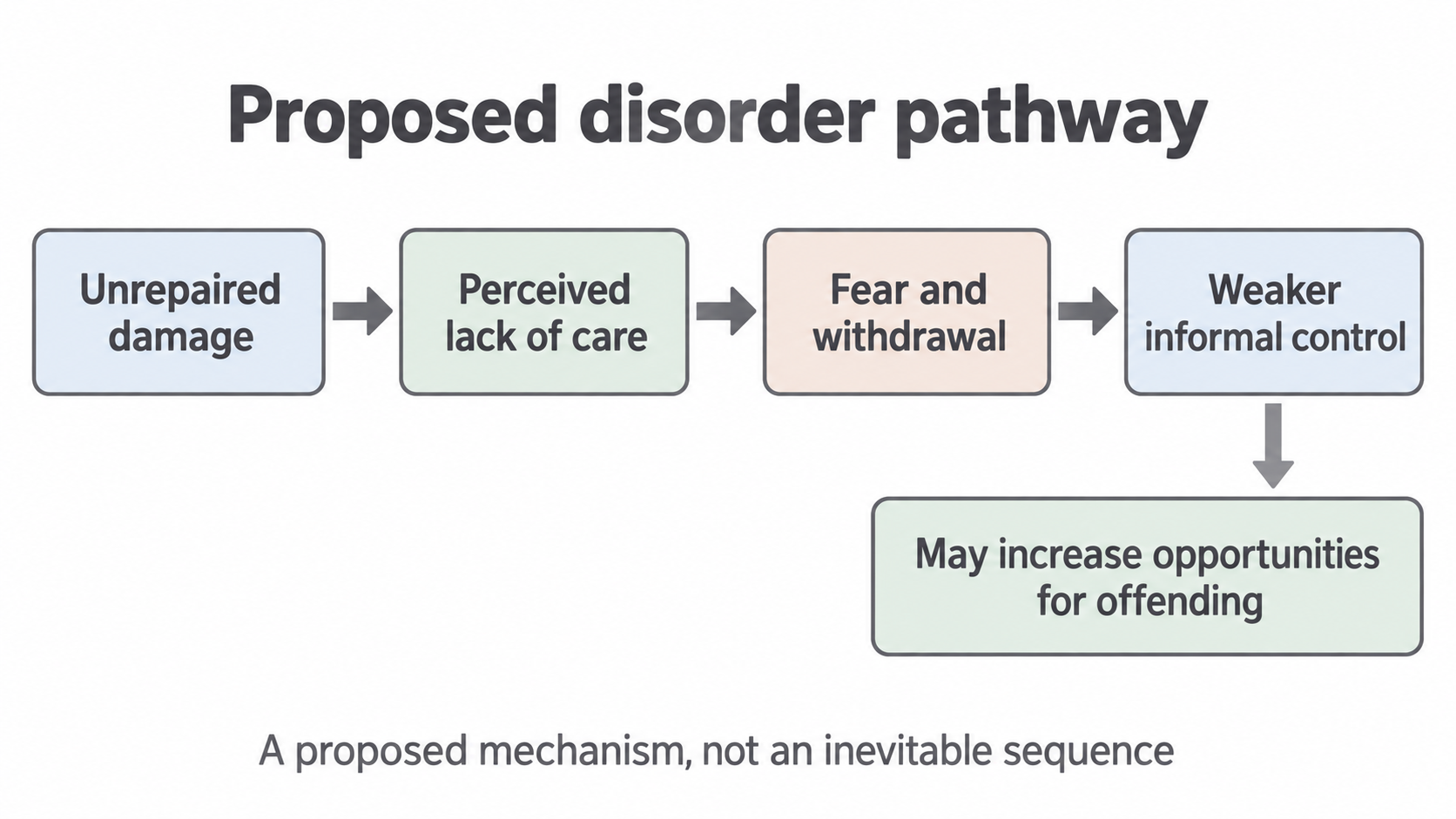
Diagram description: The arrows show the proposed cognitive and social pathway. They do not show measured data or establish that every neighbourhood follows it.
This is a proposed process, not an inevitable sequence in every area. Disorder and crime can share causes such as deprivation, poor services or unstable housing. Crime may also cause people to withdraw and damage to remain unrepaired. A correlation between litter and burglary alone cannot decide which explanation is correct.
Fear of crime and victimisation are different outcomes. A resident may feel safer after a neglected path is repaired even if recorded offences remain unchanged. Equally, greater trust in authorities may increase reporting, making recorded crime rise while previously hidden victimisation falls. Evaluation should consider perceptions, reporting and harm separately.
Continue this lesson.
You’re previewing NovaLearn without an account. Create a free account to read the rest.
Create free account