H567/03 Section B Option 4 - Arousal and anxiety in sport
A fast heartbeat can accompany excitement, worry or physical exertion. Understanding performance therefore requires separating activation from anxiety, then matching a response to the athlete and the task.
Arousal, stress and anxiety
Three related concepts
Arousal is the level of physiological and psychological activation. Stress arises when perceived demands tax or exceed perceived resources. Anxiety involves apprehension or worry, often accompanied by unpleasant bodily responses.
Arousal ranges from low alertness to intense activation. It can energise movement and attention without being unpleasant. An excited runner and a worried runner may both have a racing heart. Anxiety cannot therefore be inferred from activation alone.
Cognitive anxiety concerns thoughts: expecting failure, worrying about selection or repeatedly imagining a mistake. Somatic anxiety concerns perceived bodily symptoms, such as tense muscles, a fluttering stomach or clammy hands. The two can occur together but need not rise and fall identically. Physiological arousal is the bodily activation itself; somatic anxiety includes how that activation is experienced.
State anxiety is the athlete's anxiety at a particular time, such as immediately before today's penalty. Trait anxiety is a relatively enduring tendency to respond anxiously to competitive situations. A usually confident player can have high state anxiety before an unusually important match. Trait describes a tendency, not an unchangeable destiny.
The biological area contributes accounts of autonomic activation; the cognitive area explains appraisal, worry and attention; social psychology explains why evaluation by coaches or spectators changes perceived demands. Combining these levels helps explain why the same competition affects athletes differently.
How arousal may affect performance
Drive theory proposes that increased arousal strengthens the dominant response: the response most likely in that situation. If a skill is well learned and the dominant response is correct, greater arousal may improve performance. For a beginner learning an unfamiliar coordination pattern, the dominant response may be an error; stronger activation can then worsen performance. This is conditional, not a claim that arousal always improves sport.
The inverted-U hypothesis instead predicts improvement as arousal rises from a low level towards an optimum, followed by deterioration beyond that optimum. Too little activation may leave an athlete inattentive; too much may disrupt precision, decision-making or coordination. Its basic curve predicts a gradual decline, unlike the abrupt collapse examined by Fazey and Hardy.
[DIAGRAM: asset_slug: sp01-arousal-models; file: sp01-arousal-models.png; description: Conceptual drive-theory predictions and a smooth inverted-U relation between arousal and performance.]
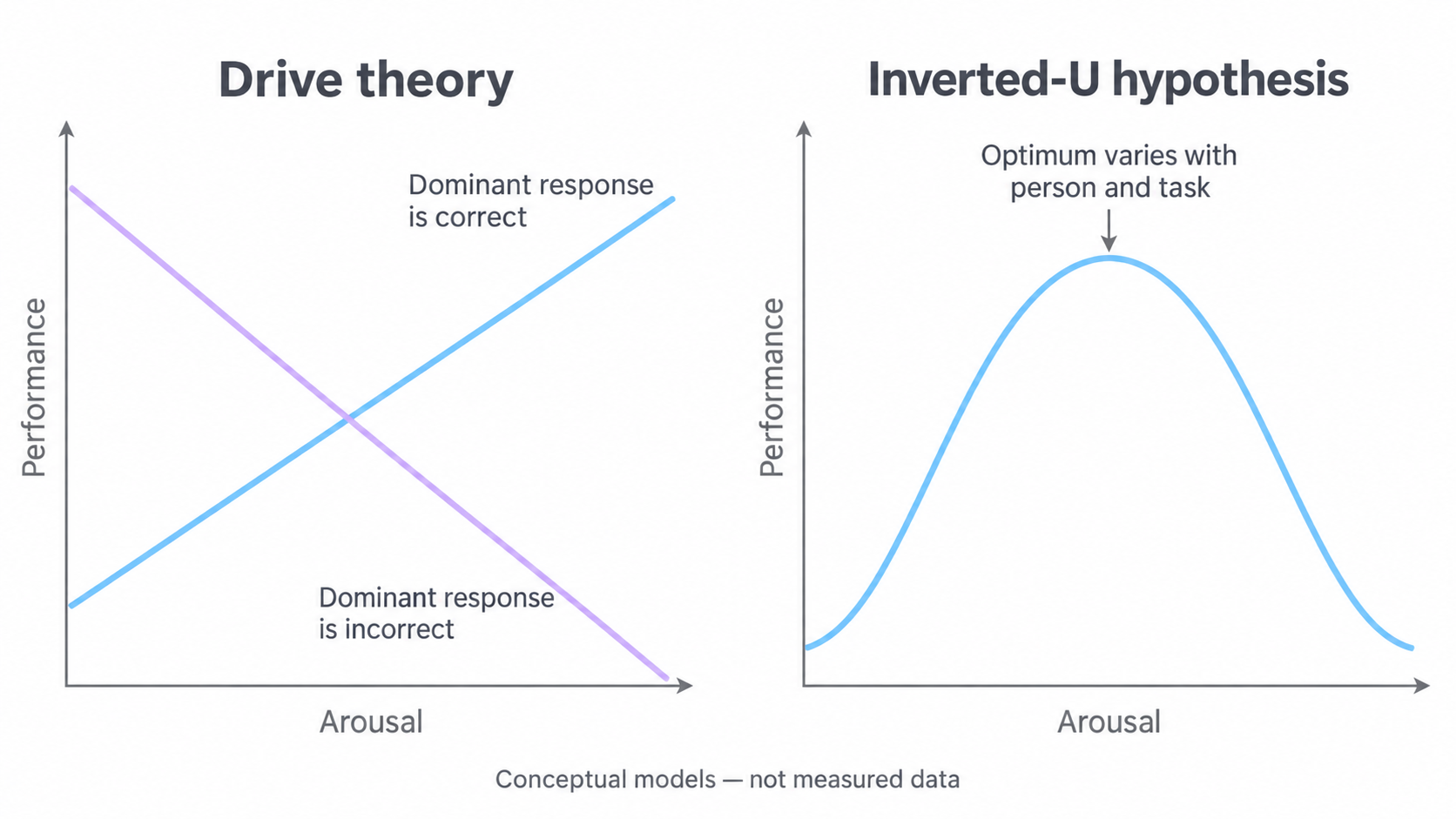
Diagram description: The drive panel shows performance rising when the dominant response is correct and falling when it is incorrect. The inverted-U panel rises to an optimum and then falls. No numerical threshold or measured data is represented.
An optimum is not one universal heart rate. A familiar power task may tolerate greater activation than a novel precision task, but skill, individual interpretation, fatigue and competition conditions also matter. An athlete can record activation, worry and a relevant performance measure across comparable practices to identify a useful personal pattern. A curve should guide investigation rather than substitute for evidence.
Optimising activation and controlling anxiety
Optimising arousal means finding activation suitable for the task, rather than always lowering it. An underactivated athlete could use an appropriate warm-up, energising music or an active rehearsal. A tense athlete might use comfortable paced breathing or progressive muscle relaxation before competition. These are proposals to trial in training; a stimulating routine that helps one athlete may overload another.
Continue this lesson.
You’re previewing NovaLearn without an account. Create a free account to read the rest.
Create free account