H567/03 Section B Option 3 - Environmental stressors and biological responses
Explain how features of an environment can become stressors, how the body responds, and why the same exposure need not have the same effect on everyone.
Environmental demands and appraisal
An environmental stressor is a feature or demand of the surroundings that threatens or challenges a person's ability to cope. Noise, extreme heat, crowding, pollution and an unpredictable disruption to normal routines can become stressors. The stressor is the demand; the stress response is the psychological and biological reaction. A loud sound and a raised heart rate are therefore different links in an explanation.
Intensity matters, but so do duration, unpredictability and perceived control. Brief predictable maintenance noise may be manageable; repeated aircraft noise that interrupts rest and cannot be controlled may be appraised as a continuing threat. Crowding means perceived insufficient space or privacy, whereas density is people per unit of space. The same density can feel welcoming at a celebration and intrusive in a bedroom shared without choice.
Appraisal connects cognitive and biological areas: a person interprets what an event means, while neural and endocrine systems prepare a response. Previous experience, coping resources and social support can change that interpretation. A person unable to afford quieter housing has less control than someone who can move. Differences do not mean that distress is imaginary or that individuals are to blame for an unequal environment.
In an original example, repeated construction noise prevents Leila from resting before a night shift. Its duration, interference with an important goal and her inability to change the schedule make it more than an isolated sound. Another resident who is away during the work receives less exposure. Comparing their reactions requires checking exposure and resources, rather than assuming identical sound levels produce identical stress.
The rapid SAM response
The sympathetic adrenomedullary (SAM) response helps mobilise resources quickly. Processing a threat can activate hypothalamic and related neural systems, increasing sympathetic activity in the autonomic nervous system. Sympathetic nerves stimulate the adrenal medulla, the inner region of the adrenal glands, to release adrenaline into the bloodstream. Sympathetic neural activity and circulating adrenaline act together; adrenaline is not a signal released by the pituitary.
Heart rate and the force of contraction rise, supporting greater blood flow. Energy stores are mobilised so that glucose is more available, and circulation is directed towards tissues needed for action. These changes support fighting, escaping or dealing with a demand. They are an adaptive preparation, even when the environmental problem cannot actually be solved by running away.
After a sudden nearby crash, Leila's faster heartbeat and immediate readiness to act fit this rapid response. The explanation needs a linked sequence from perceived threat through sympathetic activation to a bodily effect. Merely saying “adrenaline causes stress” reverses the explanatory order. Recovery involves regulation and reduced sympathetic activation; bodily arousal need not remain high once the demand ends.
[DIAGRAM: asset_slug: en01_stress_pathways; file: en01_stress_pathways.png; description: Two stress-response pathways from perceived environmental threat and hypothalamus, separating sympathetic nerves, adrenal medulla and adrenaline from CRH, anterior pituitary, ACTH, adrenal cortex and cortisol, with negative feedback.]
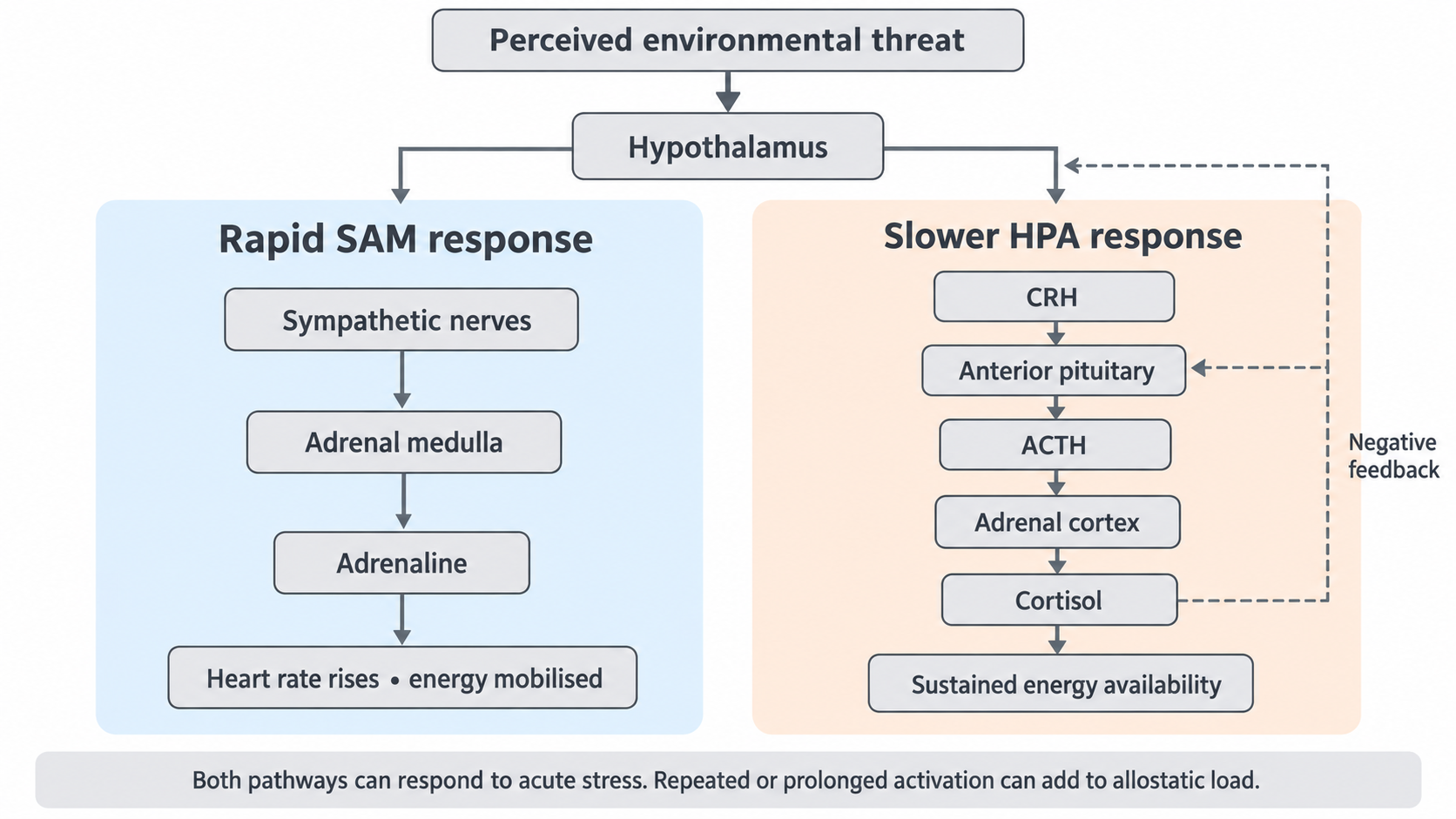
Diagram description: The left pathway mobilises resources rapidly. The right hormonal cascade is slower; cortisol feeds back to regulate the cascade. Both may be recruited by an acute stressor.
Continue this lesson.
You’re previewing NovaLearn without an account. Create a free account to read the rest.
Create free account