H567/03 Section B Option 4 - Fazey and Hardy (1988) and managing arousal
Fazey and Hardy challenged the idea that one smooth curve explains every relationship between activation and sporting performance. Their prescribed work is a theoretical monograph, not a single experiment with a newly recruited sample.
Background and nature of the research
Fazey and Hardy (1988), The inverted-U hypothesis: A catastrophe for sport psychology, is a British Association of Sports Sciences monograph. It reviews the inverted-U explanation, critiques its evidence and concepts, and develops catastrophe models of performance. There is no one new participant sample, apparatus, manipulated independent variable or numerical results table to memorise as if this were a laboratory experiment. Its evidence consists of the theoretical argument, earlier research and sporting observations considered by the authors. OCR Sport research guide, pp4–12.
The inverted-U tradition traces to Yerkes and Dodson's animal-learning research and later extensions to sport. In its simple form, rising arousal gradually improves performance to an optimum, then gradually reduces it. Moving back towards the optimum should reverse that decline along the same path. Fazey and Hardy argued that this account was too simple for the abrupt breakdowns athletes sometimes experience under pressure.
They identified three connected problems. First, “arousal”, “stress” and “anxiety” were often treated as interchangeable, although physiological activation and cognitive worry differ. Second, support for a precise universal inverted-U relation was insufficient: research varied in tasks, people and measurement. Third, a smooth symmetric curve does not explain a sudden collapse followed by difficulty recovering after only a small arousal reduction. These objections motivate a better model; an anecdote about a collapse is not by itself proof of that model.
The cusp catastrophe model
The cusp catastrophe model relates three dimensions: physiological arousal, cognitive anxiety and performance. Physiological arousal is the normal factor; cognitive anxiety is the splitting factor. The latter changes the form of the arousal–performance relation rather than merely adding a fixed performance penalty.
At low cognitive anxiety, the model predicts a relatively smooth inverted-U relation. At high cognitive anxiety, increasing physiological arousal can support good performance until a threshold is reached; a further small increase can produce a sudden, large fall. This is a catastrophe in the mathematical sense of discontinuous change, not a statement about injury or disaster.
Hysteresis
Hysteresis means the path of change depends on the system's previous state. After a predicted collapse, lowering arousal does not immediately retrace the rising-arousal path: a substantially larger reduction may be required before performance recovers.
[DIAGRAM: asset_slug: sp02-catastrophe-hysteresis; file: sp02-catastrophe-hysteresis.png; description: Conceptual low-anxiety curve and high-anxiety collapse with a different decreasing-arousal recovery path.]
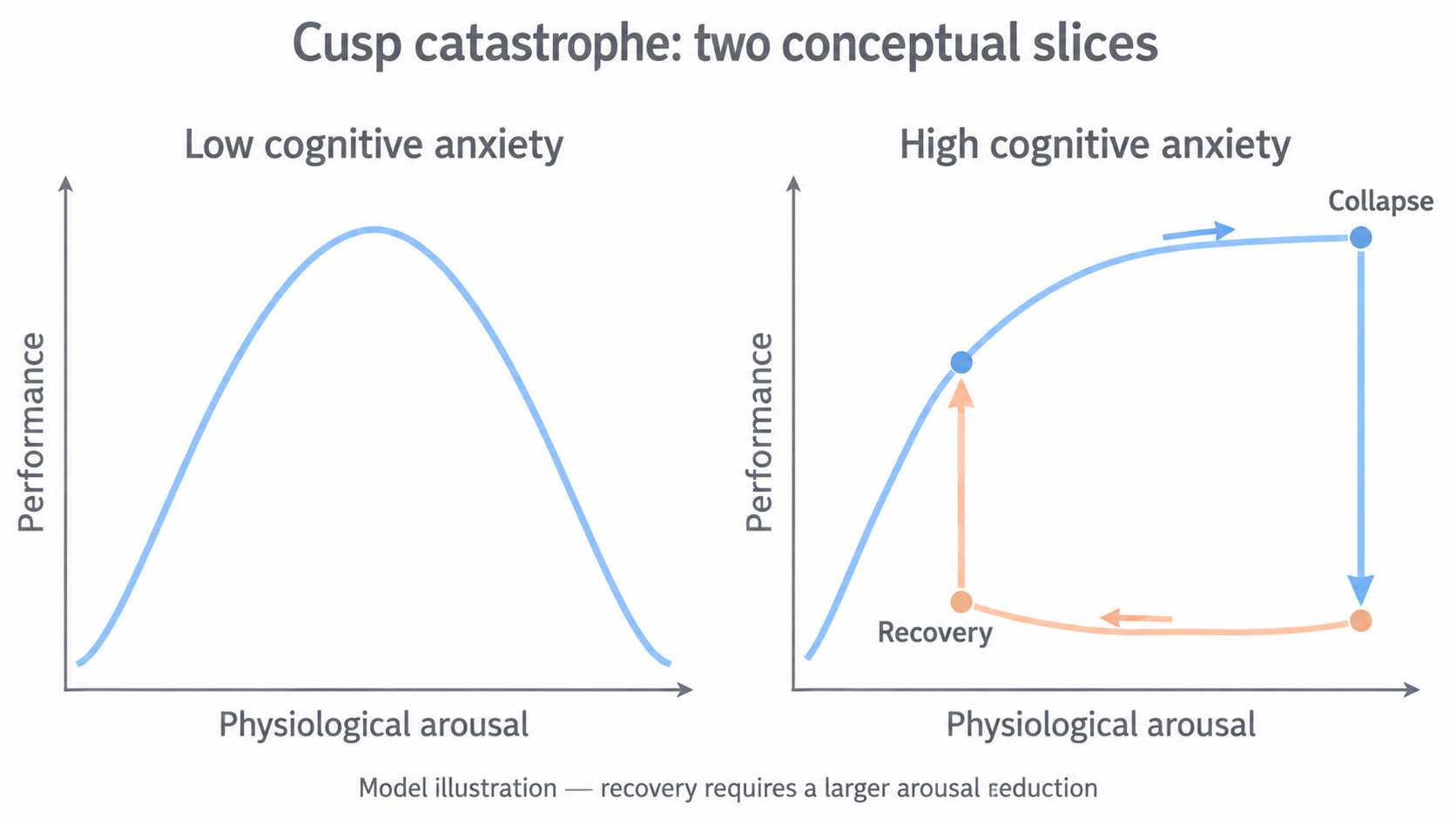
Diagram description: Under high cognitive anxiety, a rightward upper path drops at collapse. The lower return path moves left to a lower-arousal recovery point before rising. These are schematic slices through the model, not empirical observations or a full three-dimensional surface.
In the unstable region at high cognitive anxiety, intermediate performance is less likely than the upper and lower performance states. The model thus predicts discontinuity and different collapse/recovery thresholds. A coach should not assume that one brief breath after breakdown restores the athlete to the earlier level. No fixed heart-rate threshold is specified for all athletes.
Task difficulty and confidence: the butterfly extension
The butterfly catastrophe extension adds task difficulty and self-confidence. Task difficulty is the bias factor: greater information-processing demands move the predicted breakdown and hysteresis region towards lower physiological arousal, whereas a simpler task can shift it towards higher arousal. This helps explain why a complicated unfamiliar decision sequence may fail at an activation level tolerated during a familiar power task.
Self-confidence is the butterfly factor. At appropriate intermediate cognitive-anxiety levels, greater confidence can permit an additional stable intermediate-performance route, allowing recovery without passing through the same extreme collapse pattern. The extension can therefore predict three possible performance states in some conditions, rather than only the upper and lower states of the cusp. At extreme anxiety conditions the relation may again be bimodal.
These are model predictions, not evidence that confidence guarantees recovery or that every sport has a calculated threshold. Adding factors recognises athlete and task differences, but requires suitable measurement and comparisons to test whether the extra complexity improves explanation.
Continue this lesson.
You’re previewing NovaLearn without an account. Create a free account to read the rest.
Create free account